
If your Kubernetes cluster networking is acting like a moody cat, the culprit is often not the YAML, but the physical layer. This article helps platform engineers and field-minded network folks choose the right Kubernetes fiber SFP for leaf-spine or ToR links, with practical compatibility checks, failure modes, and an ROI view. You will get a head-to-head comparison against common alternatives (SFP+ copper, SFP28, and 10G/25G optics), plus a decision matrix you can actually use during procurement.
On the legal side of life: this is not legal advice, and no attorney-client relationship is formed. On the engineering side: I am going to cite standards and datasheet behavior like a responsible adult, because optics mis-matches are where uptime goes to retire early. For standards context, IEEE 802.3 governs Ethernet physical layer behavior, including reach and optics link profiles. For vendor specifics, always confirm the module’s compliance and supported DOM implementation in the switch vendor interoperability list. [Source: IEEE 802.3] [Source: Vendor transceiver datasheets]
Kubernetes fiber SFP performance: SFP+ vs SFP28 vs “just use copper”
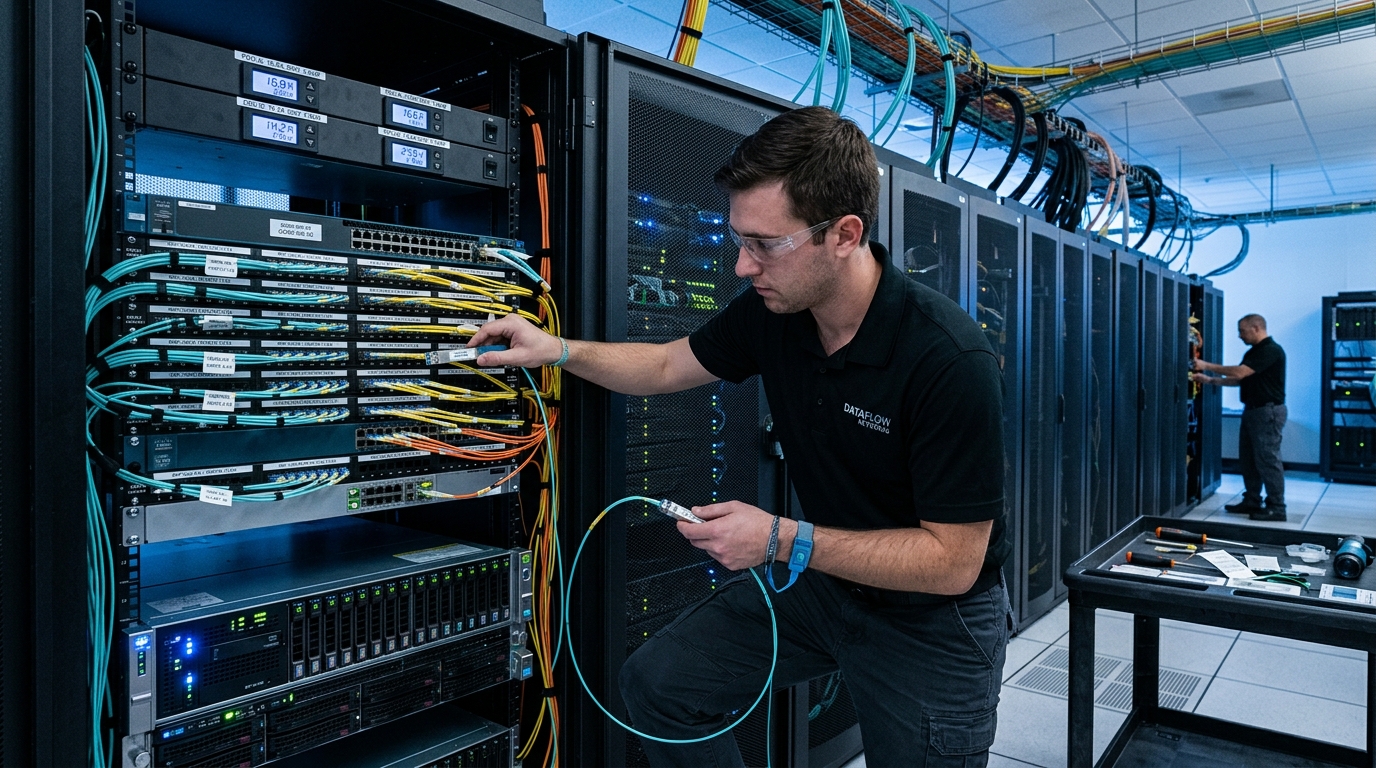
In Kubernetes networking, the optics choice determines link budget margin, latency stability, and failure characteristics under thermal and link partner variation. Most clusters today still lean on 10G for east-west or storage adjacency, but 25G is increasingly common for modern leaf-spine designs. A Kubernetes fiber SFP typically means an SFP-family pluggable using fiber (often LC connectors), but the exact class matters: SFP+ (10G), SFP28 (25G), and higher-rate variants (sometimes not “SFP” form factor depending on platform).
What to compare (the stuff that bites)
- Wavelength and optics type: SR is multimode (MMF), LR is single-mode (SMF).
- Reach: governed by link budget and fiber grade, not vibes.
- Power and thermal limits: affects switch airflow and transceiver temperature derating.
- Link partner compatibility: especially for DOM support and vendor-coded optics allowlists.
Typical spec reality check (examples you can recognize)
Engineers often deploy modules like Cisco-branded or third-party optics that are electrically compatible with the switch’s PHY expectations. Example parts you might see in the wild include Cisco SFP-10G-SR (10G SR multimode), Finisar FTLX8571D3BCL (10G SR), and FS.com SFP-10GSR-85 (10G SR, 850nm). Always verify that the switch model supports that exact transceiver class and DOM behavior.
| Transceiver type (common) | Data rate | Wavelength | Typical reach | Connector | DOM | Operating temp (example) |
|---|---|---|---|---|---|---|
| SFP+ SR | 10G Ethernet | 850 nm | ~300 m on OM3, ~400 m on OM4 (varies by vendor) | LC | Commonly supported | 0 to 70 C (varies) |
| SFP+ LR | 10G Ethernet | 1310 nm | ~10 km on SMF (varies) | LC | Commonly supported | -5 to 70 C (varies) |
| SFP28 SR | 25G Ethernet | 850 nm | ~70 m on OM3, ~100 m on OM4 (varies) | LC | Commonly supported | 0 to 70 C (varies) |
| SFP+ copper (DAC) | 10G Ethernet | Electrical | ~3 m (varies by cable) | Direct attach | Varies | 0 to 70 C (varies) |
Core takeaway: fiber SFP modules buy you reach and clean link budgets for patching and spares. Copper DAC reduces optics spend and avoids vendor allowlists, but it limits distance and can become a cable-management circus in dense racks.
Pro Tip: If your switch reports “DOM present but values out of range,” do not immediately blame the Kubernetes node. Many field incidents trace to a transceiver vendor coding mismatch combined with switch firmware interpreting thresholds differently. The optics may still link, but monitoring alerts trigger automated remediation loops that look like network flakiness. Validate DOM readings against the module datasheet before you blame the cluster.
Kubernetes fiber SFP cost and ROI: optics price is only half the bill
Procurement teams often compare only unit cost, but total cost of ownership (TCO) depends on spares strategy, failure rates, power draw, and operational overhead from troubleshooting. In practice, third-party optics can cut acquisition cost, but the real question is whether your switch firmware accepts them without logging complaints or throttling behavior. For Kubernetes, the operational cost shows up as time-to-repair, replacement lead time, and whether monitoring escalates to incident response.
Realistic price ranges (ballpark)
- 10G SR SFP+: OEM modules often cost roughly $40 to $120 each; reputable third-party options sometimes land in the $20 to $70 range.
- 10G LR SFP+: OEM commonly $150 to $400; third-party maybe $80 to $250 depending on reach and coding.
- 25G SFP28 SR: OEM frequently $60 to $250; third-party may be $40 to $180.
Power is usually not the dominant line item for short runs, but it matters at scale. If you have 1,000 optical ports, even a few watts difference per transceiver can become a measurable cooling and electrical cost. Also consider that failed optics cause packet loss and BGP/overlay churn depending on your architecture, which can create cascading “network incidents” that are actually transceiver events.
Compatibility caveat that affects ROI
Some switches enforce strict optics compatibility. When a module is not on the allowlist, you may see port-disable behavior or degraded monitoring. That can erase the savings from cheaper optics by increasing downtime and support tickets. Always check the platform’s interoperability guidance and verify DOM and link diagnostics behavior in a staging rack before you roll into production.
Compatibility and switch behavior: where Kubernetes fiber SFP choices go to fail
Compatibility is where optics projects become either smooth or legendary. Fiber SFP modules must match the switch’s PHY expectations (10G vs 25G), the correct connector type (LC for most SR/LR), and the optics profile (SR vs LR). On top of that, DOM support and vendor coding can influence whether the switch treats the module as “healthy” or “mystery guest.”
DOM, thresholds, and monitoring integration
Most modern transceivers support digital optical monitoring (DOM) over an I2C interface. Kubernetes does not directly talk to DOM, but your monitoring stack does (Prometheus exporters, switch telemetry, or syslog-based alerts). If DOM values are misinterpreted, you can get false alarms and automated workflows that restart network components. That is not a Kubernetes bug; it is a physics-to-telemetry translation problem.
Electrical and optical constraints to respect
- Fiber type: OM3 and OM4 behave differently at 850 nm; do not assume “multimode equals multimode.”
- Launch and receive power: link budget depends on connector cleanliness and patch panel losses.
- Link partner settings: auto-negotiation and speed/duplex behavior can be constrained by switch port profiles.
Field deployment reality: Many clusters use a leaf-spine topology where ToR switches connect to spine via 10G or 25G uplinks. If the module is SR multimode but the fiber run is actually SMF, you will get link failure or intermittent loss. If the module is LR but you plugged it into a multimode run, you might still see a link for a moment, then it degrades under temperature or connector issues. Physics is dramatic that way.
Use-case showdown: which option fits your Kubernetes topology?
Let us compare four practical options: Kubernetes fiber SFP (MMF SR), Kubernetes fiber SFP (SMF LR), DAC copper for short hops, and higher-rate optics (SFP28 SR) for dense 25G environments. The best choice depends on distance between endpoints, patching model, and your tolerance for operational risk.
Decision matrix (engineering-friendly)
| Option | Best for | Distance | Port density impact | Operational risk | Cost outlook |
|---|---|---|---|---|---|
| Kubernetes fiber SFP SR (MMF) | Data center rack-to-rack and short uplinks | Hundreds of meters | High (standard SFP cage) | Low to medium (fiber grade and cleaning) | Usually best |
| Kubernetes fiber SFP LR (SMF) | Long runs, campus, or cross-row | Up to multi-km | High | Medium (higher cost, SMF handling) | Higher |
| DAC copper | Very short hops inside racks | Few meters | Very high, but cable bulk | Medium (cable fragility, bend radius) | Lowest unit cost |
| SFP28 SR (25G) | High east-west throughput, modern leaf-spine | Shorter MMF distances | High (more bandwidth per port) | Medium (reach limits, optics cost) | Higher |
Selection criteria / decision checklist
- Distance: measure the actual fiber run length including patch cords and panel losses; do not guess.
- Budget: include optics plus spares plus potential downtime costs during replacements.
- Switch compatibility: verify transceiver class support and any allowlist behavior.
- DOM support: confirm your monitoring stack handles DOM consistently across vendors.
- Operating temperature: ensure the module spec covers your airflow and expected ambient range.
- Vendor lock-in risk: decide whether you can standardize on one ecosystem or tolerate mixed optics.
In a 3-tier data center leaf-spine topology with 48-port 10G ToR switches and 2 uplink pairs per ToR, teams often deploy 10G SR SFP+ for rack-to-row links. If each uplink is about 220 m including patch panels on OM4, SR optics typically fit with margin when connectors are clean and the patch cords are the right length. For cross-row runs near 1.5 km, the same architecture usually switches to 10G LR SMF SFP+ to avoid stretching multimode reach into the danger zone.
Common mistakes / troubleshooting: why your Kubernetes fiber SFP link won’t behave
Optics problems can look like Kubernetes networking issues because overlays and CNI plugins respond to packet loss. Below are frequent mistakes, their root causes, and what to do next. When in doubt: start at the physical layer, then move up the stack like a polite detective.
-
Mistake 1: Wrong fiber type assumption
Root cause: Using MMF SR optics on a run that effectively has higher loss than expected (wrong fiber grade, dirty connectors, or excessive patching).
Solution: Verify OM3 vs OM4 labeling, clean connectors with proper procedures, replace patch cords, and re-test link at the switch with transceiver diagnostics. -
Mistake 2: Speed mismatch between optics and port profile
Root cause: Installing a higher-rate module (or wrong class) where the switch port is configured for a different PHY mode, causing repeated link up/down events.
Solution: Confirm the exact port speed setting and module data rate; check switch logs for optics negotiation messages. -
Mistake 3: DOM monitoring triggers automation loops
Root cause: DOM values from a non-OEM module are interpreted as threshold violations, generating alerts that lead to automated remediation (restarts, reroutes, or node drain).
Solution: Compare DOM readings with the vendor datasheet; adjust monitoring thresholds or confirm DOM compatibility in a staging environment. -
Mistake 4: Dirty LC connectors and “it linked yesterday” syndrome
Root cause: Contamination increases attenuation; marginal links work until temperature, vibration, or time makes them fail.
Solution: Inspect and clean with approved cleaning tools, then re-seat the transceiver; test with a known-good patch cord.
Legal aside, the troubleshooting process is like due diligence: document what you changed, when you changed it, and what the optics reported before and after. Your future self will thank you, and your support ticket will be shorter.
Which option should you choose?
Choose Kubernetes fiber SFP SR (MMF) if your runs are within typical SR reach for your fiber grade and you want a cost-effective, high-port-density approach. Choose Kubernetes fiber SFP LR (SMF) when you have longer cross-row or campus-like distances and you can justify higher optics cost for stability. Choose DAC copper only for very short in-rack hops where cable management is manageable and you accept limited distance. Choose 25G SFP28 SR when you need higher throughput and your MMF distance constraints are still realistic, not aspirational.
Next step: pick a candidate module list, validate in a staging switch with the exact port profile, and confirm DOM behavior end-to-end. If you are also planning your CNI and network policy rollout, review Kubernetes networking for fiber-based clusters for how physical link events propagate to pods.
FAQ
Q: What exactly counts as a Kubernetes fiber SFP?
A: In most deployments, it means an SFP-family fiber transceiver used to provide Ethernet links for Kubernetes nodes and networking gear. The key is not the Kubernetes label, but the optics class (SFP+ vs SFP28), wavelength (850 nm SR vs 1310 nm LR), and compatibility with your switch ports. Always confirm IEEE Ethernet PHY expectations and your vendor interoperability notes.
Q: Can I mix OEM and third-party optics in the same cluster?
A: Often yes, but not always. The risk is switch allowlist behavior, DOM threshold interpretation, and monitoring differences that can trigger false alarms. Test mixed optics on a staging rack and confirm stable link and correct telemetry before broad rollout.
Q: How do I choose between SR and LR for Kubernetes fiber SFP?
A: Use measured fiber distance and fiber type. SR (850 nm) is typically multimode and best for shorter data center runs; LR (1310 nm) is single-mode for longer distances. Connector cleanliness and patch panel losses can decide the winner even when the nominal reach looks fine.
Q: What DOM issues should I watch for?
A: Watch for “DOM unsupported,” “DOM threshold exceeded,” or inconsistent optical power readings. If your monitoring stack reacts to those alerts, you can create operational churn that looks like Kubernetes network instability. Validate DOM readings against the module datasheet and confirm the switch firmware interpretation.
Q: Is 25G SFP28 SR worth it versus 10G SFP+?
A: It depends on your traffic profile and your actual fiber reach. 25G can reduce congestion and improve east-west throughput, but SR reach on MMF is often shorter than 10G SR. If your topology can tolerate the distance and cost, 25G is frequently a sensible upgrade path.
Q: Where should troubleshooting start when pods can not talk?
A: Start with link stability and optics diagnostics on the switch. Check for link flaps, DOM warnings, and error counters before touching CNI or Kubernetes networking policies. Physical-layer instability can masquerade as overlay problems, and optics are usually easier to fix than software.
Author bio: I have deployed fiber transceiver fleets across leaf-spine and ToR designs, including DOM monitoring and staged firmware validation before production cutovers. I write with a field engineer mindset and a lawyerly respect for documentation, because both uptime and audits enjoy receipts.
