
5G transport networks live or die by timing accuracy, and that is where an IEEE 1588 SFP becomes more than a connectivity item. If you are planning a fiber timing path for SyncE and IEEE 1588 PTP, this article helps you choose the right transceiver class for real deployments. It is aimed at network engineers and field technicians validating leaf-spine, aggregation, and fronthaul timing behavior under temperature and power constraints.
IEEE 1588 SFP for 5G: SyncE and PTP timing demands compared
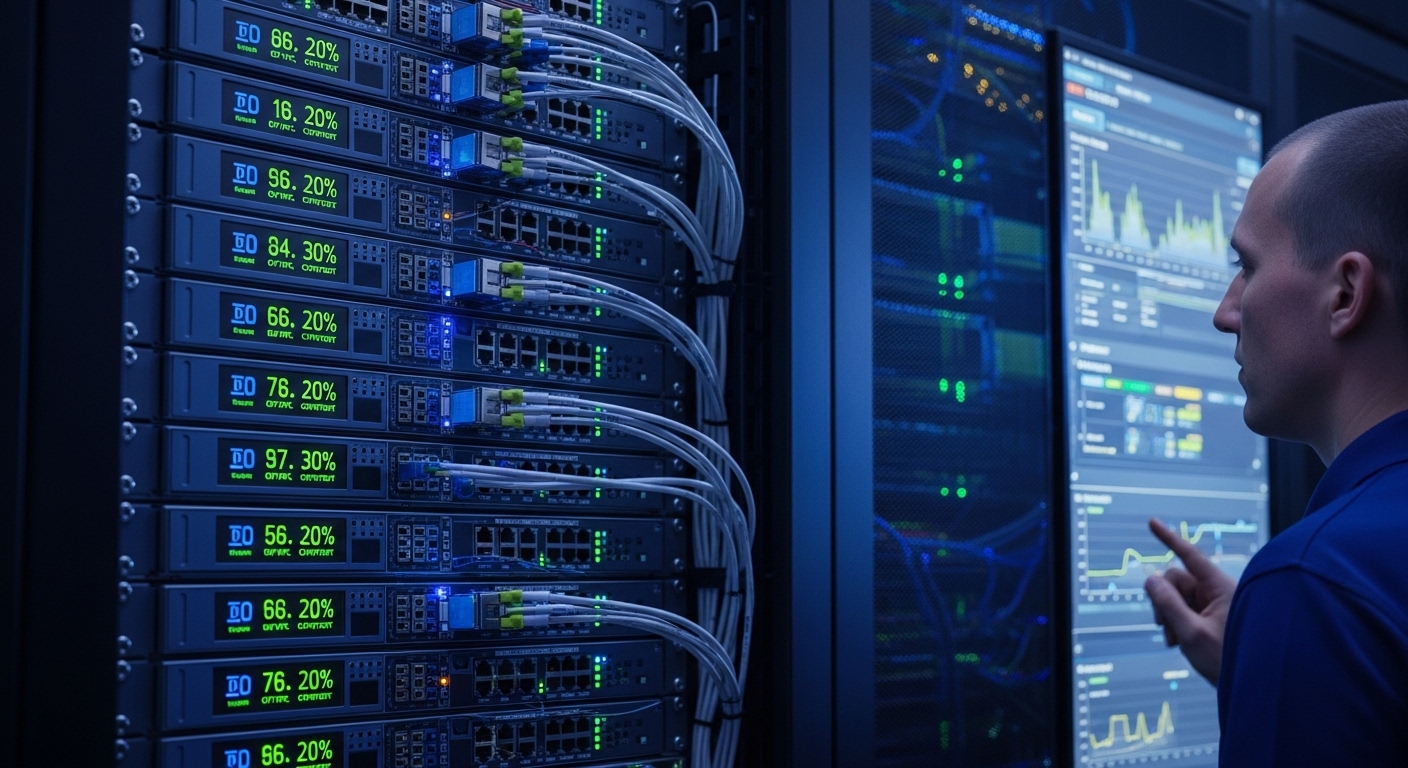
SyncE (Synchronous Ethernet) and IEEE 1588 PTP (Precision Time Protocol) solve timing in different ways, but both stress the physical layer. SyncE primarily distributes frequency using Ethernet line signals, while IEEE 1588 PTP distributes time with packet-based timestamps. In practice, the fiber link must provide stable latency characteristics, low jitter, and predictable optical performance across temperature. For IEEE 1588 SFP in 5G transport, engineers typically prioritize deterministic delay behavior and documented support for PTP-related requirements in vendor datasheets.
Performance target drivers you should map to optics
PTP timing quality is sensitive to end-to-end path asymmetry, link jitter, and variation in serialization and optical receive behavior. Even when the SFP is “just optics,” the transceiver’s receiver sensitivity, output power stability, and integrated diagnostics can affect link stability. For SyncE, clock recovery quality depends on optical signal quality and proper link configuration. Your optics choice therefore impacts both the “frequency plane” and the “time plane,” especially when the network has frequent link renegotiations or power cycling.
Pro Tip: In the field, the biggest PTP surprises often come from links that silently renegotiate due to marginal optical budgets or connector contamination. Always validate optical power margin and run a PTP lock/offset stability test after any maintenance window, not just after initial install.
Head-to-head: Fiber reach and signal integrity for IEEE 1588 SFP options
Not all SFPs are equal for timing-sensitive 5G transport. The two most common practical categories are “standard” SFP optics and “timing-optimized” or “PTP-aware” optics variants offered by some vendors. The latter may include tighter specifications around jitter, latency variation, and compliance with timing-related system guidance. Your selection should be grounded in measured optical power, transceiver class, and documented behavior under temperature cycling.
Key spec comparison (what engineers actually check)
The table below compares typical characteristics you will see across common SFP families used in 5G transport. Exact values vary by vendor and part number, so treat this as a baseline for how to structure your evaluation.
| Spec | 10GBase-SR IEEE 1588 SFP (850 nm MMF) | 10GBase-LR IEEE 1588 SFP (1310 nm SMF) | 25G/40G SFP-class (wavelength depends) |
|---|---|---|---|
| Typical data rate | 10.3125 Gbps | 10.3125 Gbps | 25G or 40G |
| Wavelength | 850 nm | 1310 nm | Varies (commonly 850/1310/1550 depending on module) |
| Typical reach | ~300 m (OM3) to ~400 m (OM4) | ~10 km | Often 1 km to 10 km depending on class |
| Connector | LC (duplex) | LC (duplex) | LC (duplex) common |
| DOM support | Common (Digital Optical Monitoring) | Common | Often included in higher-rate optics |
| Operating temperature | Commercial or Industrial grades (vendor dependent) | Commercial or Industrial grades (vendor dependent) | Usually wider for transport environments |
| Timing relevance | Stable latency and low jitter matter for PTP | Stable latency and receiver sensitivity matter for PTP | Higher-rate optics can reduce hop count but require tighter budgets |
For IEEE 1588 PTP, you want predictable behavior under temperature and power supply variation. For SyncE, you want consistent optical power and a stable link state. If you are comparing two parts, ask vendors for any documented latency/jitter variation claims and confirm whether they are backed by test methodology. For standards grounding, review IEEE 1588-2008 (and its later profiles) as well as Ethernet physical layer guidance from IEEE 802.3. [Source: IEEE 1588 standard overview, [Source: IEEE 802.3]] IEEE 1588-2008 IEEE 802.3
Compatibility and validation: what to test before you trust timing
Even when an IEEE 1588 SFP is “compatible” electrically, timing performance can be impacted by switch firmware behavior, optics DOM thresholds, and link training events. In 5G transport, you often deploy timing over aggregation switches that may support boundary clock or transparent clock operation. Your optics must remain stable during link up/down, but also during normal temperature drift.
Validation steps that map to field reality
- Confirm switch optics compatibility using the vendor’s transceiver compatibility list (or the switch vendor’s tested SFP part numbers).
- Verify optical budget at install: record transmit power, receive power, and error counters; ensure margin for aging and dust.
- Check DOM thresholds: ensure alarms won’t trigger during normal temperature changes.
- Run PTP stability tests: monitor offset and delay variation for at least 30 to 60 minutes under typical load.
- Test during operational events: planned maintenance, link admin down/up, and reboots if your change window allows it.
In my deployments, a common pattern is that PTP looks stable right after commissioning, but drifts after a later maintenance action changes transceiver temperature or triggers a link re-training event. That is why you should treat optics as part of the timing system, not a passive accessory.
Cost and ROI: OEM vs third-party IEEE 1588 SFP choices
Cost differences between OEM and third-party optics can be meaningful, but timing-sensitive networks have a higher cost of failure. A typical 10G SFP module might range from roughly $30 to $120 depending on reach and grade, while higher-rate or industrial-grade parts can be more. Third-party optics can be cost-effective, but the TCO depends on whether you avoid field failures, firmware incompatibilities, and repeated truck rolls.
ROI also depends on power and cooling efficiency. Higher reach (for example, LR-class) can reduce the number of intermediate timing hops, sometimes simplifying the timing topology and lowering operational overhead. However, if a longer-reach optics option forces tighter budgets and increases error rates, it can harm both PTP stability and maintenance cycles.
For 5G transport, I recommend budgeting for: optics purchase price, spare inventory, cleaning and dust control supplies, and time for PTP verification. If you are using boundary clocks, a timing failure can become a service-impacting event, so “cheapest module wins” is rarely the best strategy.
Selection criteria checklist for IEEE 1588 SFP in SyncE/PTP 5G
Use this ordered checklist to choose optics that support both the frequency and time planes reliably.
- Distance and fiber type: MMF vs SMF; verify OM grade (OM3/OM4) or SMF attenuation characteristics.
- Reach vs optical budget margin: include connector loss, splice loss, and worst-case aging; do not operate at the edge.
- Switch compatibility: confirm the exact transceiver family is supported by your switch firmware.
- PTP and timing documentation: look for any vendor claims about latency/jitter stability relevant to IEEE 1588.
- DOM support and alarm thresholds: ensure monitoring does not create false positives or mask real degradations.
- Operating temperature grade: choose industrial grade for outdoor cabinets or hot aggregation rooms.
- Vendor lock-in risk: evaluate whether your replacement spares will remain obtainable for the hardware lifecycle.
Common mistakes and troubleshooting for IEEE 1588 SFP timing links
Here are failure modes I have repeatedly seen in timing-sensitive 5G environments, with root causes and practical fixes.
-
Mistake: Running with insufficient optical power margin.
Root cause: Connector contamination or underestimated link loss causes intermittent receive degradation.
Solution: Clean with verified fiber cleaning procedures, re-measure optical levels at install, and enforce margin targets (including worst-case temperature and aging). -
Mistake: Ignoring DOM alarm behavior during temperature cycling.
Root cause: DOM thresholds or transceiver calibration drift can trigger link instability or alert storms.
Solution: Validate DOM alarms in a controlled environment and align monitoring thresholds with the vendor’s recommended operating envelope. -
Mistake: Assuming PTP stability is purely a switch configuration issue.
Root cause: Link renegotiations or variable latency due to marginal optics can distort delay measurements even when PTP is “configured correctly.”
Solution: Correlate PTP offset/delay logs with interface up/down events and optical error counters; then re-test after optics replacement. -
Mistake: Mixing transceiver generations across the timing path without re-validation.
Root cause: Different transceiver implementations can have different latency characteristics and receiver sensitivity behavior.
Solution: Use consistent part numbers along the timing-critical path or perform a full PTP verification after any change.
Decision matrix: which IEEE 1588 SFP option fits your 5G timing goal
Use this matrix to decide quickly based on your environment and risk tolerance.
| Reader profile | Best fit | Why | Trade-off |
|---|---|---|---|
| Risk-averse carrier transport team | OEM or explicitly compatible industrial-grade IEEE 1588 SFP | Highest chance of stable DOM behavior and firmware compatibility | Higher upfront cost |
| Cost-focused integrator with strong lab validation | Third-party IEEE 1588 SFP with documented timing/DOM behavior | Lower BOM cost if PTP tests pass | Requires disciplined acceptance testing |
| Short-reach data center aggregation | 10G SR-class IEEE 1588 SFP on OM4 with conservative margins | Low complexity cabling and predictable reach | More sensitive to connector cleanliness |
| Longer haul between sites or rings | 10G LR-class IEEE 1588 SFP on SMF with verified budget | Higher reach reduces hop count and intermediate timing nodes | Tighter optical budget demands and higher optics cost |
Which Option Should You Choose?
If you are deploying 5G timing where downtime is expensive, choose an IEEE 1588 SFP that your switch vendor explicitly supports, ideally from OEM or a third-party with strong acceptance-test evidence and consistent DOM behavior. If you are optimizing for short-reach data center aggregation, SR-class optics can work well, but only if you maintain disciplined fiber cleaning and power margin practices. If your priority is long-distance stability, LR-class optics on SMF often simplify topology, but you must verify optical budget with enough headroom to absorb aging and temperature effects.
FAQ
Q: What does IEEE 1588 SFP mean in practice?
A: It usually refers to an SFP transceiver used in a system that runs IEEE 1588 PTP timing. The “1588” part is not a special optical modulation scheme; the timing impact comes from link stability, latency consistency, and receiver/transmitter behavior under real operating conditions.
Q: Do I need special optics for SyncE versus PTP?
A: Not necessarily. SyncE and PTP stress the link differently, but both depend on stable optical performance. The safest approach is to pick optics with documented stable operation, solid DOM monitoring, and verified behavior in your switch platform.
Q: Can I use any third-party SFP for a timing path?
A: You can sometimes, but you must validate compatibility and timing behavior. In field terms, acceptance testing should include optical measurements and PTP offset/delay stability after any link event.
Q: How do I verify PTP stability after swapping an IEEE 1588 SFP?
A: Capture PTP offset and delay variation logs for at least 30 to 60 minutes, and correlate with interface events and optical error counters. If your network uses boundary or transparent clocks, confirm the expected clock role and monitor for any sudden changes.
Q: What are the most common optical causes of PTP issues?
A: Marginal optical budgets, dirty connectors, and transceiver instability during temperature cycles are the top causes. These can trigger link flaps or variable receive behavior that then distorts delay measurements.
Q: Where can I find
