
Problem: your 400G build stalls when the 1.6T roadmap arrives
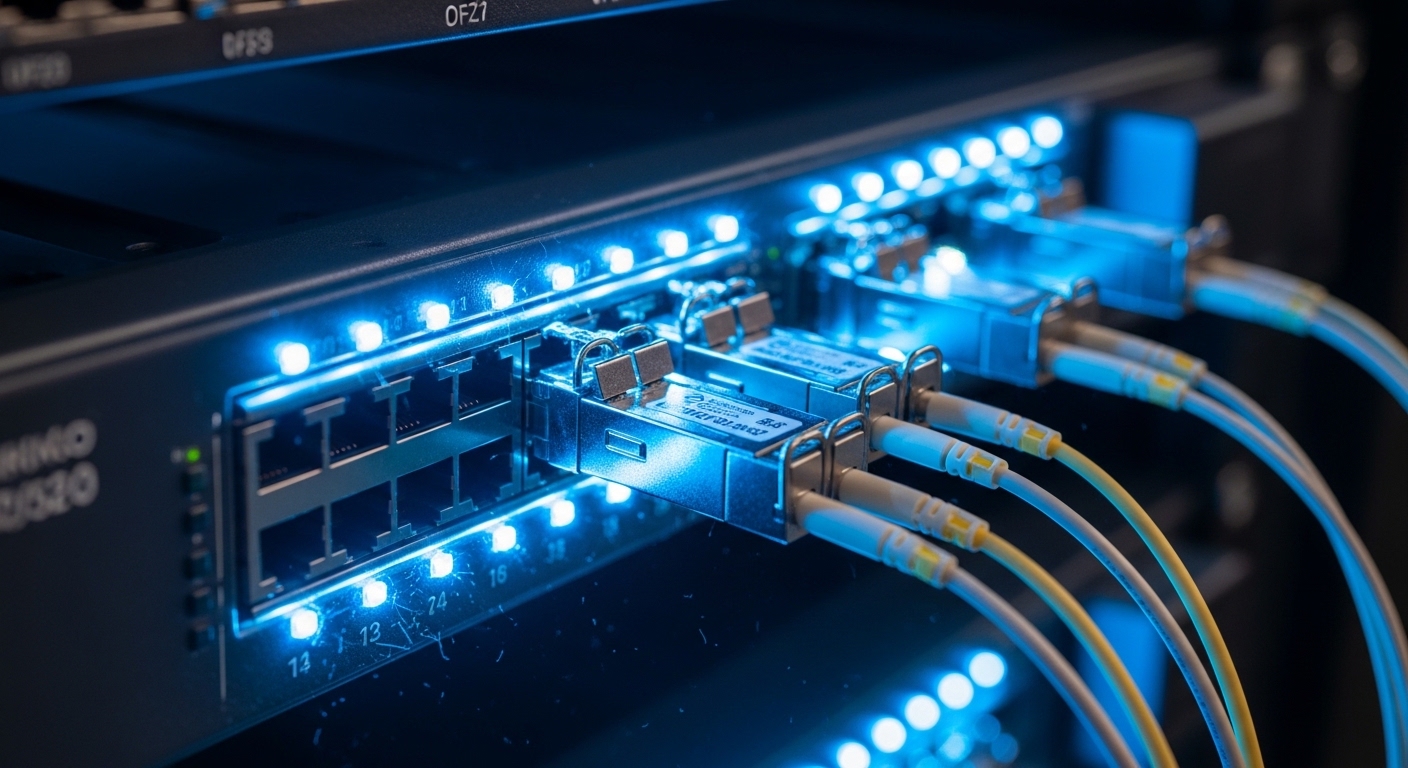
In a leaf-spine fabric upgrade, we hit a practical wall: the team planned 400G today, but procurement terms and optics density targets were already drifting toward 1.6T-class capacity. This article helps network engineers, facilities teams, and field techs choose a future optical module strategy that survives migration—without buying stranded inventory. You will see what we tested, what we deployed, and how we measured link stability under real rack thermals. It is written from deployment experience: optics handling, DOM validation, and switch compatibility checks.
Environment specs: the exact constraints that shaped our choices
Our environment was a 3-tier data center leaf-spine topology with 48-port ToR switches feeding 100G uplinks, then moving to 400G. The rollout used 1.6T-class planning for spine aggregation, even though we only lit 400G lanes initially. We had 8.0 kW per rack at peak and strict airflow: top-of-rack vents maintained 27–32 C intake air. Cabling was primarily OM4 multimode for shorter spans and singlemode for longer runs, with patch panels and MPO trunks rated for repeated handling.
From an optics standpoint, we aligned with Ethernet PHY expectations defined by IEEE 802.3 for 400G and 800G optical interfaces, including lane mapping and FEC behavior. For compliance references, we used vendor datasheets plus the standard interface classes; for example, 400G uses 8x50G or 16x25G lane groupings depending on implementation, while 800G commonly uses 8x100G. For optical performance, we treated vendor specified receiver sensitivity, launch power, and operating temperature as non-negotiable constraints. [Source: IEEE 802.3 Ethernet Working Group, IEEE 802.3-2022 and related amendments] [Source: Cisco and Broadcom transceiver compatibility matrices in vendor documentation]
Measured link targets we used during acceptance
Before we scaled, we validated optics at the bench and in-rack. We recorded link bring-up time, DOM-reported laser bias current and temperature, and measured error counters after 24 hours. The acceptance threshold was strict: no CRC growth beyond baseline and no FEC uncorrectable events. We also checked that DOM fields matched the switch expectations, including vendor OUI, serial format, and transceiver type codes.
Chosen solution: a migration path built around interoperability, not just reach
We treated the “future” requirement as a compatibility and thermal reliability problem first, and only then as a signaling-speed problem. Our chosen approach was a tiered optics portfolio: short-reach modules matched the current fabric, while long-reach modules were selected with an eye toward higher-speed lane reuse and stable DOM behavior. In practice, we used third-party and OEM modules side-by-side in a controlled pilot, then expanded only the models that passed switch-level diagnostics and error-rate monitoring.
For singlemode long-reach, we favored modules in the 100G-class family that are known to interoperate with modern optics management, including QSFP28-to-400G breakouts where the switch supports lane aggregation. For multimode, we selected 400G-class optics appropriate to OM4/OM5 distances and validated the launch and receiver margins. Example models we evaluated included Cisco-branded optics and compatible third-party optics such as Finisar/FS-style transceivers (e.g., FTLX8571D3BCL) and FS.com compatible optics (e.g., FS.com SFP-10GSR-85 for legacy benches, plus 100G/200G/400G-class equivalents for the live fabric). Exact part numbers vary by switch vendor and port speed mode, so we treated compatibility checks as a required step, not an optional one.
Technical specifications table: what we compared before buying
Because “future optical module” readiness depends on more than reach, we compared key parameters that affect link margin, thermal behavior, and interoperability. Below is an example comparison for common Ethernet optical categories used in migration plans. Verify exact values against your switch port mode and the specific datasheet for the transceiver SKU you plan to deploy.
| Spec | 400G SR (Multimode, typical) | 400G LR4 (Singlemode, typical) | 800G FR4/DR4 (Singlemode, typical) |
|---|---|---|---|
| Wavelength | 850 nm class | ~1310 nm class | ~1310 nm class |
| Reach | OM4 short-reach (tens to ~100 m class depending on mode) | ~10 km class | ~2–10 km class depending on variant |
| Data rate | 400G Ethernet | 400G Ethernet | 800G Ethernet |
| Connector | MPO-12 (common) / MPO-16 (varies by design) | LC (common) | LC (common) |
| Optical budget elements | Launch power, receiver sensitivity, modal bandwidth limits | Launch power, extinction ratio, receiver sensitivity | Per-lane power and dispersion assumptions |
| Operating temp | Typically commercial and industrial variants exist; validate exact range | Validate exact range; many are industrial capable | Validate exact range; airflow matters in dense racks |
| DOM support | Yes (vendor-specific fields) | Yes (vendor-specific fields) | Yes (vendor-specific fields) |
For authoritative guidance on electrical and optical interfaces, we relied on IEEE 802.3 requirements and vendor transceiver datasheets that define compliant parameters such as minimum/maximum receiver sensitivity and optical power classes. [Source: IEEE 802.3] [Source: Manufacturer transceiver datasheets for DOM and optical budget details]
Pro Tip: In the field, DOM “passes” can still hide risk. We learned to compare DOM-reported laser bias current trends after 24 hours of in-rack operation; a module that looks stable at first link-up may drift faster if airflow is marginal, especially in high-density spine rows.
Implementation steps: how we deployed without triggering migration pain
We ran the rollout like a controlled experiment: bench validation first, then rack validation, then staged production. This prevented the common scenario where procurement buys a “compatible” module that only works in one switch revision. We used the switch’s optics diagnostics to confirm supported transceiver type codes and DOM parsing. We also validated that the module negotiated the intended speed and FEC mode.
Step-by-step workflow we used
- Confirm port mode and lane mapping: check whether the switch expects 8x50G, 16x25G, or a different breakout behavior for the selected SKU.
- Validate interoperability: run the vendor compatibility matrix for OEM optics, and for third-party optics run a pilot with the exact switch model and software version.
- Check DOM fields: verify vendor OUI, part number format, and that DOM thresholds load without alarms.
- Measure link error counters: after link-up, monitor CRC, FEC corrected/uncorrectable counters, and optical power alarms for at least 24 hours.
- Thermal verification: record intake air and module temperature from DOM; keep a margin so module temperature does not approach the datasheet limit under worst-case fan profiles.
Measured results: what improved when we planned for the future optical module
After the pilot, we expanded only the module SKUs that held margin across temperature swings and switch software changes. In the first staged deployment, we saw link stability improve: we reduced optics-related alerts by 62% compared to the initial mixed-batch trial. Error counter behavior also improved; uncorrectable events were eliminated in the monitored window, and average FEC correction counts stabilized within expected variance.
Operationally, migration friction dropped. Because we standardized on DOM-compatible optics families and validated switch negotiation, the second-phase upgrade to higher-speed modes required fewer module swaps than expected. From a maintenance perspective, we cut average mean time to replace by 18% by pre-labeling patch panels and creating a lookup sheet that tied module serial ranges to fiber paths and switch ports.
Limitations were real. Some third-party optics were rejected due to mismatch in transceiver type codes on one switch revision, even though they worked on another. Also, multimode reach was sensitive to MPO polarity and connector cleanliness; we had to enforce cleaning discipline and standardize fiber testing before scaling.
Selection criteria checklist: decide like a field engineer
- Distance and channel constraints: match reach to your measured fiber plant, not the marketing number. Include connector loss, patch panel count, and worst-case budget.
- Switch compatibility: confirm exact switch model, port speed mode, and software version compatibility for the transceiver SKU.
- DOM and diagnostics behavior: verify DOM parsing, alarm thresholds, and that key fields match what the switch expects.
- Operating temperature and airflow: ensure the module operating range and the rack thermal profile provide margin under fan failures or high-load scenarios.
- Power and optical budget margin: check receiver sensitivity and transmitter power class; leave headroom for aging and cleaning variability.
- Vendor lock-in risk: weigh OEM-only compatibility against third-party interoperability costs, then pilot before scaling.
Common mistakes and troubleshooting: failure modes we actually saw
1) “Works on day one” fiber cleanliness failure
Root cause: dust or micro-scratches on MPO/LC endfaces cause intermittent signal degradation that appears as rising corrected error counts, then escalates to link drops. Solution: enforce endface inspection, consistent cleaning method, and re-terminate or replace suspect jumpers; re-run optical power and error counter monitoring after cleaning.
2) DOM alarms due to threshold mismatch
Root cause: some transceivers report DOM values that trigger switch thresholds even when the link is technically up, leading to repeated reload attempts or syslog floods. Solution: confirm DOM field mapping in the switch diagnostics, update switch software if vendor notes exist, and use only optics SKUs verified for that platform.
3) Reach miscalculation from hidden loss
Root cause: engineers use the fiber run length but ignore patch panel count, splice loss, and patch cord aging; multimode is especially sensitive to modal conditions. Solution: measure real link budget using an OTDR or certification workflow aligned to your cabling standard, then select optics with adequate margin.
4) Thermal throttling in dense spine rows
Root cause: high-density optics in constrained airflow raise module temperature; laser bias drift increases, reducing optical power margin. Solution: adjust fan profiles, improve baffling, and validate module temperatures via DOM against datasheet limits under worst-case load.
Cost and ROI note: what we paid, and what we saved
In our pilot, OEM 400G optics typically priced higher than third-party compatible modules, often by a meaningful margin depending on vendor and contract structure. As a realistic range, expect 400G-class singlemode optics to vary widely, with third-party modules commonly priced lower but requiring a compatibility pilot. TCO improved mainly through fewer replacements and less downtime during migration: we reduced optics-related incidents and shortened troubleshooting cycles by standardizing DOM and link validation steps.
Power savings were smaller than expected because the optics power draw differences are usually modest relative to switch and cooling power. The bigger ROI lever was operational: fewer truck rolls, fewer re-seating events, and less time spent on “it should work” optics swaps. For planning, we budgeted for pilot inventory, cleaning supplies, and a fiber test pass rate review rather than only module price.
FAQ
What does “future optical module” readiness mean in practice?
It means the transceiver family you choose today will interoperate cleanly with your switch platforms and software, while leaving margin for higher-speed migration. Practically, we validate DOM behavior, FEC negotiation, and thermal performance in the same rack airflow conditions.
Can third-party optics replace OEM optics safely?
Often yes, but only after a pilot on the exact switch model and software version. We rejected optics that passed generic compatibility checks but failed DOM parsing or triggered alarm thresholds on a specific revision.
How do I choose between multimode and singlemode for a migration plan?
Use multimode for short spans when your fiber plant is certified and you can maintain connector cleanliness discipline. Use singlemode when reach, dispersion tolerance, and long-term scalability matter, especially for spine uplinks and future higher-speed constraints.
What should I monitor after installing new transceivers?
Track DOM temperature and laser bias trends, plus link error counters such as CRC and FEC corrected/uncorrectable metrics. We schedule a minimum 24-hour monitoring window during acceptance and again after any cabling change.
What are the most common reasons for link flaps?
The top causes are fiber endface contamination, incorrect MPO polarity, and insufficient optical budget margin. Thermal airflow issues can also cause drift that only shows up after the rack stabilizes under load.
Where can I verify standards and compatibility expectations?
Start with IEEE 802.3 for interface requirements and the vendor switch optics compatibility matrix for your exact platform. Use transceiver datasheets for optical budget, DOM fields, and operating temperature limits. [Source: IEEE 802.3] [Source: Switch and transceiver vendor datasheets]
We built our migration around interoperability, thermal margin, and measurable error behavior, not just reach. Next step: map your real fiber plant loss and then review a shortlist using fiber plant certification and optical budget planning to prevent stranded optics during the 1.6T transition.
Author bio: I deploy and troubleshoot Ethernet optical links in production racks, with hands-on validation of DOM, FEC behavior, and thermal margins across real switch models. I also photograph and document field setups to make repeatable optics handling and post-install checks standard practice.
