
Upgrading uplinks without breaking links is the daily reality for network engineers, especially when moving from legacy 1G or 10G to modern 25G, 40G, 100G, and even 400G. This article compares optical transceiver speeds from 1G to 400G with engineering constraints: wavelength bands, reach classes, modulation formats, power budgets, and switch compatibility. You will get a practical decision checklist, field troubleshooting patterns, and a clear recommendation by reader type.
Fiber optic speeds vs transceiver form factors: what actually changes
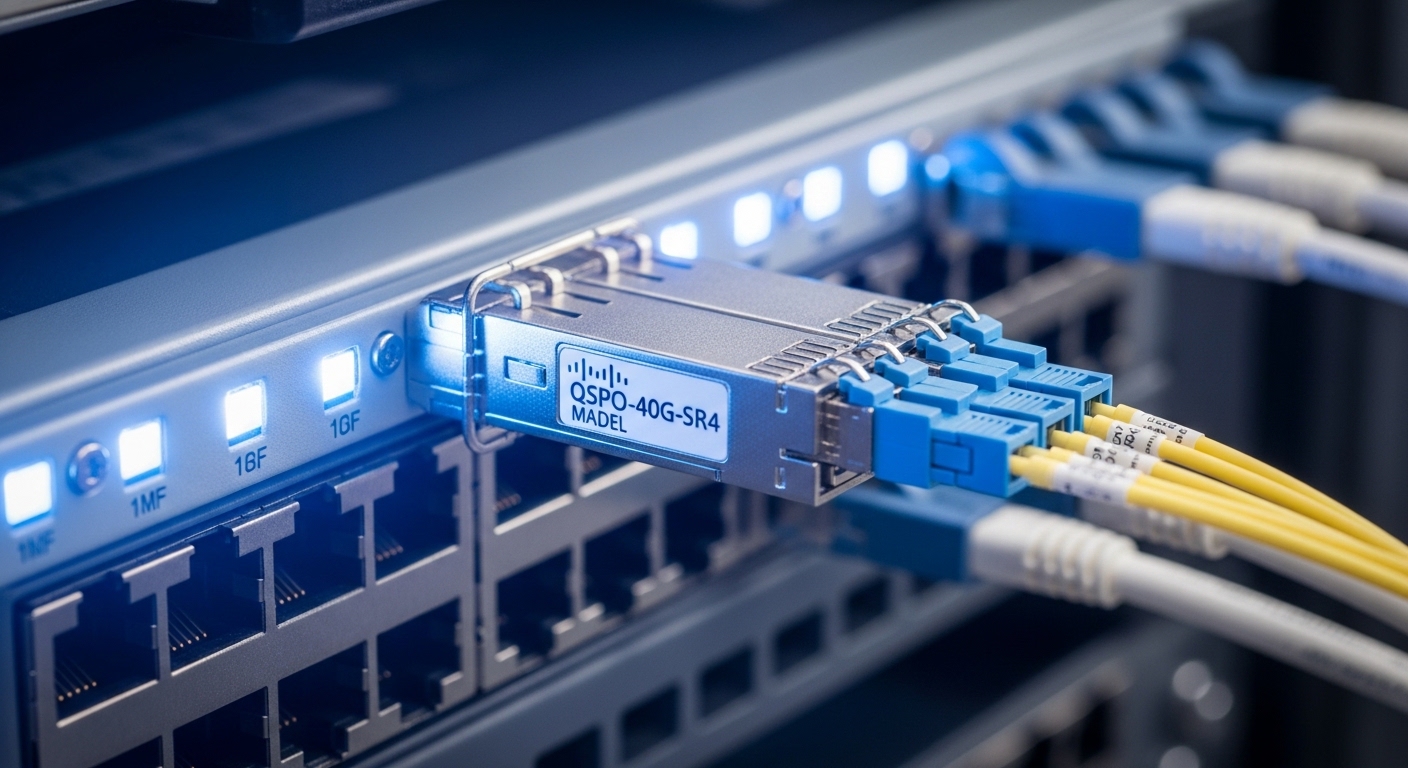
At the physical layer, “fiber optic speeds” are not just a number; they are a coupled system of optical signaling rate, coding overhead, lane count, and connector/optics module form factor. For example, 10G Ethernet commonly uses 1 lane at 10.3125 Gb/s line rate, while 100G typically uses 10 lanes at 10.3125 Gb/s each, depending on the exact interface (e.g., 100GBASE-SR4 vs 100GBASE-SR10). As speeds rise to 200G and 400G, lane aggregation and DSP complexity increase, making compatibility checks more critical.
Form factor impacts mechanical fit and thermal behavior. SFP and SFP+ are common for 1G and 10G, while QSFP and QSFP28 are typical for 40G and 25/100G classes. For 400G, you will usually see QSFP-DD or OSFP, each with specific pinouts, cage designs, and power dissipation expectations. Vendor datasheets and switch platform guides are the authoritative constraint sources here, not marketing tables.
Performance comparison: 1G, 10G, 25G, 40G, 100G, 200G, 400G optics
Below is a head-to-head comparison focused on what engineers verify during procurement and link bring-up: wavelength, typical reach classes, optical power and receiver sensitivity ranges, typical module type, connector style, and operating temperature. Exact values vary by vendor and exact part number, so treat this as a planning baseline and confirm with the switch compatibility list and module datasheet.
| Speed class | Common Ethernet clause | Typical module | Wavelength (typ.) | Reach class (typ.) | Connector | Operating temp (typ.) | Notes engineers care about |
|---|---|---|---|---|---|---|---|
| 1G | 1000BASE-SX/LX | SFP | 850 nm (SX) / 1310 nm (LX) | ~550 m (MM SX) / ~10 km (SM LX) | LC | -5 to 70 C | Lower DSP; easier tolerance, but older optics may lack modern DOM expectations |
| 10G | 10GBASE-SR/LR | SFP+ | 850 nm (SR) / 1310 nm (LR) | ~300-400 m (MM SR) / ~10 km (SM LR) | LC | 0 to 70 C | MMF reach depends heavily on fiber OM class and patch loss |
| 25G | 25GBASE-SR | SFP28 | 850 nm | ~70-100 m (MM) class-dependent | LC | 0 to 70 C | Higher lane rate; requires cleaner optics and accurate link budgets |
| 40G | 40GBASE-SR4 | QSFP+ | 850 nm | ~100-150 m (MM) class-dependent | LC | 0 to 70 C | Often 4-lane; check switch lane mapping and breakout behavior |
| 100G | 100GBASE-SR4/FR/DR | QSFP28 | 850 nm (SR) / 1310 nm (FR) / 1550 nm (DR) | ~100-150 m (MM SR) / ~2 km (FR) / ~10 km (DR) | LC (varies) | 0 to 70 C | Most failures are power budget or polarity/patch loss mistakes |
| 200G | 200GBASE-FR4/DR4 | QSFP56 or similar (platform-dependent) | 1310/1550 nm (SM) | ~2-10 km class-dependent | LC or MPO (varies) | 0 to 70 C | Lane aggregation increases sensitivity to connector contamination |
| 400G | 400GBASE-FR8/DR8 (and variants) | QSFP-DD / OSFP | 1310/1550 nm | ~2-10 km class-dependent | MPO (common) | 0 to 70 C | DSP and retiming; strict switch compatibility and optics vendor behavior matter |
Engineering anchor points: Ethernet PHY requirements are defined by IEEE 802.3 clauses for each speed and reach variant, while optics behavior and diagnostics follow SFF specifications and vendor implementation details. For standards context, consult [Source: IEEE 802.3] and SFF documentation such as SFF Committee resources plus the specific transceiver datasheets for optical power and receiver sensitivity.
Cost and ROI: when fiber optic speeds justify the upgrade
ROI is driven by more than optics price. Higher fiber optic speeds reduce oversubscription in leaf-spine fabrics, improve congestion behavior, and lower the number of uplink ports needed per rack. However, the total cost of ownership includes transceiver unit cost, optics power draw, switch port activation costs, patch panel labor, and—often overlooked—spares strategy.
In typical enterprise and service-provider sourcing, OEM optics (switch-vendor branded) may cost roughly 1.2x to 2.5x third-party equivalents for the same nominal reach, but they frequently reduce bring-up risk via tighter compatibility validation. Third-party optics can be cost-effective, yet you must validate DOM support and switch behavior under your exact platform firmware. A realistic planning assumption for TCO: optics replacement is rarely the dominant lifetime cost; instead, downtime risk, labor, and link instability drive cost when the network is already operational.
Pro Tip: During procurement, request the vendor’s DOM implementation notes and verify DOM reads on a sacrificial port before scaling. Field teams often discover that “it lights up” can still hide marginal receiver margin or DOM parsing quirks that later cause alarms, slow resets, or unexpected link flaps under temperature swing.
Compatibility and interoperability: how to avoid speed mismatches
Optical transceivers are constrained by three layers: the physical interface (SFP/QSFP/QSFP-DD/OSFP), the electrical lane mapping expected by the switch, and the transceiver’s optical parameters (wavelength, reach class, and power levels). Even when the connector type matches, a module can fail if it is not in the switch’s supported optics list, if the switch expects a specific coding mode, or if the module’s DOM fields do not align with the platform’s diagnostics logic.
Concrete examples from the field: Cisco systems often validate optics against an internal compatibility database; Finisar (now part of II-VI) modules such as FTLX8571D3BCL are common for 10G-SR use cases, while FS.com offers SFP-10GSR-85 style options for 10G SR variants. For 10G SR, a representative part number is Cisco SFP-10G-SR and a third-party equivalent might be FS.com SFP-10GSR-85. For 100G SR, you will frequently see QSFP28 modules with MPO connectors and reach classes that depend on MMF OM grade and patch loss budgets.
DOM support also matters operationally. Most modern optics expose digital diagnostics over I2C (temperature, supply voltage, laser bias current, received power, and sometimes transmit power). Ensure your monitoring stack expects the same DOM register mapping and that your switch firmware reads those fields without raising “unsupported module” events. This is where IEEE PHY compliance and SFF optics management meet real operations.
Selection criteria checklist for fiber optic speeds (field-ready)
Use this ordered checklist when selecting optics for upgrades from 1G to 400G. It is designed to match how field engineers actually prevent outages during staged rollouts.
- Distance and reach class: Confirm measured fiber plant attenuation and patch loss, not just vendor reach marketing. Use OTDR or at minimum certified link loss results.
- Fiber type and grade: Match MMF OM level (OM3/OM4) or SMF spec. 850 nm MMF reach is extremely sensitive to patching quality.
- Switch compatibility: Validate part numbers against the switch vendor compatibility list and firmware release notes.
- DOM and monitoring requirements: Verify diagnostics fields your NOC dashboards depend on. Confirm alert thresholds and units.
- Operating temperature and thermal design: Check module temperature range and switch airflow. High-density 25G/100G ports can create localized thermal hotspots.
- Optical interface and connector cleanliness: Confirm polarity (for duplex LC) or MPO polarity scheme. Plan for cleaning tooling and inspection.
- Vendor lock-in risk: Decide whether the project can tolerate “only OEM” constraints or whether third-party validation is acceptable.
- Spare strategy and lifecycle: Buy spares that match exact speed and reach variants, and document serial numbers for warranty workflows.
Common mistakes and troubleshooting patterns
When fiber optic speeds increase, failure modes become more correlated with link margin and optics behavior. Below are concrete pitfalls with root causes and field solutions.
- Mistake: Assuming reach is fixed by wavelength only
Root cause: Patch panel loss, dirty connectors, and fiber grade deviations reduce receiver margin.
Solution: Re-measure link loss with certified results; clean connectors; verify MPO polarity; adjust patching to reduce attenuation. - Mistake: Plugging an optics module that “links up” but flaps under load
Root cause: Marginal received power or DSP equalization limits become visible only during traffic bursts or temperature rise.
Solution: Check DOM received power and laser bias; compare against datasheet thresholds; validate with traffic and temperature ramp; swap with a known-good module. - Mistake: Ignoring switch lane mapping and breakout expectations
Root cause: Some modules require specific lane ordering or are not compatible with certain breakout modes (e.g., 100G to 4x25G).
Solution: Confirm port profile settings, breakouts, and lane mapping tables in the switch hardware guide. - Mistake: Skipping connector inspection and cleaning on higher-speed optics
Root cause: Contamination increases insertion loss and back-reflections, which disproportionately harm higher-rate modulation formats.
Solution: Use endface inspection tools; clean with approved methods; re-test after cleaning; maintain consistent inspection logs for MPO cassettes.
Decision matrix: which speed tier fits your network today
Engineers often need a fast, defensible recommendation. The matrix below ranks options by compatibility risk, typical deployment fit, and operational complexity. Use it as a starting point, then finalize with your measured link budgets and switch compatibility list.
| Reader profile | Best default speed tier | Why | Compatibility risk | Operational complexity |
|---|---|---|---|---|
| SMB with modest uplinks | 1G to 10G | Lower cost, simpler troubleshooting, broad compatibility | Low | Low |
| Enterprise campus upgrading core | 25G or 40G | Good density and performance per port; manageable optics ecosystem | Medium | Medium |
| 3-tier data center leaf-spine modernization | 100G | Balanced economics; mature optics; strong ecosystem for SR/FR/DR | Medium | Medium |
| High-throughput spine expansion | 200G | Higher aggregation without fully jumping to 400G port density | Medium-High | High |
| 400G-ready fabric with strict change control | 400G | Future capacity headroom; fewer uplink ports; high performance | High | High |
Which Option Should You Choose?
If you are moving incrementally and want predictable operations, choose optics that match your switch’s current supported tiers: 10G for legacy segments, 25G/40G for densification, and 100G for most modern leaf-spine spines. If you need maximum spine bandwidth with constrained port counts and you can enforce strict compatibility validation, choose 400G only after you have verified DOM behavior, lane mapping, and link margins in a staging rack.
Clear recommendations: For campus upgrades and stable change windows, pick 25G or 40G. For data centers with measured OM4 and certified patch loss, pick 100G SR for short reach and 100G FR/DR for longer paths. For hyperscale-like fabrics with strong test automation and spare discipline, pick 400G with QSFP-DD or OSFP optics matched to your platform.
Real-world deployment scenario: staged 100G migration with measured margins
In a 3-tier data center leaf-spine topology with 48-port 10G top-of-rack switches and 100G spine uplinks, an operator migrated uplinks from 10G to 100G in phases. They used QSFP28 100GBASE-SR on OM4 MMF for rack-to-spine within 80 m measured distance including patching, and they required certified link loss under a conservative budget. During cutover, engineers checked DOM received power and verified that no links were operating within the last 10 percent of receiver margin. Result: fewer than 0.5 percent link retries after cleaning, compared to earlier pilots where connector contamination caused most failures.
FAQ
What fiber optic speeds should I plan for in a typical enterprise upgrade?
If you are still mostly on 1G and 10G, plan a staged move to 25G or 40G for access and 100G for core/uplinks. Use your switch roadmap and measured link budgets to avoid re-cabling.
Does higher fiber optic speed always require different fiber?
Not always, but the reach and margin change. 850 nm MMF optics (SR variants) are sensitive to OM grade and patch loss, while 1310/1550 nm SMF optics (FR/DR variants) behave differently and often tolerate longer distances.
Can I mix third-party optics with OEM transceivers at the same speed?
Sometimes, but compatibility is platform-specific. Validate on your exact switch model and firmware, confirm DOM behavior, and run traffic tests to detect marginal receiver conditions.
Why do 100G and 400G links fail even when the cable is “the right type”?
Most root causes are reduced receiver margin from patch loss, MPO polarity errors, or connector contamination. Higher-rate modulation formats also reduce tolerance for back-reflections and marginal signal quality.
What measurements should I capture during commissioning?
Capture certified link loss, then validate live DOM received power and error counters under load. If your process supports it, perform endface inspection for every MPO/LC termination before final acceptance.
How do I estimate total cost of ownership when moving to faster optics?
Include not only module unit price but also spares, labor for patching and cleaning, downtime risk, and potential rework from compatibility issues. In many deployments, the largest cost is operational disruption rather than the optics themselves.
Mastering fiber optic speeds from 1G to 400G is about aligning optics physics with platform constraints and verified link budgets. Next step: map your switch model and reach requirements, then cross-check optics compatibility and DOM diagnostics using link budget and receiver margin.
Author bio: I have deployed and troubleshot SFP/SFP+/QSFP/QSFP-DD optics across staged migrations and high-density fabrics, validating link budgets with DOM and certified fiber loss records. My work focuses on operational reliability under real thermal and connector-cleanliness conditions.
