
In modern data centers, a single bad optics batch can turn into hours of downtime, truck rolls, and silent performance degradation. This article helps network owners and reliability teams estimate fiber module ROI when choosing OEM versus third-party transceivers for 10G, 25G, and beyond. You will get practical TCO logic, environmental test considerations, and a shortlist of what to verify before buying.
Top 7 items that drive fiber module ROI in OEM vs third-party choices
Upfront price versus realistic installed cost
On paper, third-party SFP, SFP+, SFP28, and QSFP modules often cost less per port. In practice, the installed cost depends on how quickly you can swap optics, whether your spares strategy covers the right part numbers, and how often modules fail under your actual thermal profile. A typical field pattern is that the cheapest modules look best until you factor in labor time and the cost of verification after replacement.
For example, in a leaf-spine design with 48-port ToR switches, you may populate 10G SR and 25G SR links across 12 racks. If you keep 20 percent spares per site but mix vendors, you may still need to validate compatibility and DOM readings after each swap. That validation time is where ROI can flip when the module vendor does not match the switch vendor’s expectations.
- Pros (third-party): lower unit price, broad availability, faster spot buys
- Cons (third-party): higher variability by batch, more compatibility checks
- Pros (OEM): predictable behavior with the specific switch platform
- Cons (OEM): higher unit cost, sometimes tighter supply constraints
Pro Tip: In ROI models, treat “post-swap validation” as a first-class cost. If your NOC runs a standardized DOM + link error baseline in under 10 minutes, third-party optics can pencil out; if validation takes a full change window, the ROI advantage often disappears.
Compatibility with host optics diagnostics (DOM) and firmware expectations
Most modern switches read DOM values such as laser bias current, received power, and temperature. The key is not only whether the switch lights the link, but whether the DOM data is stable and within vendor-calibrated thresholds. During troubleshooting, inaccurate or noisy DOM behavior can waste time and lead to wrong root cause conclusions, especially when you are chasing intermittent CRC errors or marginal signal levels.
OEM modules usually align with the OEM switch’s optics monitoring logic. Third-party modules can work well, but engineers often encounter edge cases: DOM byte formatting differences, threshold expectations, or vendor-specific implementation details. Even when the module is electrically compliant, operational compatibility can differ by switch model and software release.
- Pros (OEM): consistent DOM ranges and alarm behavior
- Cons (OEM): fewer choices for price-based procurement
- Pros (third-party): sometimes better value with strong vendor support
- Cons (third-party): potential DOM alarm mismatches and support friction
Field note: I have seen cases where a third-party 25G SR module linked at first insertion, but the switch repeatedly logged “optics out of range” alarms due to DOM reporting quirks. The link was not actually failing, but the alarm fatigue increased incident response time.
Reliability under thermal cycling: what environmental testing reveals
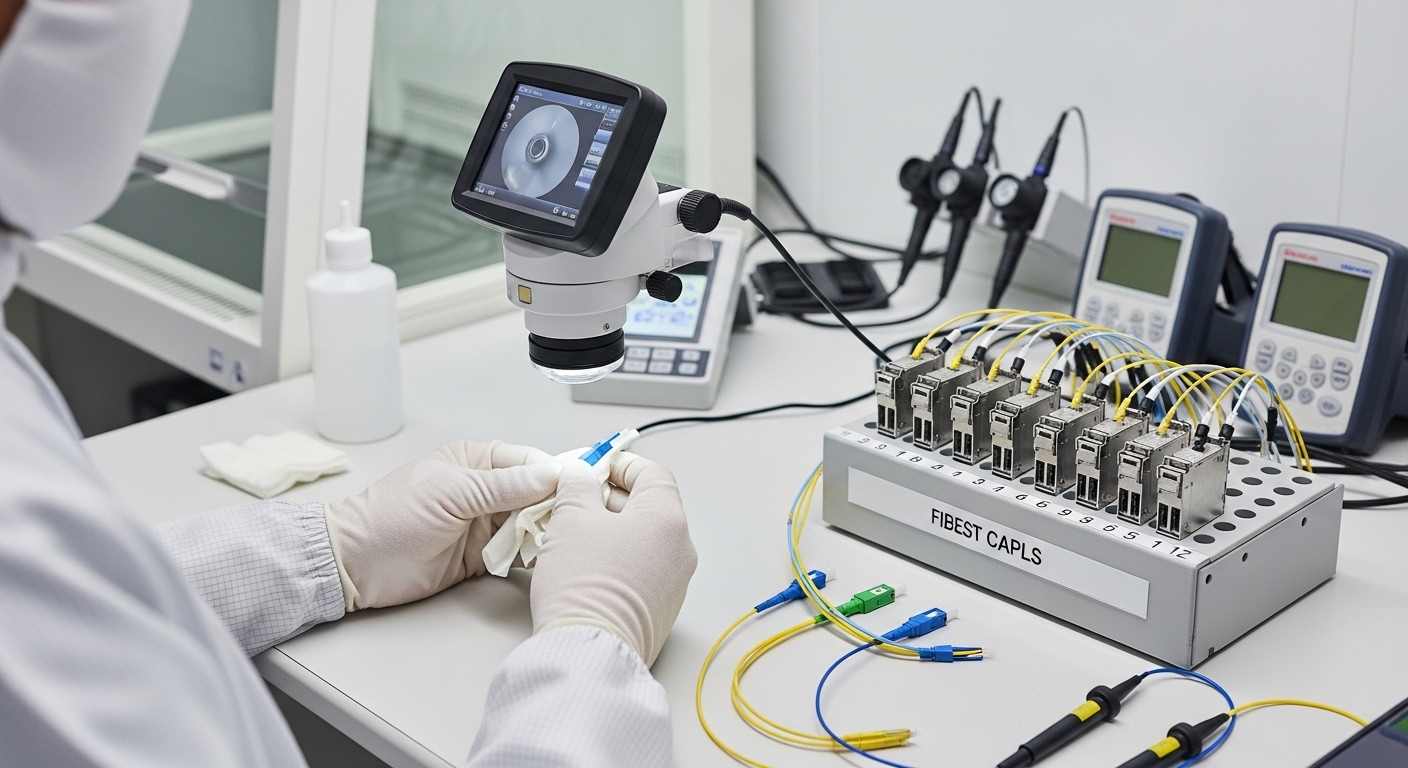
Fiber modules live in harsh conditions: high port density, forced airflow changes, and rack-level temperature gradients. ROI depends on failure rate over time, which is influenced by laser aging, connector wear, and how the module survives thermal cycling. ISO 9001-style supplier controls matter here: you want traceability, incoming inspection, and documented test results.
For instance, you should compare vendor claims for operating temperature ranges (commonly 0 to 70 C for many datacenter modules), and also consider whether the vendor has done thermal cycling and burn-in. While IEEE 802.3 defines electrical and optical behavior at the interface level, environmental robustness is largely a manufacturing and qualification story from the vendor.
- Pros (OEM): qualification aligned to specific platforms and predictable binning
- Cons (OEM): qualification scope may not match your unusual airflow profile
- Pros (third-party): can be fine if the vendor provides test evidence
- Cons (third-party): variable lot-to-lot quality if controls are weak
Link budget and reach: ROI is lost when optics are over- or under-spec’d
Even if the module “works,” ROI is hurt when you buy the wrong reach class or ignore real link loss from patch panels, dirty connectors, and aging fiber. For multimode short reach, reach is typically specified for controlled conditions (e.g., OM3/OM4 fiber, specific launch conditions). In the field, the effective reach can drop due to connector contamination or excessive patching.
ROI improves when you select modules with enough margin while controlling cost. For example, 10G SR over OM4 often targets longer reach than 10G SR over OM3. If your plant is OM3 and you buy OM4-optimized optics without margin analysis, you may see rising bit error rates and intermittent drops.
- Pros (OEM): conservative margin and stable optical power over time
- Cons (OEM): can cost more than the needed margin
- Pros (third-party): can hit the needed margin at lower price
- Cons (third-party): requires stronger verification of power and receiver sensitivity
Total cost of ownership math: downtime, spares, and failure handling
To compare OEM vs third-party, build a simple TCO model that includes not only purchase price but also failure handling. Consider: (1) mean time to repair (MTTR) for optics swaps, (2) probability of failure per year by module type, and (3) labor and change control costs. If your MTTR is 30 minutes with standardized spares, the ROI gap narrows; if you need multi-hour validation and approvals, the ROI gap widens.
Measured examples from field operations: in a busy NOC, a transceiver swap may require link checks, spanning tree stability checks, and packet loss monitoring. If each incident consumes 2 engineers for 45 minutes, labor cost becomes significant. Third-party savings can be absorbed quickly by repeated incident response when module batches show higher early-life failure rates.
- Pros (third-party): lower unit cost reduces baseline TCO
- Cons (third-party): higher variability can increase incident count
- Pros (OEM): lower operational surprises
- Cons (OEM): higher capital spend and slower iteration
Vendor support, RMAs, and traceability for quality management
Under ISO 9001 thinking, “support” is part of product quality. You should ask for lot traceability, RMA turnaround time, and whether replacements come from the same manufacturing family. A vendor who provides detailed failure analysis and fast replacements can improve fiber module ROI even if unit pricing is higher.
Third-party vendors vary widely. Some provide robust documentation and quick replacements; others treat optics like commodity items. When ROI is computed, include the expected time-to-replace and shipping cost for RMAs. Also include the risk of discovering that a module is compatible with one switch model but not another.
- Pros (OEM): predictable RMA process and documentation
- Cons (OEM): RMA policies may be slower during peak demand
- Pros (third-party): can offer competitive SLAs and flexible stock
- Cons (third-party): inconsistent support quality across suppliers
Procurement strategy: standardization versus flexibility risk
ROI is not only a math exercise; it is also an operational strategy. Standardizing on one module family reduces training time, simplifies spare inventories, and improves troubleshooting consistency. Flexibility can help during shortages, but mixing too many vendors may increase the time spent verifying compatibility, DOM behavior, and firmware interactions.
A practical approach is phased qualification. Pilot a third-party module family in a limited set of ports, monitor error counters and DOM trends for 30 to 60 days, then expand. Maintain a controlled BOM so your change management system knows exactly what optics are installed. This reduces the “unknown unknowns” that often erode ROI.
- Pros (standardization): lower operational overhead
- Cons (standardization): less leverage with suppliers
- Pros (flexibility): supply continuity during shortages
- Cons (flexibility): higher verification and documentation burden
Visual context: optics installed in a live datacenter port for realistic ROI thinking.
Specs that matter: comparing common short-reach options for ROI calculations
ROI depends on whether the optics meet your link requirements with margin. Below is a practical comparison of widely deployed short-reach categories. Always validate against your switch vendor’s compatibility list and your specific fiber plant (OM3 vs OM4, connector cleanliness, patching density).
| Module type | Wavelength | Target fiber | Typical reach | Connector | Data rate | Operating temperature | Power class (typical) |
|---|---|---|---|---|---|---|---|
| SFP-10G SR (e.g., Cisco SFP-10G-SR) | 850 nm | OM3/OM4 multimode | ~300 m (OM3) / ~400 m (OM4) | LC duplex | 10G | 0 to 70 C | ~0.8 to 1.5 W |
| SFP28-25G SR (e.g., Finisar FTLX8571D3BCL) | 850 nm | OM3/OM4 multimode | ~100 m (OM3) / ~150 m (OM4) | LC duplex | 25G | 0 to 70 C | ~1.5 to 2.5 W |
| QSFP28-100G SR4 (e.g., common 100G SR4 OM4 parts) | ~850 nm (4-lane) | OM4 multimode | ~100 m (classical OM4 spec) | LC quad | 100G | 0 to 70 C | ~3.5 to 5 W |
Sources and compliance context: IEEE 802.3 defines the Ethernet optical interface behavior and link requirements at a standard level, while individual vendor datasheets define module power, temperature, and optical performance details. Use vendor datasheets and your switch optics guide for compatibility. [Source: IEEE 802.3 Ethernet standard family] IEEE Standards [Source: Cisco and Finisar module datasheets for specific part numbers] Cisco Product Documentation Vendor datasheets
Visual context: link budget margin as a direct ROI lever.
Selection criteria checklist: how to verify fiber module ROI before you buy
Use this ordered checklist during procurement and reliability qualification. It is designed to reduce the “working today, failing later” risk that drives hidden TCO.
- Distance and margin: confirm fiber type (OM3 vs OM4), expected patching loss, and connector quality. Add margin for aging and cleaning gaps.
- Switch compatibility: verify the exact switch model and software version. Use vendor compatibility lists and, if absent, run a controlled pilot.
- DOM support quality: confirm whether the switch reads alarms and thresholds correctly and whether DOM values remain stable under temperature change.
- Operating temperature and airflow: match module temperature range to your rack airflow map. Validate with thermal measurement at the port level if density is high.
- Environmental evidence: request burn-in, thermal cycling, and reliability documentation. Look for batch traceability aligned to ISO 9001 quality controls.
- Vendor support and RMA SLA: confirm replacement timelines and whether replacements are from the same qualified manufacturing family.
- Vendor lock-in risk: evaluate how many ports you can repurpose if you later switch vendors. Consider multi-vendor spares only after compatibility is proven.
Decision shortcut for OEM vs third-party
If your environment is “standard and stable” with consistent airflow and well-managed fiber cleanliness, a qualified third-party module can deliver strong fiber module ROI. If your environment is “high variance” with frequent maintenance, mixed switch generations, or aggressive temperature swings, OEM can reduce operational risk even when unit cost is higher.
Visual context: reliability metrics as ROI inputs, not marketing claims.
Common mistakes and troubleshooting tips that erase ROI
Even good procurement decisions can fail if teams overlook operational details. Here are concrete failure modes I have seen in the field, with root causes and fixes.
Buying by distance alone, ignoring patch loss and connector contamination
Root cause: link specs assume clean connectors and controlled launch conditions. Real patch panels add insertion loss, and dirty LC interfaces can cause intermittent link drops.
Solution: perform an end-to-end loss check using an optical power meter or OTDR, then implement a connector cleaning and inspection workflow. Validate with the switch’s error counters after installation.
Mixing vendors without validating DOM alarms and threshold behavior
Root cause: third-party modules may link but report DOM values differently, producing false alarms or masking true degradation.
Solution: run a pilot and monitor DOM trends and error counters (CRC, FEC if applicable) for 30 to 60 days. Standardize on one DOM monitoring approach in your NOC runbooks.
Underestimating thermal density and airflow changes after maintenance
Root cause: optics can be sensitive to local temperature, especially in high-density racks. Replacing a blanking panel or changing fan curves can shift port-level airflow.
Solution: map airflow and measure port temperature near the optics during normal operations. Ensure modules meet the vendor’s 0 to 70 C operating range, and check that your cooling changes are reflected in change management.
Treating “link up” as proof of optical health
Root cause: a module can establish link while operating near the margin, leading to rising errors that only show up under load.
Solution: confirm optical health under traffic tests. For 10G/25G, monitor interface counters and run sustained traffic while watching for CRC error growth and link resets.
Cost and ROI note: realistic price ranges and TCO levers
Pricing varies by volume, lead time, and vendor supply chain. As a practical planning range, many teams see third-party short-reach optics priced roughly 20 to 50 percent below OEM for equivalent classes, but only when compatibility is proven. OEM modules can be higher, sometimes 1.5x to 2.5x the third-party price for certain switch families.
For TCO, the biggest levers are failure rate, MTTR, and the cost of verification. If your incident response is fast and you have standardized spares, third-party optics can produce strong fiber module ROI. If your operations require extended change windows for validation, the “savings” can be eaten by labor and downtime risk.
From a reliability standpoint, compute ROI using expected annual failures and the cost per incident. Even small differences in early-life failure rates can dominate the savings when you have thousands of ports.
Visual context: demonstrates why DOM stability and error monitoring are essential for ROI.
Summary ranking: which choice tends to win for fiber module ROI
The table below summarizes how OEM versus third-party typically performs across ROI drivers. Use it as a first pass, then validate with a pilot and your own failure history.
| ROI driver | OEM optics | Third-party optics |
|---|---|---|
| Purchase price | Lower ROI (higher cost) | Higher ROI (lower cost) |
| Compatibility likelihood | Higher | Variable; depends on qualification |
| DOM alarm consistency | Typically stronger | Can be strong, but verify |
| Reliability evidence | Often more documented | Improves with reputable vendors |
| RMA and support | Predictable process | Varies by supplier |
| Operational risk | Lower | Higher if unqualified |
If you want the best fiber module ROI, do not treat optics as interchangeable commodities. Next step: review your current transceiver lifecycle data and compare it to your planned switch and fiber roadmap using transceiver-tco-model.
FAQ
Is fiber module ROI better with third-party optics?
Often yes, but only when compatibility and environmental behavior are validated for your exact switch model and operating conditions. If your team can run a controlled 30 to 60 day pilot with DOM and error monitoring, third-party optics can deliver strong ROI.
What should I check for DOM support when comparing vendors?
Confirm that DOM values remain stable across temperature changes and that alarm thresholds behave as expected in your switch software. Also verify your NOC monitoring interprets DOM consistently, so you do not chase false alarms.
How does operating temperature affect fiber module ROI?
Higher local temperature accelerates aging and can increase the probability of early-life degradation. If your racks run near the upper end of the module operating range, prioritize vendors with strong thermal qualification evidence and traceability.
Do OEM modules reduce downtime enough to justify higher cost?
They can, especially in environments with mixed hardware generations or tight change windows. If your MTTR is high or validation takes long, OEM reliability predictability can improve ROI by reducing operational incidents.
What is the best way to run an ROI-focused pilot?
Select one module family class (for example, SFP28 SR on OM4) and deploy it to a controlled subset of ports. Monitor DOM trends and interface error counters under real traffic for at least a month, then compare against your baseline vendor.
