
Earth station fiber links are often treated like a “wavelength problem,” but in practice the real risk is signal integrity across baseband distribution—where timing, jitter, and interface compatibility matter as much as optics. This guide helps RF and transport engineers, plus network admins supporting satellite ground station backhauls, design an SFP-based fiber plan for baseband signal distribution. You will get a step-by-step deployment workflow, a practical compatibility checklist, and troubleshooting patterns drawn from field replacements and link bring-up.
Prerequisites for SFP-based earth station fiber baseband distribution
Before you order transceivers or touch patch panels, confirm that the baseband transport method and physical interface match what your SFP can actually carry. Many ground stations use fiber to move digitized I/Q or intermediate-frequency-over-fiber (IFoF) signals, but the line code and electrical interface vary widely between vendors and radio chains. If you skip this step, you can end up with “optically up” links that still fail at the baseband layer due to framing, scrambling, or clocking mismatch.
Gather these inputs
- Baseband interface: Common electrical standards include LVDS, CML, or vendor-specific SERDES transport; identify the exact interface name from the radio/ODU/BU or baseband unit (BBU).
- Data rate and encoding: Measured in Gb/s per lane or total stream; include whether the signal is continuous or packetized (e.g., Ethernet, custom framing).
- Link budget constraints: Expected fiber length from radio room to equipment rack, plus worst-case connector/splice loss.
- Optical class requirements: Laser safety category, connector type (LC/SC), and whether you need bend-insensitive fiber.
- Switch/router/SFP cage compatibility: Verify platform support for SFP types and vendor-specific optics compatibility lists.
- Environmental conditions: Rack temperature range, HVAC behavior, and whether you need industrial-grade optics.
Expected outcome
You will produce a one-page “optics and interface” sheet listing the exact SFP type family, target wavelength, reach class, and electrical interface constraints. This sheet prevents ordering the wrong wavelength (or wrong electrical signaling) that still “looks fine” on a basic optical power check.
Step-by-step implementation: deploy earth station fiber SFPs end-to-end
This section walks through a field-style rollout from patch panel design to first traffic validation. It assumes you are using SFP transceivers as the optical boundary for baseband distribution between an outdoor/remote unit and the station rack, or between baseband processing shelves.
Define the fiber path and loss budget
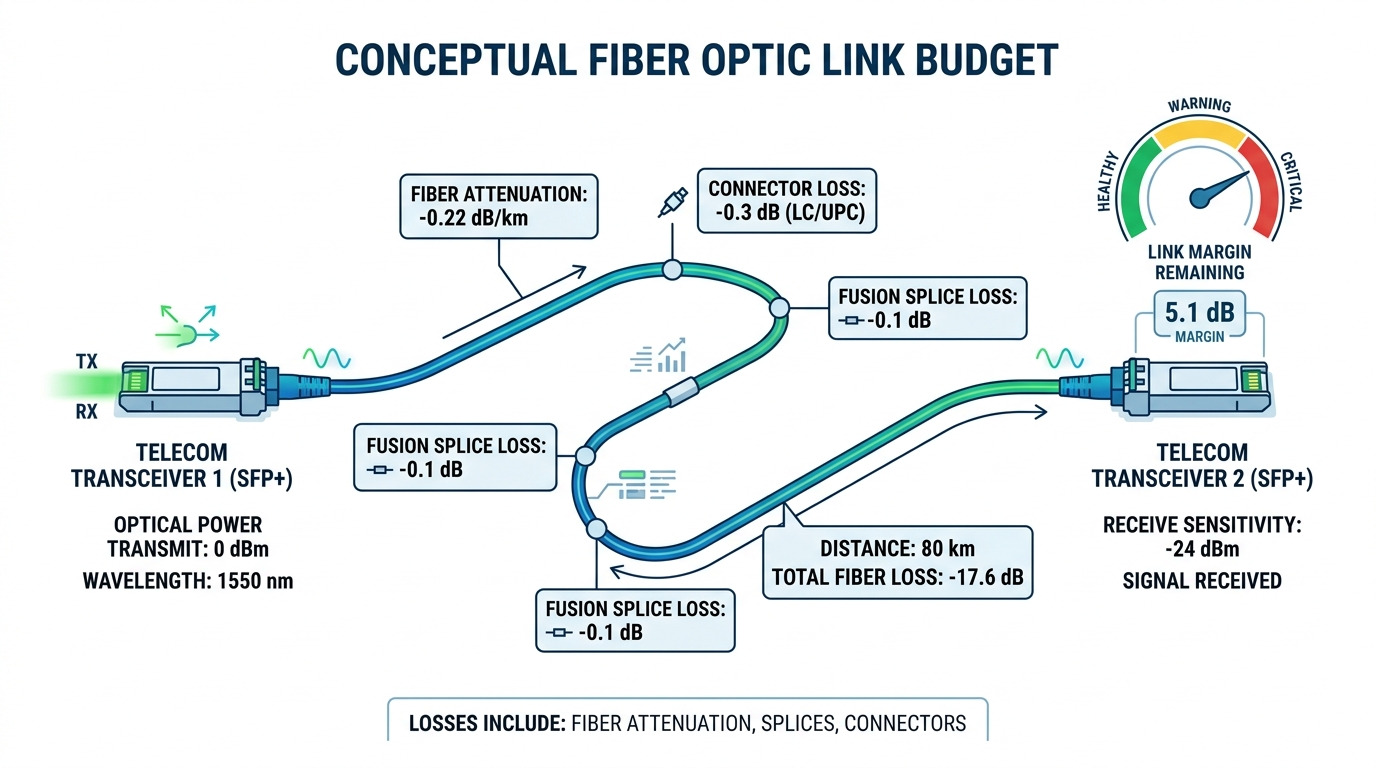
Map the route from the radio/ODU or remote fiber termination to the patch panel and onward to the rack where the SFP cages live. For terrestrial ground station runs, include connector and splice loss and confirm you are within the SFP module’s specified receiver sensitivity. As a starting point, many engineers budget 0.75 dB per connector and 0.2 dB per fusion splice, then add margin for aging and cleaning variability.
Expected outcome: A calculated worst-case optical loss number that fits the selected SFP reach class with at least 3 to 6 dB of design headroom.
Select the SFP wavelength and reach class
For most baseband-over-fiber designs, you choose between common short-wave and long-wave optics depending on distance and fiber type. Typical choices include 850 nm multimode for short reach, or 1310 nm / 1550 nm single-mode for longer runs. For example, a short run from an outdoor enclosure to an adjacent equipment row might use an SFP like Cisco SFP-10G-SR (10G-SR optics) when multimode is already installed, while longer or single-mode-only facilities often standardize on 1310 nm SFPs.
Expected outcome: A specific wavelength plan aligned to your fiber type (MMF vs SMF) and the measured distance.
Confirm electrical interface compatibility with the baseband unit
This is where earth station fiber projects succeed or fail. SFP optics are not universally interchangeable because the electrical side may expect a specific electrical standard, lane mapping, or clocking behavior. Validate whether your baseband unit outputs a supported input for the SFP (or for the switch/router port that hosts the SFP) and whether it expects a particular framing mode.
Expected outcome: Verified electrical compatibility: the baseband unit’s output mode matches the SFP’s expected input signaling and the receiving device can lock to the recovered clock.
Build and label patch panels with deterministic labeling
Use numbered fiber jumpers and consistent labeling conventions that match your documentation. In ground stations, troubleshooting often happens under time pressure during satellite passes, so you need to identify “which fiber goes to which I/Q stream” quickly. Include a label on both ends of every jumper, and keep a mapping sheet in the rack door notes.
Expected outcome: A deterministic fiber map that reduces mean time to repair (MTTR) during a pass-window outage.
Clean connectors and verify optical power before insertion
Always clean LC/SC connectors using appropriate inspection tools and cleaning methods. Then check optical power levels or at least verify that the receiver is not saturated. Even with correct wavelengths, dirty connectors can create intermittent faults that look like baseband loss-of-lock.
Expected outcome: Stable link bring-up with no “works sometimes” behavior.
Insert SFPs and validate link layer first, then baseband layer
Insert the SFPs into the correct cages and bring up the link. Validate that the optics report status (Tx/Rx power, temperature, DOM fields) and that the switch/router indicates link up. Then validate the baseband service: confirm framing sync, error counters, and any station-specific health indicators.
Expected outcome: You see optical link up plus clean baseband transport metrics (minimal BER/FER, stable recovered clock, and no repeated resync events).
Implement operational monitoring and alarm thresholds
In production, you want alerts for real failure modes: optical power drift, DOM temperature excursions, high error rates, and sudden link flaps. If you are using a managed switch/router, poll DOM telemetry and set thresholds conservatively based on your baseline readings during commissioning.
Expected outcome: Monitoring that catches degradation early (connector contamination, aging optics, or fiber damage) rather than waiting for a hard outage.
Choosing the right earth station fiber SFP: specs that actually matter
Optics selection is not just “distance equals wavelength.” For baseband distribution, engineers care about receiver sensitivity, optical budget margin, DOM support, and operating temperature stability. Below is a comparison of common SFP families used in 10G-class deployments, which are frequently repurposed in baseband transport architectures when the electrical layer is compatible.
| Parameter | Example SFP Type (10G) | Typical Wavelength | Reach Class | Connector | Typical DOM | Operating Temperature |
|---|---|---|---|---|---|---|
| Short-reach multimode | Cisco SFP-10G-SR | 850 nm | Up to ~300 m (OM3/OM4 depends) | LC | Supported | Commercial (vendor-defined) |
| Longer reach single-mode | Finisar FTLX8571D3BCL (10G class) | ~1310 nm | Up to ~10 km class | LC | Supported | Commercial or industrial (variant-dependent) |
| Single-mode 10G option | FS.com SFP-10GSR-85 (variant naming differs) | Varies by SKU | Varies by SKU | LC | Often supported | Varies by SKU |
Use this table as a reference pattern, then confirm your exact SKU datasheet for wavelength, reach, DOM support, and temperature range. For standards context, the Ethernet PHY and optical interface behaviors are rooted in IEEE 802.3 media specifications and vendor implementation details; see [Source: IEEE 802.3] and the specific transceiver datasheet. anchor-text
Pro Tip: In baseband distribution, the receiver can “lock” while still producing elevated error counters if the link budget is marginal. Commission by capturing baseline Rx power and error-rate telemetry at the same time, then set alarms on drift rather than waiting for a full outage.
Expected outcome: You select optics that meet the physical budget and the operational behavior you will measure during commissioning.
Selection criteria checklist for earth station fiber SFP deployments
When engineers choose earth station fiber SFPs for baseband distribution, they weigh compatibility and operational risk as much as raw reach. Use the ordered checklist below during procurement and engineering review.
- Distance and fiber type: Verify SMF vs MMF, confirm end-to-end length including patch panels, and ensure the selected SFP wavelength matches fiber transmission characteristics.
- Switch/platform compatibility: Check the host device’s SFP compatibility list; some platforms reject non-OEM optics or require specific DOM behavior. This matters for baseband distribution where a “link up” is not sufficient.
- DOM and telemetry requirements: Confirm the SFP supports Digital Optical Monitoring (DOM) so you can alarm on Tx/Rx power and temperature. If DOM is absent, you lose early warning signals.
- Operating temperature range: Earth station racks can swing during HVAC cycles; pick industrial-grade modules if ambient can exceed commercial optics limits.
- Optical budget margin: Include connector/splice loss, aging, and cleaning variability. Aim for design headroom so receiver sensitivity is not stressed.
- Power and laser safety constraints: Ensure compliance with your facility’s laser safety policies and connector cleanliness standards.
- Vendor lock-in risk: OEM optics can be costly; third-party options can reduce CapEx but may increase compatibility and support risk. Plan a validation test window before mass replacement.
- Maintenance and spares strategy: Standardize on a small set of optics SKUs so spares fit the same cages and the same operational baselines.
Expected outcome: A defensible selection decision that survives both commissioning and long-term operations.
Common pitfalls and troubleshooting for earth station fiber SFPs
Below are three high-frequency failure modes seen during bring-up and routine maintenance of earth station fiber baseband distribution. Each includes root cause and a practical fix.
Troubleshooting failure point 1: Optical link up, baseband transport fails
Root cause: Electrical interface mismatch or framing/clocking incompatibility between the baseband unit and the optical boundary. The SFP may simply transport bits, but your baseband receiver expects a specific lane mapping, scrambling state, or timing reference.
Solution: Validate the baseband interface configuration first (lane order, serializer mode, clock source). Then compare error counters and resync events before changing optics. If you have access to a protocol analyzer or the baseband unit’s diagnostic counters, confirm the failure is at the baseband layer rather than PHY.
Troubleshooting failure point 2: Intermittent link flaps during satellite passes
Root cause: Connector contamination or micro-bends causing transient attenuation, often worse under vibration or thermal cycling. Engineers sometimes “clean once” during commissioning and forget that re-patching can re-contaminate connectors.
Solution: Inspect with an optical microscope or fiber inspection scope, re-clean, and re-seat connectors. Check for cable strain relief issues and verify bend radius compliance. If possible, swap the jumper end-to-end to isolate whether the fault follows the patch lead.
Troubleshooting failure point 3: DOM shows abnormal Rx power or temperature
Root cause: Marginal link budget, dirty connectors, or an optics mismatch (wrong wavelength class or wrong fiber type). Some third-party optics report DOM values differently; incorrect assumptions can mislead troubleshooting.
Solution: Confirm wavelength class and fiber type at both ends, then measure Rx power with calibrated equipment. Re-check the loss budget and verify that the Rx power is inside the module’s specified operating range. Use DOM telemetry trends to identify degradation before catastrophic failure.
Expected outcome: Faster isolation of whether the issue is physical optics, electrical compatibility, or baseband layer behavior.
Cost and ROI considerations for earth station fiber SFP optics
Cost is not only per module; it is per successful uptime event and per spare that fits your cages. OEM 10G SFPs can range roughly from $200 to $600 depending on wavelength, reach, and industrial grade, while third-party optics may land around $60 to $250 but require validation and potentially higher failure-risk acceptance. Over a multi-year ground station program, the TCO often favors optics with reliable DOM telemetry and a documented compatibility track record, because maintenance labor and downtime windows are expensive.
For ROI, quantify: expected annual module replacements, average MTTR, and the cost of a missed pass-window. If your station has strict maintenance windows, spending more on a proven optics SKU can reduce operational risk even when CapEx increases.
Deployment visuals to standardize your build and inspection workflow
Use consistent visuals during commissioning so your team can compare “known good” states to new failures.
FAQ
What does earth station fiber mean in baseband distribution?
It refers to using fiber links inside or between parts of a satellite ground station to carry digitized baseband signals or IF-over-fiber transport. In this context, earth station fiber is often implemented at an SFP boundary so the optical layer becomes a standardized transport for the baseband stream.
Can I use any 10G SFP module for baseband transport?
No. Even when data rates are similar, compatibility depends on the host platform’s electrical interface expectations, DOM behavior, and sometimes the baseband unit’s framing and clocking. Always validate with the exact baseband mode and confirm the SFP is supported by the host device.
How do I choose between multimode 850 nm and single-mode 1310/1550 nm?
Use multimode 850 nm for short runs where MMF is already installed and you are confident about connector quality and reach. Choose single-mode 1310/1550 nm for longer distances and for facilities that standardize on SMF; it generally reduces reach limitations and is more tolerant of longer campus-style routes.
What DOM checks should I monitor for early failure warning?
Track Rx power, Tx power, module temperature, and link status events. Set thresholds based on your commissioning baseline; the goal is to alarm on drift patterns that precede high error rates.
Why does the link show up but baseband errors spike?
Common causes include electrical incompatibility, incorrect lane mapping, or marginal optical budget that increases bit errors without immediately dropping link state. Validate baseband counters and compare them to DOM telemetry trends before swapping optics.
Are third-party SFPs safe for mission-critical earth station fiber links?
They can be, but only after compatibility testing on your exact host platforms and with your expected environmental conditions. Plan a validation window and keep OEM or known-good spares available until you confirm stable DOM telemetry and error performance.
For next steps, align your fiber plant records with an optics standardization policy and verify the physical layer before changing baseband configurations: fiber patch panel labeling best practices.
Author bio: I have deployed and troubleshot routing, switching, and fiber optics for satellite and terrestrial transport networks, including SFP-based baseband distribution in rack and outdoor enclosure environments. I focus on measurable commissioning outcomes: DOM telemetry baselines, optical loss budgets, and repeatable isolation procedures.
