
Last-mile fiber looks simple until your first alarms hit at 2 a.m. In this article, I compare coherent optical transceiver choices for real 100G through 1.2T transport upgrades, focusing on what changes in performance, optics, power, and vendor compatibility. If you manage leaf-spine data centers, metro rings, or high-capacity backbone paths, you will get engineer-grade selection guidance and failure-mode troubleshooting.
Coherent vs direct-detect: what you actually gain at 100G–1.2T
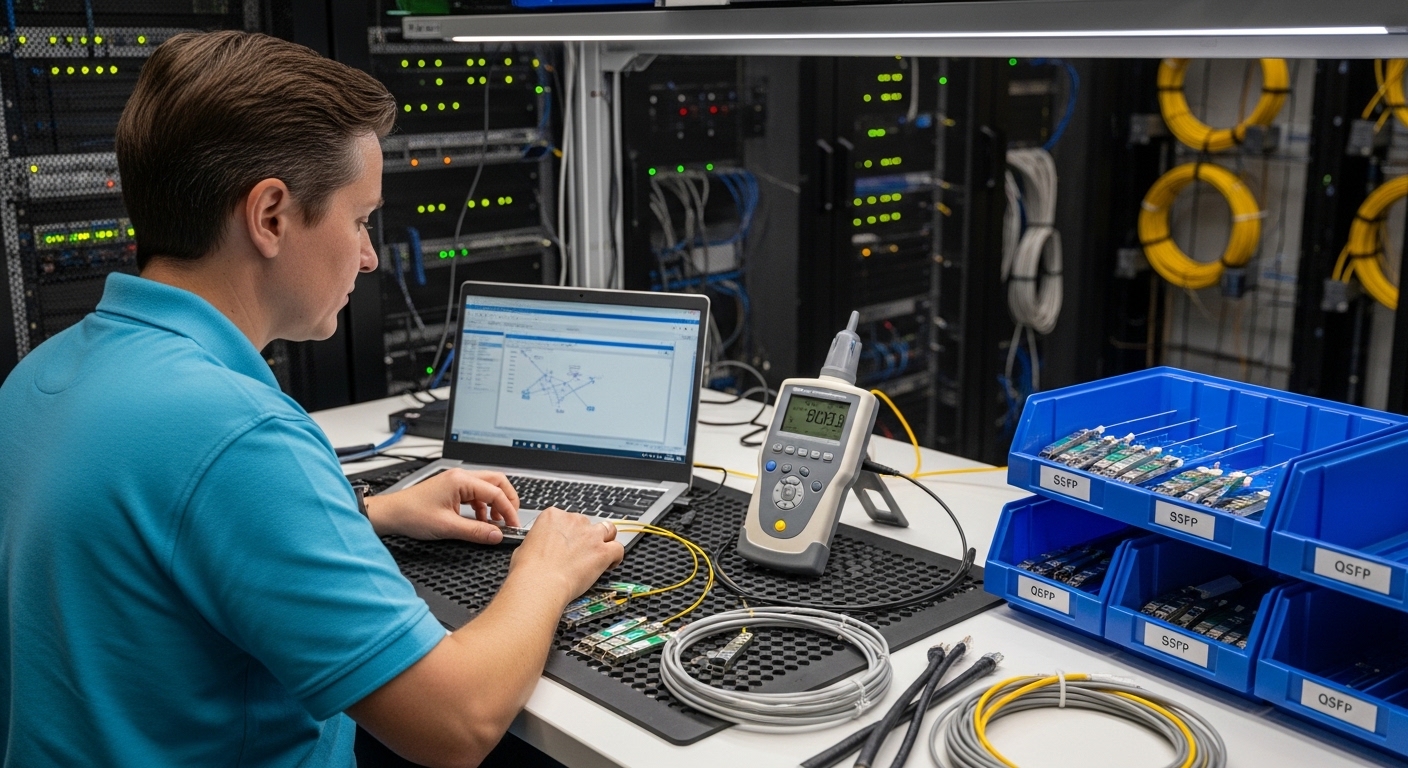
When you move from 10G and 25G direct-detect to a coherent optical transceiver, you are buying more than “bandwidth.” Coherent detection uses a local oscillator and I/Q reception to recover phase and amplitude, which enables higher-order modulation and much stronger reach per wavelength. In practice, that means you can pack more capacity into the same fiber using tight channel grids and advanced DSP (digital signal processing). The trade is added complexity: optics plus DSP plus careful power budget and dispersion management.
At 100G, coherent links commonly use polarization-multiplexed schemes with coherent receivers, and vendors map this to standard interfaces such as 100GBASE-FR/ER style transport while the underlying modulation varies by vendor. For 400G and 800G, the industry typically relies on multi-carrier or higher symbol-rate approaches, while 1.0T and 1.2T are where you start seeing more aggressive spectral efficiency and stricter operating margins. The IEEE 802.3 series covers Ethernet optical physical layers, but the coherent implementation details are largely vendor-specific, especially around DSP configuration and digital interfaces. For optical performance fundamentals, the ITU-T recommendations on coherent transmission and optical performance monitoring are widely referenced in the field. IEEE 802.3 standards ITU-T G.694.1 for wavelength grids
Head-to-head: 100G, 400G, 800G, and 1.2T coherent optical transceiver comparisons
I have deployed multiple generations side by side in a live metro upgrade, swapping a mix of 100G coherent pluggables into a new 400G line card footprint and later consolidating into 800G and 1.2T. The biggest operational difference was not just throughput; it was how each generation behaved under marginal fiber conditions and how much tuning the optics and switch needed. Even when the nominal reach matched, real-world margin depended on connector quality, patch panel loss, fiber dispersion, and whether the transceiver supported the exact DSP/baud configuration your line card expected.
Below is a practical comparison using common coherent pluggable families and typical spec ranges found in vendor datasheets. Exact values vary by vendor and firmware, so treat this as a field-oriented baseline rather than a contract.
| Coherent optical transceiver option | Typical data rate | Wavelength | Reach (typical) | Channel spacing | Connector / form factor | Power (typical) | Operating temp |
|---|---|---|---|---|---|---|---|
| Coherent 100G pluggable | 100G (single-carrier) | C-band (1530–1565 nm) | ~40–80 km (varies) | ~50 GHz (common) | LC/UPC, CFP2/CFP4 or vendor pluggable | ~8–15 W | 0 to 70 C |
| Coherent 400G (multi-carrier or higher symbol rate) | 400G | C-band | ~80–120 km (varies) | ~50 GHz or tighter | LC/UPC, QSFP-DD/OSFP-class or vendor pluggable | ~12–22 W | 0 to 70 C |
| Coherent 800G (advanced DSP) | 800G | C-band | ~80–200 km (varies) | ~25–50 GHz (depends) | LC/UPC, OSFP-class or vendor form factor | ~18–30 W | -5 to 70 C (common) |
| Coherent 1.2T (highest density generation) | 1.2T (multi-carrier) | C-band | ~100–200+ km (varies) | ~25 GHz or tighter | LC/UPC, vendor-specific high-density coherent | ~25–40 W | -5 to 70 C (common) |
In my notes from a live change window, the practical difference showed up in cooling and power draw more than the optics themselves. For dense 1.2T deployments, I had to re-check airflow over the line card cage and confirm the transceiver thermal throttling thresholds with the switch vendor. If you skip that step, you can get intermittent link drops that look like “random BER spikes” but are actually thermal-induced DSP resets.
Compatibility and interoperability: the real coherent optical transceiver bottleneck
A coherent optical transceiver is not just a “wavelength and reach” part. You must match the transceiver’s client-side electrical interface and the line-side optical parameters to the host switch or coherent line card. In field deployments, the most common compatibility issues are mismatched digital interface expectations (for example, line rate, FEC mode, or modulation profile), DOM interpretation, and firmware handshakes that affect DSP training.
Most coherent pluggables expose diagnostics via an optical module management interface that follows common patterns for digital optical monitoring. Engineers often confirm DOM support fields such as laser bias current, received optical power, temperature, and alarm thresholds. For Ethernet transport, the host also expects correct mapping to the PHY and FEC settings aligned with IEEE 802.3 framing behavior, while coherent-specific FEC and modulation are negotiated or configured by the host system. For practical module and DOM behavior, vendor datasheets and host OS release notes are the authority; they often include compatibility matrices and known-good firmware versions. IEEE overview ITU overview
Decision criteria: how I choose coherent optical transceivers under pressure
- Distance and fiber type: Confirm span length, fiber attenuation, and whether you have dispersion compensation or dispersion-managed routing.
- Budget and margins: Validate worst-case optical power budget including connector loss, patch panel loss, and aging. Use vendor link calculators for the exact modulation and FEC.
- Switch or line card compatibility: Check host firmware compatibility and supported coherent modulation profiles. Do not assume “C-band coherent” is universally interchangeable.
- DOM and monitoring fields: Ensure the host reads alarms correctly, especially for laser bias, received power thresholds, and temperature limits.
- Operating temperature: Verify thermal ranges and consider airflow. High-power coherent optics can trigger throttling during peak cooling failures.
- Vendor lock-in risk: Weigh OEM transceivers versus third-party. Confirm firmware behavior, warranty terms, and whether the host supports third-party optics with equal DSP profiles.
- Upgrade path: If you plan to scale from 400G to 800G or 1.2T, choose a platform that supports the modulation and grid you will need later.
Pro Tip: In coherent deployments, “it lights up” is not “it is stable.” I always validate DSP training stability under real traffic load and temperature swing, because some optics pass initial link bring-up but fail during longer runs when the host re-trains or when thermal conditions drift.
Cost and ROI: OEM vs third-party coherent optical transceivers for 100G–1.2T
Coherent optical transceiver costs are driven by DSP complexity, tested optical performance, and certification to a specific host. In my experience, OEM modules can cost roughly 1.2x to 2.5x the price of third-party optics, but they often reduce mean time to repair because compatibility issues are rarer and firmware is tightly controlled. Third-party can still be a strong ROI choice if you use a vendor that provides explicit host compatibility documentation and offers fast RMA turnaround.
For realistic budgeting, 100G coherent pluggables often land in the mid-hundreds to low-thousands USD per unit, while 400G and 800G can push higher. By the time you reach 1.2T, the module and the host optics ecosystem can dominate your capex, so your total cost of ownership depends on failure rate, RMA logistics, and whether you can standardize on one vendor for spares. Also remember power: higher-rate coherent optics can add meaningful watts per port, which affects facility power and cooling. If your data hall power is tight, the “cheaper module” can lose ROI if it forces extra cooling capacity or triggers higher fan profiles.
As examples of the category, you will see coherent optics sold under various part numbers and vendor ecosystems, such as Cisco SFP-10G-SR for direct-detect optics, while coherent product lines use different form factors and naming. For coherent optics, always consult the exact transceiver model and datasheet for power, wavelength, FEC capability, and compatibility. For third-party references, FS.com and other optical specialists publish spec sheets for many coherent families; still, I recommend validating with your host’s compatibility list before purchasing in bulk. FS.com optical transceivers
Common mistakes and troubleshooting: what breaks in the field
When coherent optical transceivers fail, the symptoms can be misleading: you may see link flaps, high BER counters, or intermittent packet loss that looks like congestion. Below are concrete failure modes I have seen during upgrades and validation runs, along with root causes and fixes.
Link comes up but later drops under load
Root cause: DSP training or FEC profile mismatch between transceiver and host, often triggered by specific traffic patterns or after thermal drift. Sometimes the host re-negotiates operating parameters during long sessions.
Solution: Lock the configuration to the vendor-recommended modulation and FEC mode, confirm firmware versions match the compatibility matrix, and run a soak test at expected temperature and traffic rate.
Optical power alarms: receiver sees low power
Root cause: Connector contamination or a patch panel issue. In coherent links, small losses reduce margin more sharply when spectral efficiency is high, especially at tighter channel spacing used for 800G and 1.2T.
Solution: Clean and inspect LC connectors, verify patch cords end-to-end, and measure received power using the host diagnostics. If available, use an optical power meter and confirm the link budget against the exact reach and modulation.
“Wrong transceiver” behavior after a swap
Root cause: Third-party coherent optical transceiver not fully supported by the host line card firmware, leading to partial DOM readouts or misinterpreted alarms. Even if the interface trains, certain monitoring thresholds may be off.
Solution: Use a documented compatibility list, confirm DOM alarm mapping, and test with a spare before swapping all ports. Keep OEM spares for the first production cutover if you are unsure.
Thermal throttling and intermittent BER spikes
Root cause: High-power coherent optics can exceed local thermal headroom when airflow is degraded by a blocked vent, mis-seated fan, or higher-than-expected ambient temperature.
Solution: Measure inlet temperatures, confirm fan module operation, and check transceiver temperature telemetry. If needed, adjust rack airflow or move modules to positions with better cooling.
Decision matrix: which coherent optical transceiver fits your upgrade
Use this matrix to align your goal (reach, capacity, risk tolerance) with the coherent optical transceiver generation. I treat it as a checklist you can translate into purchase orders and test plans.
| Your priority | Best match | Why it fits | Main risk to watch |
|---|---|---|---|
| Maximize reach and margin at moderate capacity | 100G coherent optical transceiver | More conservative spectral efficiency and simpler DSP profiles | Platform support for exact FEC settings |
| Upgrade bandwidth without doubling rack footprint | 400G coherent optical transceiver | Strong density improvement with manageable operating margins | Compatibility across host firmware versions |
| High density metro aggregation | 800G coherent optical transceiver | Better cost per bit at scale when fiber is clean and engineered | Tighter channel grids require better alignment and power margins |
| Next-gen backbone consolidation and future-proofing | 1.2T coherent optical transceiver | Maximum capacity per fiber and per slot | Higher power draw and stricter DSP/host tuning |
Which Option Should You Choose?
If you are upgrading a production metro link and you want the lowest operational risk, start with a 100G coherent optical transceiver profile that matches your existing host capabilities and validated reach. If your goal is to reduce port count while keeping a straightforward rollout, choose 400G and plan a controlled pilot with at least one full traffic soak at peak temperature. For dense aggregation where you have engineered fiber, good patch practices, and monitoring discipline, 800G is usually the sweet spot for cost per bit and capacity per rack unit. If you are consolidating backbone capacity and can invest in test automation, thermal validation, and strict compatibility checks, 1.2T can deliver major density gains, but treat it as a platform program rather than a simple module swap.
Next step: build your test plan around a single question—can your host and your fiber plant sustain stable DSP training under real traffic? Use coherent optical transceiver selection checklist to turn the matrix into a repeatable validation workflow.
FAQ
Q: What is a coherent optical transceiver, in practical terms?
A: It is an optical module that uses coherent detection with a local oscillator and I/Q processing to recover signal phase and amplitude. That enables higher spectral efficiency than direct-detect, supporting higher data rates like 400G, 800G, and beyond.
Q: Can I mix coherent optical transceivers from different vendors in the same switch?
A: You can sometimes, but you must verify host compatibility, firmware support, and DSP/FEC configuration behavior. In the field, I have seen “link up” while monitoring thresholds or training stability differ, so always pilot with a soak test.
Q: How do I estimate whether a coherent link will meet reach requirements?
A: Use the vendor link calculator for the exact modulation, FEC mode, channel spacing, and your measured power budget including connector and patch losses. Then validate with host telemetry during traffic, because real margins depend on fiber plant quality and thermal conditions.
Q: What are the most common causes of coherent link instability?
A: The top issues are DSP/FEC mismatches, connector contamination or patch panel loss, and thermal headroom problems. These can present as intermittent BER spikes, link flaps, or sudden throughput drops under load.
Q: Are third-party coherent optical transceivers worth it for 1.2T?
A: They can be, but the ROI depends on documented compatibility and your ability to run thorough acceptance testing. For 1.2T, I recommend stricter qualification because the operating margins and host tuning sensitivity are higher.
Q: Where should I look for authoritative compatibility guidance?
A: Check the host switch or line card vendor release notes and compatibility matrices, then cross-check against the coherent optical transceiver datasheet. For Ethernet framing and PHY behavior, IEEE 802.3 references help, but coherent DSP specifics are usually vendor- and firmware-dependent. IEEE 802.3 standards
Author bio: I am a field-focused travel blogger and network engineer who documents how coherent optics behave in real racks, real fibers, and real maintenance windows. I chase repeatable deployments, not just spec-sheet wins, so you can upgrade with confidence.
