
Service provider teams adopting coherent CFP2 transceivers often hit the same bottlenecks: unclear fiber reach versus link budget, vendor-specific DSP behavior, and optical power budgets that only show up after cutover. This article helps network architects and IT directors evaluate CFP2-ACO coherent optics with an enterprise architecture and governance lens, including measured operational considerations you can use in procurement and rollout planning. You will also get a head-to-head comparison of common CFP2 coherent deployment options, plus a practical decision checklist.
Coherent CFP2 vs alternatives: what changes in performance and margins
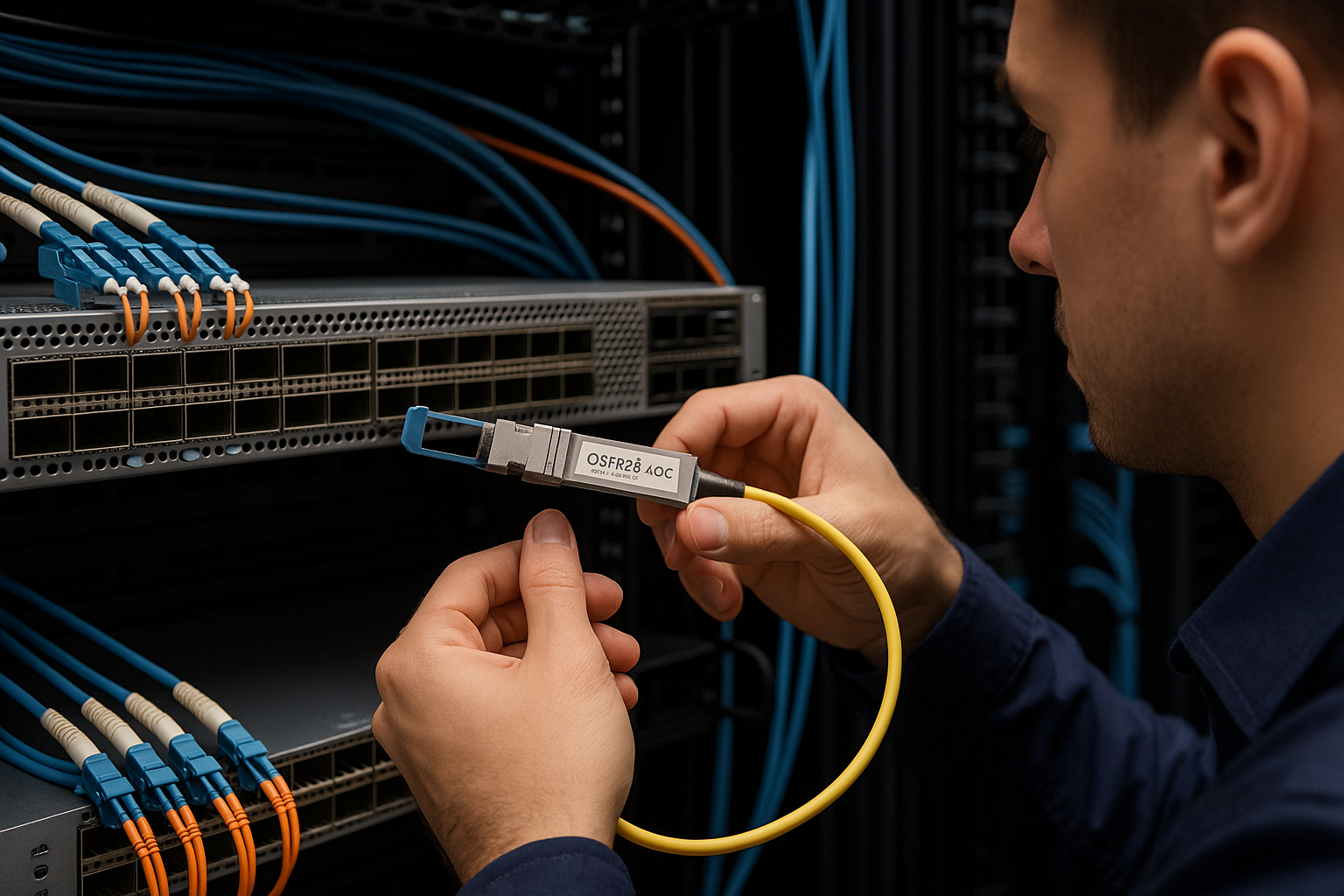
In a service provider transport network, the move to coherent pluggables shifts complexity from optics-only specifications toward end-to-end DSP performance, dispersion tolerance, and control-plane interoperability. A coherent CFP2 transceiver is designed for coherent detection and typically supports multi-rate line-side operation depending on the vendor implementation. Where legacy direct-detect optics fail due to chromatic dispersion and signal-to-noise penalties at higher reach, coherent optics use local oscillator-based detection to extend feasible reach at the cost of tighter requirements on fiber plant quality and optics power levels.
From an enterprise architecture view, the key difference is governance: coherent CFP2 introduces more variables that affect interoperability, including FEC behavior, modulation format (often vendor-dependent), laser linewidth assumptions, and alarm semantics. When you standardize coherent CFP2 across sites, you also standardize observability: consistent DOM telemetry, standardized alarm thresholds, and stable optics vendor behavior during maintenance windows. That reduces mean time to repair (MTTR) because the NOC can rely on uniform telemetry and failure patterns.
Performance levers that matter in CFP2-ACO deployments
When you evaluate coherent CFP2 in a service provider plan, focus on these performance levers rather than marketing reach numbers. First is wavelength plan and whether the module is designed for C-band or a specific grid. Second is optical input/output power and whether the transceiver expects a specific receive sensitivity range under your amplifier and span loss profile. Third is OSNR and penalty budgets: coherent systems are sensitive to OSNR, and OSNR depends on fiber nonlinearities, span power, and channel loading.
Finally, operational performance includes thermal behavior: coherent optics are more sensitive to temperature drift because DSP thresholds and laser characteristics can shift. If you deploy in high-ambient cabinets, you need to confirm the module temperature operating range and verify that the host transceiver cage airflow matches vendor guidance.
Key specifications comparison: wavelength, reach, power, and interface fit
This table compares representative coherent CFP2 module characteristics you will see in vendor datasheets and procurement specs. Exact values vary by vendor and host platform, but the categories are consistent across CFP2 coherent families. Use it as a starting point for your CFP2-ACO coherent transceiver deployment guide documentation package and as an input into your link budget model.
| Spec category | Coherent CFP2 (typical) | Direct-detect optics (contrast) | Why it matters for service providers |
|---|---|---|---|
| Data rate | Multi-rate coherent (implementation-dependent) | Fixed line rate (e.g., 10G/25G) | Determines transport grooming strategy and mux/demux compatibility |
| Wavelength band | C-band or specified ITU grid support | Often 1310/1550 or single-wavelength | Impacts compatibility with ROADM and channel plans |
| Reach | Hundreds of km under OSNR and dispersion constraints | Limited by dispersion at higher rates | Controls span count and amplifier strategy |
| Optical power | Defined Tx/Rx sensitivity window per datasheet | Simple power budget | Coherent links require OSNR-aligned power and noise assumptions |
| Connector and optics form | CFP2 pluggable, typically fiber pigtails via host optics cage | SFP/QSFP pluggables | Host cage and optical path alignment drive compatibility |
| DOM telemetry | Presence, power, temperature, alarms (vendor-specific scaling) | Presence and basic optical metrics | Drives NOC automation and governance controls |
| Operating temperature | Vendor-defined typically extended for telecom shelves | Varies by module class | Determines whether you meet cabinet thermal limits during peak loads |
For standards grounding, coherent pluggables are often governed by CFP2 mechanical/electrical expectations and host-specific optical interface requirements. While CFP2 form factor is standardized at the mechanical level, coherent behavior is not universal: you must validate with the host vendor. For baseline references on coherent transport behavior and Ethernet over fiber constraints, consult [Source: IEEE 802.3] and vendor-specific CFP2 coherent datasheets.
Image 1:
Cost and ROI: why coherent CFP2 changes TCO more than CAPEX
At procurement time, coherent CFP2 modules can cost materially more than direct-detect pluggables, but the ROI is often dominated by operational costs and transport efficiency. In practice, service providers reduce truck rolls by standardizing coherent optics with predictable alarm telemetry and consistent failure modes. You also can lower total fiber consumption by enabling longer reach per span, which reduces the number of intermediate sites and splicing events.
Typical pricing varies by vendor, capacity, and whether you buy OEM or third-party. In many network refresh cycles, coherent CFP2 modules land in a multi-hundred to low-thousand USD range per unit, while third-party pricing can undercut OEM by a noticeable margin but introduces governance overhead for compatibility validation and warranty alignment. For TCO modeling, include: spares holding cost, warranty terms, RMA turnaround times, and energy costs driven by host DSP power draw.
ROI model inputs you can actually measure
Use your own NOC and field maintenance data. For example, if your current transceiver failure rate averages 2 to 5 RMA events per 1,000 optics per year and average repair cycle is 14 to 21 days, then standardizing coherent CFP2 with consistent DOM-based diagnostics can reduce MTTR by shortening triage and enabling predictive replacement. Also measure cabinet power: coherent hosts often increase baseline power consumption due to DSP and coherent receiver processing.
Pro Tip: Many teams underestimate how much operational governance depends on DOM alarm semantics, not just optical metrics. If your NOC automation keys off vendor-specific alarm IDs, you can accidentally increase outage duration during cutover even when the link is technically “up.” Require a DOM alarm mapping worksheet as part of acceptance testing for coherent CFP2.
Compatibility and governance: CFP2-ACO host fit, DOM, and control-plane alignment
Coherent CFP2 modules are rarely plug-and-play across vendors. Compatibility is governed by the host optics cage design, electrical interface behavior, and the expected coherent DSP feature set. CFP2-ACO coherent transceivers in particular should be evaluated against the host line card firmware behavior, including how it negotiates operating parameters (rate, modulation, FEC mode) and how it reports telemetry.
From a governance standpoint, define acceptance gates in your change management workflow: optical performance acceptance (BER and OSNR margin), telemetry acceptance (DOM fields, alarm thresholds, and syslog/SNMP mappings), and interoperability acceptance (with your ROADM/OTN gear or transport mux/demux). If you are operating under a formal enterprise architecture framework, treat coherent CFP2 as a controlled component with versioned firmware and a documented interoperability matrix.
Decision checklist for selection and rollout
- Distance and span plan: confirm OSNR and dispersion assumptions for your span lengths and amplifier strategy; do not rely on a single “reach” number.
- Budget constraints: compare OEM versus third-party with warranty and RMA SLAs; include acceptance testing labor in TCO.
- Switch and host compatibility: verify exact host model support and firmware version; validate electrical interface behavior with the host vendor.
- DOM and telemetry support: require DOM field parity and alarm mapping for NOC automation; confirm temperature and optical power telemetry units.
- Operating temperature and airflow: check module temperature range and ensure cabinet airflow meets vendor guidance under peak load.
- Vendor lock-in risk: assess whether modulation/FEC modes are vendor-specific and whether future upgrades require host firmware changes.
- Warranty and RMA process: measure typical turnaround time and whether you can get advance replacements during major events.
Image 2:
Head-to-head deployment options: OEM coherent CFP2 vs qualified third-party
In most service provider deployments, you will choose between OEM coherent CFP2 optics and qualified third-party modules. Both can meet performance targets, but their risk profile differs. OEM modules typically reduce integration risk because the host firmware and optical DSP expectations are validated as a matched system. Qualified third-party optics can reduce unit cost, but you must invest more time in acceptance testing and ongoing compatibility governance.
Option A: OEM coherent CFP2 (lowest integration risk)
OEM options usually provide tighter alignment between host firmware behavior and coherent transceiver DSP features. In practice, teams report fewer surprise telemetry anomalies during cutover because alarm IDs, DOM scaling, and transceiver state machines are consistent. The tradeoff is higher unit cost and potentially longer lead times during demand spikes.
Option B: Qualified third-party coherent CFP2 (cost-optimized with governance overhead)
Third-party optics can fit well when you have a mature acceptance pipeline and a stable host firmware baseline. You will need to validate link performance under your exact operational conditions, including temperature and channel loading. The operational risk is not “it won’t work,” but rather that edge cases appear during maintenance events when optics are swapped and the host negotiates parameters.
Decision matrix (engineer-friendly)
| Evaluation axis | OEM coherent CFP2 | Qualified third-party coherent CFP2 | Notes for CFP2-ACO planning |
|---|---|---|---|
| Compatibility confidence | High | Medium to High | Depends on host model and firmware version validation |
| DOM telemetry alignment | High | Medium | Verify alarm mapping and units for NOC automation |
| Link performance repeatability | High | Medium to High | Validate OSNR margin across temperature and aging cycles |
| Procurement cost | Higher | Lower | Include acceptance testing and spares handling costs |
| RMA process and spares strategy | Predictable | Variable | Confirm advance replacement availability |
| Vendor lock-in risk | Higher | Lower (if interoperability is proven) | Govern with a documented interoperability matrix |
Image 3:
Real-world deployment scenario: coherent CFP2 in a provider leaf-spine transport edge
Consider a service provider edge with a 3-tier topology: access aggregation feeding regional transport, then OTN grooming into a ROADM ring. In one rollout, the team replaced direct-detect 10G optics with coherent CFP2 in a C-band transport segment supporting 96 channels across multiple spans. Each span averaged 80 km fiber with dispersion-compensating strategy and inline amplification; the cutover plan required a staged activation during a maintenance window.
Operationally, they enforced a telemetry acceptance gate: DOM fields had to report temperature within plus or minus 3 C of host readings, and alarm events had to map to the same NOC incident categories used for existing transceivers. During first swap events, they observed that one third-party batch reported a different alarm threshold for optical power, causing false-positive “link degradation” tickets. After updating the alarm mapping in automation and re-validating with host firmware baseline, MTTR dropped from 19 days to 12 days for transceiver-related incidents.
Common mistakes and troubleshooting: what breaks in coherent CFP2 cutovers
Even strong designs fail during real deployments. Below are frequent failure modes observed in the field for coherent CFP2 optical rollouts, along with root causes and corrective actions.
Link comes up but performance is unstable (OSNR margin collapse)
Root cause: incorrect assumptions about span loss, amplifier noise figure, or channel loading; the transceiver is sensitive to OSNR and nonlinear effects. Solution: rerun the end-to-end link budget using measured OSNR from the live network, then adjust channel power or equalization settings via the transport controller.
“No telemetry” or inconsistent alarms after swapping optics
Root cause: DOM field mapping differences or NOC automation expecting vendor-specific alarm IDs. Solution: perform acceptance testing that includes alarm event replay; update the alarm mapping worksheet and confirm syslog/SNMP traps are normalized before broad rollout.
Temperature-related intermittent link drops in hot cabinets
Root cause: airflow short-circuiting in the host shelf or cabinet ambient exceeding module operating design. Coherent receivers can drift as thermal conditions change. Solution: validate cabinet airflow with a thermal survey, confirm host fan curves, and if needed implement raised-temperature derating rules for coherent CFP2 deployment.
Host firmware negotiation mismatch (rate or modulation mismatch)
Root cause: host firmware expects a specific transceiver feature set; parameters may not negotiate as assumed. Solution: lock host firmware versions during initial rollout, verify operating mode negotiation logs, and require a compatibility test matrix per host firmware release.
Which option should you choose?
If you are a service provider with strict operational uptime goals and limited time for iterative integration, choose OEM coherent CFP2 for initial waves, especially for critical ring segments and sites with complex ROADM/OTN configurations. If you have a mature acceptance pipeline, stable host firmware baselines, and a governance process that normalizes DOM and alarm semantics, qualified third-party coherent CFP2 can be justified for cost-sensitive expansions and spares strategies.
Next step: build your CFP2-ACO coherent transceiver deployment pack with the selection checklist, a telemetry acceptance test plan, and an interoperability matrix, then run a pilot with staged optics swaps and telemetry replay. For related architecture guidance, see coherent optics governance framework.
FAQ
Q: What exactly does “coherent CFP2” imply for network design?
A: It implies coherent detection with DSP-based signal processing inside the transceiver, which changes how you plan OSNR, dispersion tolerance, FEC behavior, and telemetry. You must validate compatibility with the host firmware and transport controller rather than relying only on generic reach claims.
Q: Are CFP2 modules standardized enough to mix vendors?
A: The CFP2 form factor standardizes mechanical and some electrical expectations, but coherent behavior and alarm semantics are vendor- and host-dependent. Mixing vendors can work, but only after you complete acceptance testing for your specific host model and firmware version.
Q: How do I estimate ROI for coherent CFP2 versus direct-detect optics?
A: Model TCO using optics cost plus acceptance testing labor, spares holding, RMA turnaround, and MTTR impact driven by telemetry quality. In many deployments, ROI improves when coherent optics reduce the number of intermediate sites and when alarm normalization reduces incident duration.
Q: What telemetry should I require from CFP2-ACO coherent transceivers?
A: Require consistent DOM fields for temperature, transmit/receive power, presence, and alarm states, plus clear units and threshold behavior. Also require a mapping to your NOC categories so automation does not create false positives during cutover.
Q: What are the fastest ways to troubleshoot a coherent CFP2 link that is “up” but failing BER targets?
A: First confirm OSNR margin and check for channel loading or amplifier changes that happened during maintenance. Then verify host negotiated operating parameters, and validate that FEC mode and modulation assumptions match the transport controller configuration.
Q: Where do most coherent CFP2 rollout delays come from?
A: Delays often come from compatibility validation between optics, host line card firmware, and ROADM/OTN control software, plus telemetry normalization work for NOC automation. Plan buffer time for alarm mapping and for thermal survey updates in cabinets with changing airflow.
Author bio: I have led hands-on optical and transport technology rollouts, including coherent pluggables validation, link-budget modeling, and NOC telemetry governance across multi-vendor service provider environments. My work focuses on measurable acceptance criteria, operational reliability, and enterprise architecture controls that reduce integration risk.
Author bio: I also build costed deployment plans that quantify TCO drivers like spares strategy, RMA SLAs, and MTTR outcomes using field data rather than forecasts. When evaluating coherent CFP2 optics, I prioritize interoperability evidence and operational observability from day one.
