
You are staring at a Ruijie leaf or spine pair, the link is flapping, and the port shows “module not present.” This article helps network engineers and field techs choose a Chinese switch SFP that actually works with Ruijie gear, with a practical checklist, optics specs, and troubleshooting patterns you can reuse on-site.
You will get a distance and fiber-type decision guide, a compatibility table you can compare quickly, and failure-mode fixes that match what operators see in 10G and 25G deployments.
How Ruijie ports validate a Chinese switch SFP (and why “it fits” is not enough)
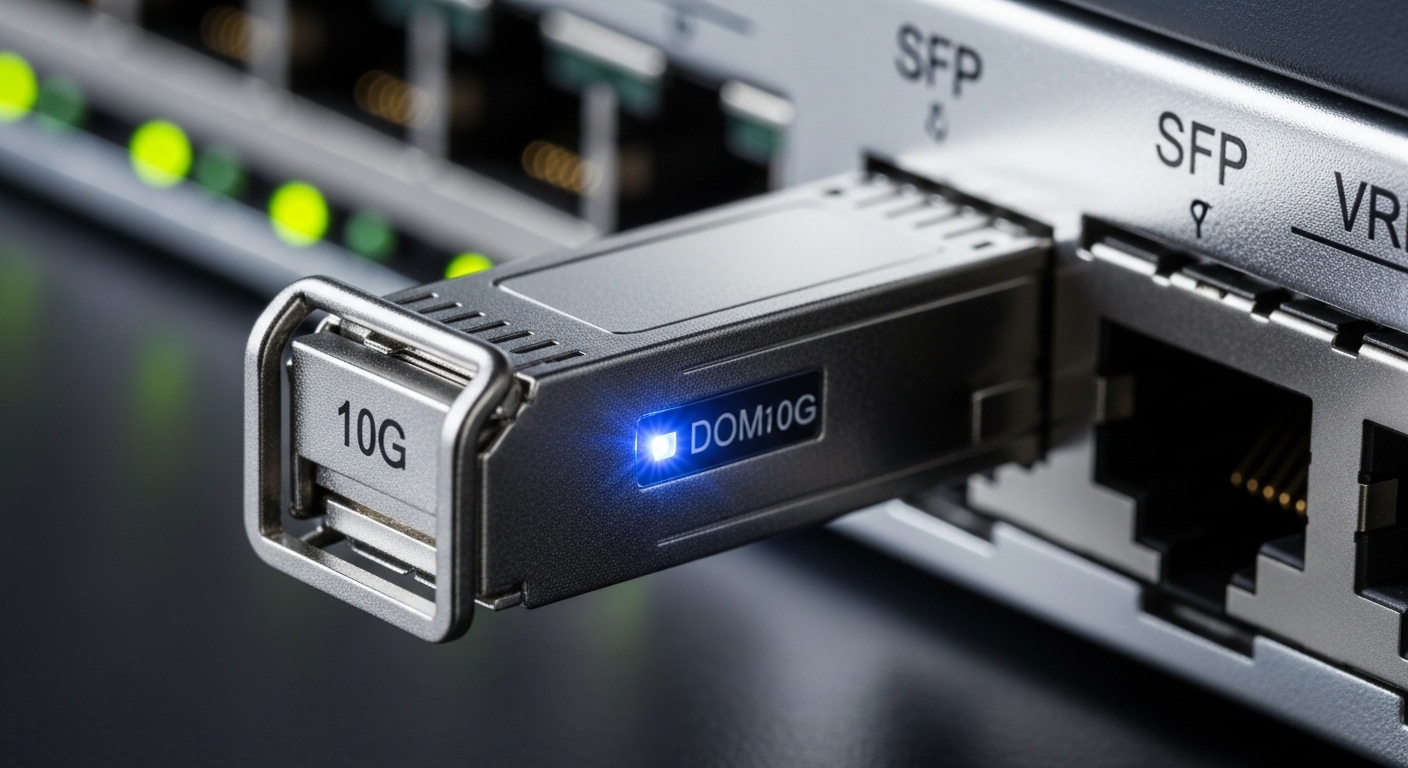
Ruijie switch optics use SFP electrical interfaces defined by IEEE 802.3 for optical link behavior, but the real-world gating factors are usually vendor-specific expectations: EEPROM wiring expectations, DOM signaling, and link timing tolerance during training. A third-party optic can be electrically valid yet rejected if the module ID, diagnostic implementation, or supported speed/laser mode does not align with the port profile.
In field cases, the fastest path is to verify three things before mounting: (1) transceiver type (10G SFP+ vs 25G SFP28), (2) fiber standard (SR for multimode vs LR for single-mode), and (3) DOM behavior (digital diagnostics over I2C). If you skip this, you can end up with a module that is detected but fails auto-negotiation or shows high error counters.
Compatibility checks you can do in minutes
- Match the port speed: Ruijie 10G ports expect SFP+; Ruijie 25G ports expect SFP28. For example, inserting a 25G SFP28 into a 10G-only port may appear “present” but never pass traffic.
- Confirm fiber type: SR optics require multimode fiber (OM3/OM4). LR optics require single-mode (OS2). Using the wrong fiber standard is a classic “it lights but won’t pass” cause.
- Check DOM support: If your Ruijie release monitors temperature and bias current, mismatched DOM can trigger warnings or policy blocks. Look for optics that explicitly support Digital Optical Monitoring.
- Validate wavelength and connector: 850 nm SR uses duplex LC; 1310/1550 nm LR/ER uses duplex LC or sometimes SC depending on adapter strategy.
Pro Tip: When a Chinese switch SFP is “present” but links never stabilize, capture a quick baseline of port counters (CRC, FCS errors, and link flaps) immediately after insertion. If errors start high and stay high even after a clean patch, suspect DOM or laser mode mismatch rather than fiber cleanliness.
Key optics specs that decide reach and stability (SR vs LR, 10G vs 25G)
Optics selection is mostly about three numbers: wavelength, link budget reach, and transceiver power/temperature envelope. For Ruijie deployments, stability is improved when the module matches the port’s intended optics profile and the fiber plant matches the SR or LR standard.
IEEE 802.3 defines optical electrical behavior for Ethernet links, while vendor datasheets define what the module can actually do: typical transmit power, receiver sensitivity, and allowable DOM ranges. Use these to avoid “works on bench, fails in rack” scenarios.
At-a-glance specifications table
Use this table to compare common SFP options you will see in Ruijie-compatible builds. Values below are typical for widely deployed parts; always confirm exact values on the specific datasheet.
| Transceiver class | Data rate | Wavelength | Fiber type | Typical reach | Connector | DOM / diagnostics | Operating temp | Common part examples |
|---|---|---|---|---|---|---|---|---|
| SFP+ SR | 10G | 850 nm | OM3/OM4 multimode | 300 m (OM3) / 400 m (OM4) | Duplex LC | Digital (I2C-based) | 0 C to 70 C (commercial) or -40 C to 85 C (industrial) | Cisco SFP-10G-SR, Finisar FTLX8571D3BCL, FS.com SFP-10GSR-85 |
| SFP+ LR | 10G | 1310 nm | OS2 single-mode | 10 km | Duplex LC | Digital (I2C-based) | 0 C to 70 C or -40 C to 85 C | Finisar 10G LR family, generic 1310 nm LR SFP+ with DOM |
| SFP28 SR | 25G | 850 nm | OM4 multimode (often required) | 100 m (typical for many OM4 builds) | Duplex LC | Digital (I2C-based) | 0 C to 70 C or -40 C to 85 C | Common 25G SR SFP28 modules with DOM |
| SFP28 LR | 25G | 1310 nm | OS2 single-mode | 10 km (common) | Duplex LC | Digital (I2C-based) | 0 C to 70 C or -40 C to 85 C | 25G LR SFP28 with DOM |
When you buy a Chinese switch SFP for Ruijie, the table becomes a contract: make sure the wavelength and fiber standard match your patch panel labeling and your OM4 vs OM3 inventory. Also confirm the temperature grade suits your rack airflow; a commercial module in a hot frame can drift and increase error rates over time.
Real deployment: Ruijie leaf-spine with 10G SR and mixed vendor optics
In a 3-tier data center leaf-spine topology with 48-port 10G ToR switches, each leaf used 24 uplinks at 10G SR over OM4 to a spine fabric. The environment ran at 25 C to 30 C ambient in cold aisle, but the top-of-rack zones reached 38 C during peak load because of constrained airflow. During a maintenance window, a batch of Chinese switch SFP modules was installed to replace aging inventory on 12 leaf uplink ports.
Within 15 minutes, 3 ports showed intermittent link drops. The root cause was not the transceiver model itself; it was a mismatch in DOM behavior: the modules were detected, but the diagnostic readout returned out-of-range values during temperature transitions, triggering an internal alarm policy. After switching those three ports to optics with known DOM compliance and matching temperature grade, the link flaps disappeared and CRC counters returned to baseline.
Selection criteria checklist for Chinese switch SFP on Ruijie
Use this ordered checklist when you are deciding between OEM optics and third-party Chinese switch SFP modules. It is designed for fast procurement-to-install decisions and includes the operational details that matter after the first week.
- Distance and fiber type: Choose SR for OM3/OM4 and LR for OS2. Measure planned distance from patch panel to transceiver, not just cable length.
- Switch compatibility profile: Confirm the module class matches the Ruijie port speed and expected transceiver type (SFP+ vs SFP28). Avoid mixing generations.
- DOM and diagnostics behavior: Prefer modules explicitly supporting Digital Optical Monitoring and reporting temperature/bias/power in expected ranges for your monitoring stack.
- Optics wavelength and coding: 850 nm modules must pair with 850 nm receivers; 1310/1550 nm must match. Also verify coding options if the vendor advertises them.
- Operating temperature: Match the module grade to rack conditions. If your measured inlet air is regularly above 35 C, consider industrial grade (-40 C to 85 C) modules.
- Switch firmware and policy: Some Ruijie releases enforce optic allowlists or stricter diagnostics thresholds. Test a small batch before scaling.
- Vendor lock-in risk and warranty path: OEM optics may be pricier, but the failure replacement process can be faster. Third-party can reduce cost but may increase downtime during RMA.
If you need an authority reference for the baseline Ethernet optical behavior, consult IEEE 802.3 for the physical layer requirements, and the vendor datasheets for each optic family. [Source: IEEE 802.3] and [Source: SFP module vendor datasheets such as Cisco and Finisar]
Common mistakes and troubleshooting tips (what actually goes wrong)
Field failures often cluster into a few predictable categories. Below are concrete mistakes with root causes and solutions that have shown up during rollouts and replacements.
“Module detected, no link” after installing a Chinese switch SFP
Root cause: Wrong transceiver class for the port (SFP28 vs SFP+ or SR vs LR). Some platforms detect the module but do not complete the optical training.
Solution: Confirm the Ruijie port speed profile and replace with the exact class. Verify wavelength and fiber standard against patch panel labeling.
Link flaps only under load
Root cause: Thermal drift or marginal fiber plant (micro-bends, dirty connectors) that worsens when transceiver temperature rises and the receiver margin shrinks.
Solution: Clean connectors with lint-free wipes and isopropyl alcohol where allowed, re-seat LC ends, and inspect patch cords for kinks. If the problem persists, upgrade optics to industrial temperature grade.
High CRC/FCS errors with stable link state
Root cause: Transmit power too low, receiver sensitivity mismatch, or DOM-driven alarm policies that correlate with weak optical levels.
Solution: Check DOM reported optical power and compare to datasheet expected ranges. If DOM looks abnormal, swap to a known-good module and verify the receiver optical budget with a fiber tester.
DOM warnings or “diagnostics not supported” messages
Root cause: DOM implementation mismatch. Some third-party optics report fields differently; Ruijie monitoring may interpret values as out-of-spec.
Solution: Select optics that explicitly support Digital Optical Monitoring and have documented compatibility with Ruijie-style diagnostics. Validate with a small pilot batch before full rollout.
Cost and ROI note: OEM vs Chinese switch SFP economics
In practice, OEM optics for enterprise switches often cost more upfront, but they can reduce operational risk through tighter compatibility testing and faster RMA handling. Third-party Chinese switch SFP modules commonly offer lower acquisition cost, yet the total cost depends on failure rate, swap labor, and the time you spend diagnosing “present but no link” events.
A realistic budgeting pattern: if OEM modules are roughly 1.5x to 2.5x the price of third-party options, the ROI hinges on downtime tolerance. If your site can tolerate a short maintenance window for pilot testing and you have fast spares, third-party can win on TCO; if not, OEM may be cheaper once you factor technician time and potential service-impact penalties.
Also account for power and cooling indirectly: stable optics reduce link renegotiations and packet loss, which reduces retransmits and CPU overhead. While the watt-level difference between good modules is usually modest, the operational stability benefit is tangible.
FAQ
Which Chinese switch SFP works best with Ruijie 10G ports?
For Ruijie 10G ports, start with SFP+ SR at 850 nm for OM3/OM4 or SFP+ LR at 1310 nm for OS2. Ensure the module includes Digital Optical Monitoring if your monitoring stack expects temperature and optical power fields.
Can I use an SFP28 Chinese switch SFP in a 10G Ruijie port?
It depends on the port’s optics support, but it often fails link training or never reaches a stable state. The safe rule is to match the port speed: SFP+ for 10G and SFP28 for 25G.
How do I verify DOM compatibility before scaling to dozens of ports?
Install a small pilot set, then check Ruijie port diagnostics for DOM warnings and compare reported optical power and temperature against the module datasheet expectations. If DOM fields look abnormal during thermal changes, swap those modules before expanding the rollout.
What is the most common reason a link stays down after inserting a new SFP?
Wrong transceiver class or wrong fiber standard (SR vs LR) is the top cause. A close second is dirty or damaged LC connectors that reduce optical margin enough to prevent stable reception.
Are there safety concerns with using non-OEM Chinese switch SFP modules?
Optics are generally safe when they meet Class 1 laser safety requirements, but compatibility and diagnostic behavior vary. Buy from reputable vendors with datasheets, DOM support, and a clear warranty/RMA process.
What should I collect during troubleshooting for faster RMA?
Capture port state transitions, CRC/FCS error counters, and any DOM diagnostic readings. Also note the exact module part number, serial label, and fiber patch cord details so the vendor can replicate conditions.
Choosing a Chinese switch SFP for Ruijie is less about “it detects” and more about matching speed class, fiber standard, and DOM expectations under real thermal conditions. Next, review fiber optic transceiver selection by reach and standards to align your optics plan with your cabling inventory.
Author bio: I design and troubleshoot high-availability Ethernet transport for enterprise data centers, focusing on optics compatibility, monitoring, and failure-mode reduction. I have deployed mixed-vendor transceiver fleets in leaf-spine fabrics and use measured link margins to prevent outages.
