
When a PTZ camera drops frames or goes dark at the edge of a site, the cause is often not the camera at all, but the fiber transport. This article helps field engineers and surveillance integrators choose the right CCTV fiber module for long-distance IP camera links using SFP transceivers, including compatibility, optical reach, and practical troubleshooting. You will also get a decision checklist, a head-to-head comparison of common module types, and a short set of failure modes that show up in real installs.
Link performance: SFP multimode vs single-mode reach for CCTV
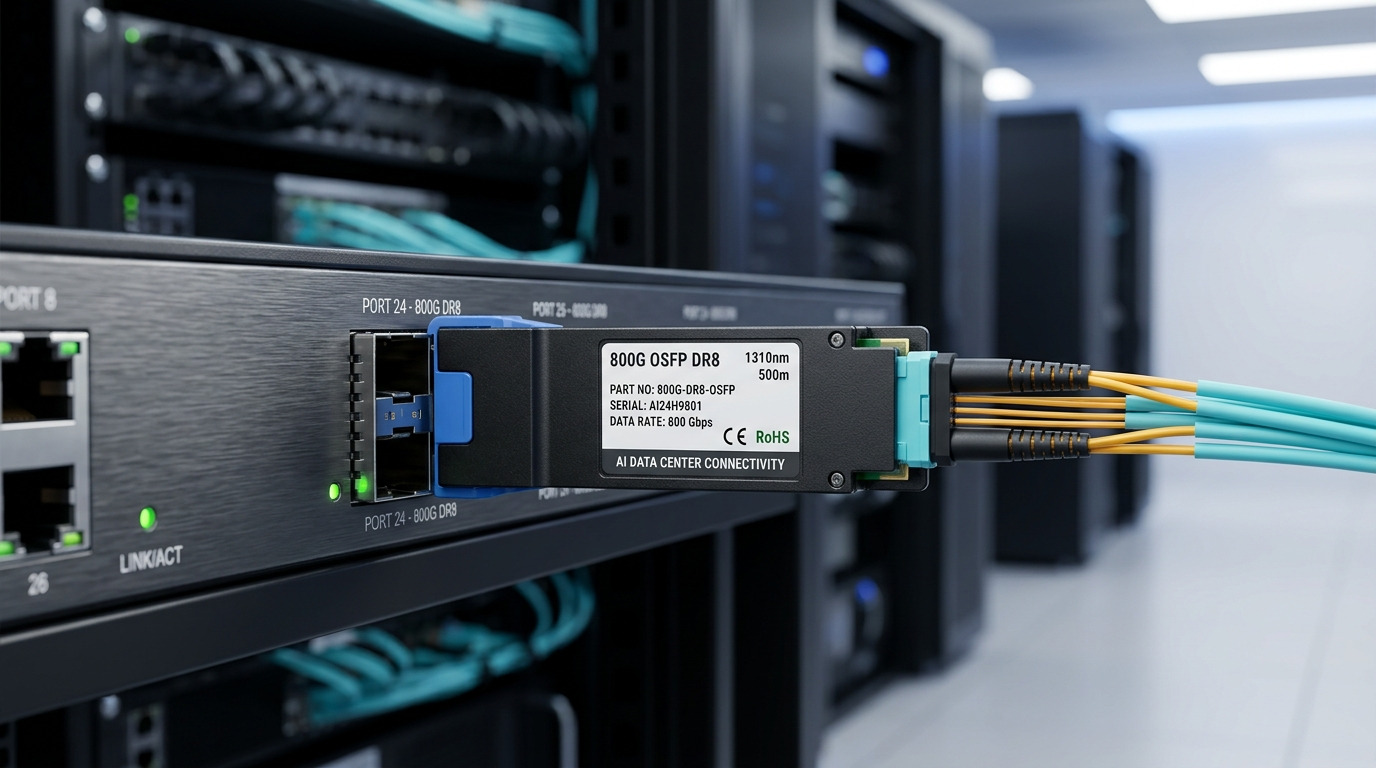
In surveillance networks, the transceiver must carry Ethernet reliably while meeting optical power and link budget limits. For SFP-based camera links, the common patterns are 10G SR over multimode fiber (typically short reach) and 1G/2.5G/10G variants over single-mode for longer spans. The IEEE 802.3 family defines electrical and optical behavior for Ethernet PHYs, while vendor datasheets define optical specifications such as wavelength, receiver sensitivity, and DOM options. A practical rule: if your camera run exceeds the rated reach for the fiber type you have in place, you will need to change either fiber type or transceiver class.
| Spec | Typical CCTV SFP over Multimode (SR) | Typical CCTV SFP over Single-Mode (LR/LX/ZX) |
|---|---|---|
| Wavelength | 850 nm (MMF SR) | 1310 nm (SMF LR) or 1550 nm (SMF long) |
| Connector | LC | LC |
| Reach (typical) | Up to ~300 m (1G) or ~400 m–~400 m class (10G, varies by optics and OM) | ~10 km (1G/10G LR class) to ~40 km (ZX class, varies by vendor) |
| Data rate | 1G, 10G (depends on camera switch design) | 1G, 10G (depends on camera uplink) |
| DOM | Common; check vendor support | Common; verify switch compatibility |
| Operating temperature | Commercial or industrial grades; verify range | Often industrial options for outdoor cabinets |
Optically, multimode SR transceivers rely on modal bandwidth of OM3/OM4 fiber, and performance drops when you mix fiber grades or use dirty connectors. Single-mode LR/LX/ZX transceivers tolerate longer distances because chromatic dispersion and modal effects are far less limiting. Field reality: even when the spec sheet says “works,” improper fiber cleaning can knock receiver margin below the minimum sensitivity needed for error-free Ethernet.
Pro Tip: Before you blame the camera, measure received optical power at the switch side (or use a certified optical power meter). If the link is marginal, you can often restore stability by cleaning LC connectors and re-terminating only the affected patch panel—without swapping the CCTV fiber module.
Use-case fit: head-to-head for long camera corridors and outdoor cabinets
Consider a 3-tier surveillance build in a logistics yard with 48 IP cameras: 24 cameras on exterior gatehouses, 16 along a loading corridor, and 8 inside a warehouse. The integrator uses a pair of 10G uplinks from a top-of-rack PoE switch to an edge aggregation closet, with camera uplinks at 1G. Exterior runs average 6 km of existing single-mode fiber in underground conduit, while the corridor runs average 250 m over multimode patching. In this environment, SR over multimode is cost-effective for the short corridor, but LR over single-mode is the only sane option for the gatehouses unless you plan a fiber replacement program.
If your cameras are clustered in a small footprint, multimode SR can reduce transceiver cost and spare inventory complexity. If your site has distributed poles, long perimeter fencing, or multi-building campuses, single-mode LR/LX/ZX typically wins on reach and operational resilience. The trade-off is that long-reach optics are more sensitive to connector quality and require disciplined handling in outdoor cabinets where temperature cycles and dust are constant.
Compatibility and interoperability: SFP standards, switch behavior, and DOM
Most CCTV fiber modules marketed for Ethernet surveillance are SFP transceivers that implement the relevant optical interface behavior defined by IEEE 802.3 for the Ethernet PHY rate. However, practical compatibility is driven by your switch platform’s transceiver support matrix and whether it accepts vendor-specific EEPROM “identifier” values. Digital Optical Monitoring (DOM) is common in modern optics; some switches read temperature, laser bias current, and received power, while others ignore it or log alarms. Always confirm that your exact module part number is supported by the model of your PoE switch, edge router, or media converter.
What to verify before you order
- Data rate match: Ensure the camera switch port and SFP both support the same Ethernet speed (for example, 1000BASE-LX vs 10GBASE-LR).
- Fiber type: Multimode SR requires OM3/OM4 characteristics; single-mode optics require SMF.
- Connector type: LC is typical; confirm your patch panels are LC and that ferrules are clean.
- DOM behavior: Validate alarm thresholds and whether the switch flags “unsupported DOM.”
- Vendor lock-in risk: Third-party optics can be fine, but confirm warranty terms and field return rates.
For reference, see vendor datasheets for specific models such as Cisco SFP-10G-SR, Finisar FTLX8571D3BCL, and FS.com SFP-10GSR-85, and cross-check against your switch’s optics compatibility list. For baseline Ethernet behavior, consult [Source: IEEE 802.3] and the optic interface guidance in vendor engineering notes. IEEE 802.3
Cost and ROI: buying the right module without paying for outages
Typical street pricing varies by speed, reach, and DOM features. As a rough field range: commercial 1G SR/LR optics often sit in the tens of dollars, while 10G LR/ZX class modules can climb into the low hundreds. OEM modules frequently cost more, but they reduce compatibility uncertainty with enterprise switch platforms. Third-party modules can cut upfront cost, yet they may increase operational risk if your switch is strict about EEPROM identification or if DOM alarms create false maintenance tickets.
ROI is not only purchase price. A single truck roll to re-seat or swap a misbehaving CCTV fiber module can exceed the difference between OEM and third-party optics. TCO also includes spares stocking: if you deploy both SR and LR, you may want at least 1–2 pre-staged spares per site type, especially when cameras are monitored 24/7 and maintenance windows are rare.
Selection criteria checklist: how engineers decide in the field
- Distance and fiber type: Compare run length to the module’s rated reach for your exact fiber grade.
- Budget and lifecycle risk: Balance purchase cost vs expected replacement and truck-roll probability.
- Switch compatibility: Confirm support for the exact SFP family and DOM behavior on your switch model.
- Optical margin: If possible, verify received power and cleanliness; plan for aging and connector drift.
- Operating temperature: For outdoor cabinets, prefer industrial temperature optics and sealed enclosures.
- Vendor lock-in risk: Validate third-party return policies and whether DOM works cleanly.
- Connector and termination quality: LC polish grade, loss per connector, and proper strain relief.
Common mistakes and troubleshooting: why CCTV fiber modules fail
Below are failure modes I have seen repeatedly during commissioning and after seasonal weather changes. Each has a root cause and a direct fix path you can execute without guesswork.
- Mistake: Using multimode SR optics on single-mode fiber (or vice versa).
Root cause: Wavelength behavior and fiber core mismatch prevent proper coupling, leading to link down or high BER.
Solution: Confirm fiber type at the MPO/LC end and label the cable plant; re-terminate if necessary. - Mistake: Dirty LC connectors after field patching.
Root cause: Microscopic dust increases insertion loss, shrinking receiver margin.
Solution: Clean with certified fiber cleaning tools, inspect with an optical microscope, then reseat and re-test. - Mistake: Mismatched speed expectations between camera uplink and switch port.
Root cause: Autonegotiation behavior and PHY capability mismatch can hold the link in a degraded state.
Solution: Set fixed speed/duplex consistently across endpoints or use media converters designed for the camera uplink profile. - Mistake: DOM alarms cause “link management” interventions.
Root cause: Switch thresholds or DOM interpretation differ across platforms and vendors.
Solution: Validate alarm behavior in a staging rack; confirm whether alarms are informational or treated as faults.
Decision matrix: which CCTV fiber module option fits your constraints
| Reader type | Best fit | Why | Watch-outs |
|---|---|---|---|
| Small site, short runs (under a few hundred meters) | Multimode SR SFP | Lower cost and simple logistics | Requires correct OM3/OM4 and clean connectors |
| Campus or perimeter with kilometers of distance | Single-mode LR/LX SFP | Reach and operational stability | Verify SMF availability and connector polish |
| Strict switch platform with DOM monitoring | OEM or fully validated third-party | Compatibility confidence | Higher upfront cost; still clean optics |
| Integrator optimizing BOM cost across many sites | Validated third-party modules | Better unit economics | Test on each switch model; track returns |
Which Option Should You Choose?
If your camera runs are mostly short and your fiber plant is correctly built for multimode, choose a multimode SR CCTV fiber module to keep spares and procurement simple. If you are spanning multi-kilometer distances across buildings, poles, or outdoor corridors, choose a single-mode LR/LX SFP family and invest time in connector cleanliness. For strict enterprise surveillance switches with active DOM monitoring, prioritize OEM or a third-party module explicitly validated for your switch model.
[[IMAGE:Clean engineering illustration comparing multimode and single-mode light paths through
