
When your AI cluster moves from pilot to production, the bottleneck is rarely compute; it is interconnect reliability under tight power and cooling budgets. This article helps network and field engineers choose an 800G OSFP transceiver AI for leaf-spine and spine-core links, with practical checks for switch compatibility, optical reach, and diagnostics. You will also get troubleshooting patterns from real installs, plus a cost and ROI view that reflects total cost of ownership.
What “800G OSFP transceiver AI” means in real fabrics
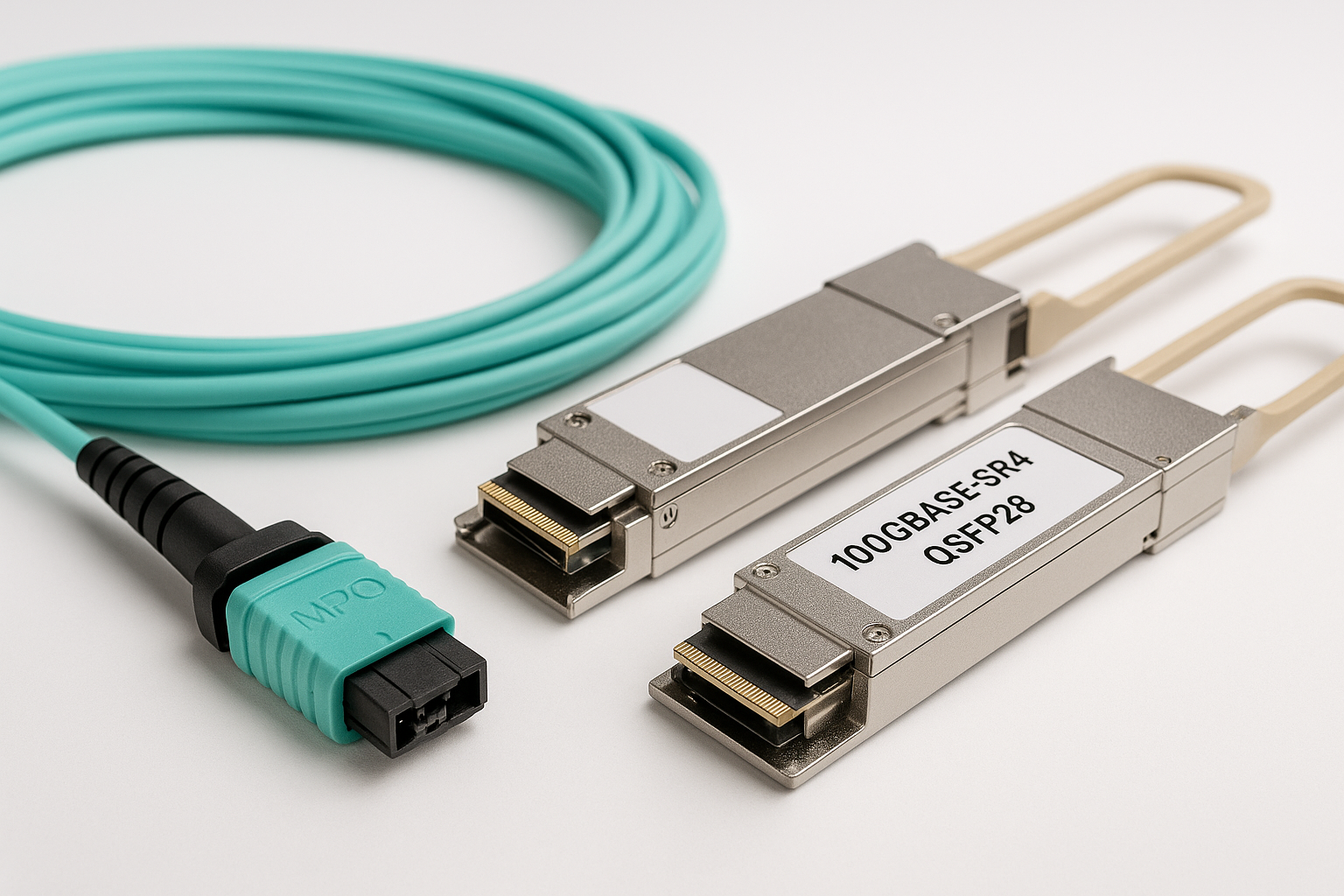
An 800G OSFP transceiver AI is an optical pluggable module designed for high-density Ethernet transport (commonly 800G-class line rates) in data centers. OSFP form factor supports high power and high port density, so optics must match your switch port electrical interface, lane mapping, and forward error correction expectations. In deployed AI fabrics, engineers often pair these modules with 800G-capable switches and structured cabling or parallel optics depending on reach.
In practice, you will see two common operational patterns: (1) short-reach links within the same row or pod (often using OM4/OM5), and (2) extended-reach links across larger footprints where fiber routing is less predictable. Your choice should be driven by measured link budgets, expected temperature swings, and switch vendor interoperability guidance.
OSFP vs QSFP-DD800: where compatibility surprises happen
Although both are used in 800G-class deployments, OSFP and QSFP-DD800 are not generally interchangeable. The physical form factor, keying, management interface behavior, and sometimes the port-side signal conditioning differ by platform vendor. Before ordering, confirm the exact transceiver part number is listed as supported by your switch model and software release.
For external reference on Ethernet physical layer expectations, see IEEE Ethernet standards discussions and vendor guidance. IEEE 802.3 overview
800G OSFP reach, optics class, and key specs you must verify
Engineers often start with “reach,” but the real decision is whether the module meets your optical link budget across worst-case conditions (aging, connector loss, temperature drift). For AI data centers, the most common issue is not that the transceiver is “bad,” but that the cabling plant or patching loss is worse than modeled.
Below is a practical comparison of common 800G OSFP-style optics families you will encounter. Exact values vary by vendor and part number; always use the specific datasheet for your ordered SKU.
| Spec | 800G OSFP SR (short reach, OM4/OM5) | 800G OSFP LR/ER (longer reach) | Notes for QSFP-DD800 (if used) |
|---|---|---|---|
| Typical wavelength | Multi-lane parallel optics (commonly around 850 nm) | Single/multi-lane long wavelength (commonly 1310 nm class) | Varies by module family; not form-factor compatible |
| Typical reach class | ~70 m to ~100 m on OM4/OM5 depending on spec | ~1 km to ~10 km depending on design | Confirm exact mapping to your port plan |
| Connector | Commonly MPO/MTP for parallel optics | Typically LC or MPO depending on architecture | Connector type still must match harness |
| Power (typical) | Often high; budget for tens of watts per module | Often higher or similar depending on optics type | Check platform power envelope |
| DOM support | Temperature, bias, received power, alarms | Same categories; exact thresholds vary | DOM behavior differs by vendor |
| Operating temperature | Commercial or industrial grades; cold-airflow impacts margin | Same; long-reach may be less tolerant of poor airflow | Match your aisle and cabinet profile |
What to measure before you trust the “reach” headline
Plan to verify: (1) fiber type (OM4 vs OM5), (2) patch panel loss and number of mated connectors, (3) MPO polarity and lane mapping, and (4) whether the switch transceiver diagnostics show margin. Use an OTDR or qualified cabling tester results to validate that your measured insertion loss stays within the module’s specified limits.
Pro Tip: In dense AI racks, the biggest real-world reach killer is often MPO/MTP polarity and patch cord swapping, not the transceiver optics. Train teams to validate lane mapping with a polarity kit and verify received optical power alarms after first link bring-up.
Deployment scenario: leaf-spine AI pod with 800G OSFP links
Consider a 3-tier data center leaf-spine topology supporting AI training. You deploy 48-port leaf switches with 800G uplinks, using 800G OSFP transceivers for ToR-to-spine and, in some cases, spine-to-core. In one rollout, each leaf has 8 uplinks at 800G, and the fabric uses four pods interconnected with short-reach optics inside the pod footprint. The cabling team provisions OM5 trunks and patching with strict MPO polarity rules, while the network team monitors DOM alarms and error counters during burn-in.
Operationally, you should expect link bring-up to succeed initially but drift under thermal stress if airflow is blocked. In field troubleshooting, we have seen received power fall below vendor threshold after a door or blanking panel was left off, causing localized overheating near the OSFP cage. The fix was not a transceiver replacement; it was restoring airflow and re-checking optical power telemetry.
Selection criteria checklist for 800G OSFP transceiver AI
Use this ordered checklist to reduce integration cycles and avoid expensive re-cabling. If you cannot answer a line item with evidence (datasheet, switch vendor compatibility list, or lab test results), pause procurement.
- Distance and fiber plant reality: verify OM4/OM5 type, patch cord count, and measured insertion loss. Do not rely on “max reach” marketing claims.
- Switch compatibility: confirm the transceiver SKU is supported on your exact switch model and software version. Check vendor interoperability lists and release notes.
- Electrical interface and lane mapping: ensure the port supports the transceiver type and expected lane configuration (critical for MPO polarity).
- DOM support and telemetry validation: confirm you can read temperature, bias current, and receive power via your network management interface and that alarms integrate with your monitoring stack.
- Operating temperature and airflow: validate that your cabinet airflow meets the module grade (commercial vs industrial) and that there is no recirculation near OSFP cages.
- DOM authenticity and vendor lock-in risk: evaluate OEM-only policies vs third-party acceptance, and confirm your auditing and RMA process does not block replacements.
For standards context on Ethernet PHY behavior and link requirements, consult IEEE Ethernet documentation and vendor datasheets. IEEE 802 overview
Common mistakes and troubleshooting patterns
The following failure modes show up repeatedly in AI data centers where 800G OSFP transceiver AI modules are installed at scale.
Link flaps or stays down after initial insertion
Root cause: MPO/MTP polarity mismatch or reversed patch cord orientation causes lane-level receive failures. Solution: verify MPO polarity using a polarity tester kit, re-terminate or swap the patch cords, and confirm received optical power in DOM after each change.
High error counters under load even though link is “up”
Root cause: optical power margin is too tight due to excess patch loss, dirty connectors, or fiber microbends. Solution: clean connectors with lint-free swabs and approved cleaning fluid, re-measure insertion loss, and check for threshold alarms in transceiver telemetry.
Thermal throttling symptoms, alarms, or intermittent drops during peak cooling cycles
Root cause: insufficient airflow, blocked baffles, or door misalignment increases module temperature beyond spec. Solution: restore cabinet airflow path, verify fan tray operation, and compare module DOM temperature against the datasheet operating range.
“Supported by switch” mismatch that only fails after upgrade
Root cause: software upgrade changes transceiver compatibility checks or thresholds. Solution: validate transceivers against the post-upgrade software release, and test a small canary set before fleet-wide rollout.
Cost and ROI note: what drives total cost of ownership
In production AI deployments, the cost of an 800G OSFP transceiver AI is only part of TCO. Typical street pricing varies widely by vendor, reach class, and whether you buy OEM vs third-party. As a practical range, engineers often see OEM short-reach modules priced roughly from $1,000 to $2,500 each, while third-party modules may be lower but still require compatibility validation and a reliable RMA path.
ROI comes from two places: (1) minimizing downtime and truck rolls by selecting modules with stable DOM telemetry and predictable thresholds, and (2) reducing power and cooling overhead by matching the module’s real power draw to your platform budget. If a module causes marginal optical performance that increases retransmissions or triggers frequent service actions, the “cheaper” option can become more expensive within a year.
FAQ: 800G OSFP transceiver AI buying questions
What fiber type should I plan for with an 800G OSFP transceiver AI?
For short-reach use cases, most deployments target OM4 or OM5 with MPO/MTP cabling. For longer reach, you may move to long-wavelength optics that use different fiber and connector types. Always confirm the exact reach and connector requirements in the module datasheet and validate with measured link loss.
Can I mix OSFP and QSFP-DD800 transceivers on the same switch?
Electrically and mechanically, they are different form factors and are not generally interchangeable. Some switches may support both types on different ports, but the safest assumption is that you must use the transceiver type specified for each port. Verify the switch model’s compatibility list per port type.
How do I confirm DOM alarms are usable in monitoring?
After first bring-up, read DOM fields for temperature, bias, and received optical power through your management interface. Then generate a controlled fault (for example, using a calibrated attenuator or verified disconnect) to confirm the alarm state transitions and that alerts route into your monitoring system. This prevents “silent degradation” scenarios.
What is the most common reason 800G links fail after installation?
In many real rollouts, the most common issue is MPO polarity or patch cord errors, leading to lane-level receive failures. A secondary cause is excess insertion loss from patch panels or dirty connectors, which can pass link training but fail under load.
Is third-party 800G OSFP optics a safe cost-saving move?
It can be, but treat it as a compatibility project, not a drop-in commodity purchase. Validate against your switch model and software version, confirm DOM behavior, and ensure RMA turnaround meets your operational timelines. If you cannot test in a staging environment, risk increases.
Which operational checks should I run during a burn-in?
Track DOM temperature and received power trends, and monitor link error counters and packet loss under realistic AI traffic patterns. Run the burn-in through peak cooling cycles to catch airflow-related margin loss. Document the baseline so that later replacements can be compared quickly.
Choosing an 800G OSFP transceiver AI is a disciplined process: match reach to measured fiber loss, confirm switch compatibility, and validate DOM telemetry and thermal margins. Next, review your platform’s transceiver support policy and cabling test methodology using AI data center transceiver compatibility and testing to reduce integration risk.
Author bio: I have deployed high-density optical networks for AI clusters, including 800G-class fabrics, and I troubleshoot DOM telemetry, MPO polarity, and thermal margin issues in live data centers. My work focuses on measurable link budgets, repeatable acceptance testing, and practical ROI for optical procurement.
