
800G Optical vs 400G Aggregation for AI data center networking: a field guide
In modern AI data center networking, every watt and every millisecond matters, especially when you scale from 100G tiers to leaf-spine fabrics and beyond. This article helps network architects and field engineers decide between native 800G optical transceivers and 400G aggregation strategies (often paired with higher port counts). You will get a technical comparison, a selection checklist, common failure modes, and deployment guidance grounded in real switch and transceiver constraints.
800G transceivers vs 400G aggregation: what changes at the physical layer
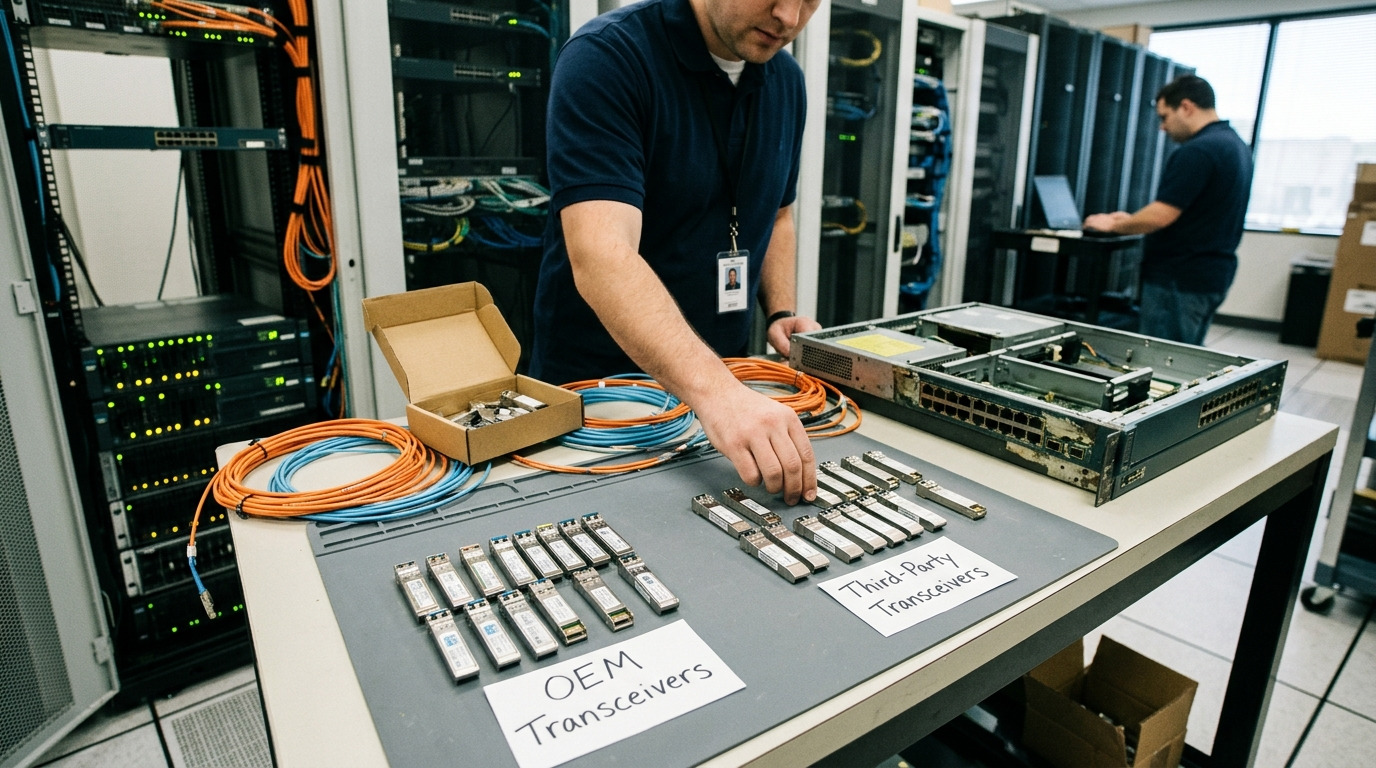
The core difference is how you map client bandwidth onto switch optics and how you manage optical reach, lane counts, and signal integrity. An 800G optical transceiver typically uses parallel optics and higher lane density (commonly via PAM4-based electrical/optical signaling depending on the vendor implementation). In contrast, 400G aggregation splits the same total throughput into fewer or more physical links, which changes oversubscription behavior and can alter buffer and scheduling pressure in the switching ASIC.
Latency and serialization: why “fewer links” can still be slower
Engineers often assume that fewer, larger links always reduce latency. In practice, the end-to-end latency is dominated by switch pipeline depth, congestion control, and queueing under load, not just serialization. If 800G optics force a different scheduling mode or require distinct ASIC lane configurations, you may see unexpected microbursts. Meanwhile, 400G aggregation can increase hop count only if it changes how you route traffic across spines, but it can also reduce congestion by distributing flows across more physical paths.
Optical reach and signal margin: where the math bites
For short-reach AI fabrics, the reach target is often within 100 m multimode fiber or short spans on single-mode depending on transceiver type. But lane count and modulation format impact the required optical power budget and receiver sensitivity. If you are using OM4 or OM5 multimode, the differential mode delay and modal bandwidth limits can become the hidden constraint, particularly when connector cleanliness or patch panel losses drift over time. For single-mode, you must also consider chromatic dispersion tolerance and end-to-end loss including splices.
Pro Tip: In AI data center networking, the fastest way to avoid “mystery link flaps” is to validate optical budgets with a measurement you trust. Vendor DOM thresholds are helpful, but they do not replace real fiber inspection and a live optical power reading at commissioning and after any patch-panel rework.
Performance comparison that matters: reach, power, temperature, and optics type
Below is a practical comparison framework for engineers evaluating 800G optics versus a 400G aggregation approach. Because vendors implement different optical interfaces and lane mappings, you should treat the numbers as selection anchors rather than universal constants. Always confirm with your exact transceiver part numbers and your switch vendor compatibility matrix.
| Spec category | 800G short-reach optics (typical) | 400G aggregation (typical) |
|---|---|---|
| Data rate | 800G per port | 2 x 400G or 4 x 200G equivalent |
| Wavelength / band | Often multimode (850 nm class) for SR; SM for LR variants | Often multimode (850 nm class) for SR; SM for LR variants |
| Connector type | Commonly MPO/MTP (12-fiber or higher density) depending on module | MPO/MTP per 400G module; patching may increase connector count |
| Reach target | SR typically designed for ~100 m on OM4/OM5 (vendor-dependent) | Similar per-module SR reach; system reach may degrade with extra interconnects |
| Optical power / sensitivity | Vendor-specific; higher lane density tightens margin sensitivity | Each 400G module has its own margin; aggregation can localize faults |
| Transceiver electrical power | Often higher per module; may be competitive per Gb/s depending on platform | Can be lower per module; total power depends on whether you need more ports |
| Operating temperature | Commonly 0 to 70 C for standard; extended variants exist | Commonly 0 to 70 C for standard; extended variants exist |
| DOM support | Usually compliant with digital optical monitoring (vendor implementation) | Same; aggregation provides more telemetry points |
For concrete reference, many SR 800G ecosystems are aligned with QSFP-DD or OSFP-style physical form factors in vendor ecosystems, while 400G frequently uses QSFP-DD or CFP2 variants depending on generation. If you are comparing specific parts, cross-check examples such as Cisco SFP-10G-SR is not directly comparable in form factor, but it illustrates how SR sensitivity and OM reach are tied to vendor calibration. For 25G SR optics, Finisar FTLX8571D3BCL and FS.com SFP-10GSR-85 show how reach and DOM thresholds vary by vendor tuning; the same principle applies to 400G and 800G despite different speeds and lanes.
Compatibility: DOM, lane mapping, and switch port constraints
Compatibility is often the deciding factor in AI data center networking because optics are not universally interchangeable across platforms. Even when two modules both claim “SR” and “MPO,” the switch may require specific lane mapping, polarity handling, or supported temperatures and firmware thresholds. Field failures frequently trace back to a mismatch between the switch’s expected electrical interface and the transceiver’s actual lane configuration.
DOM and thresholds: what to verify before rollout
Digital optical monitoring (DOM) typically exposes laser bias current, received optical power, and temperature. Your switch should read these registers successfully and apply link bring-up rules accordingly. If DOM is unsupported or partially supported, the switch might enter a conservative mode that reduces link speed or disables the port. Before you scale, validate DOM readout using your switch CLI, confirm alarm thresholds, and test with at least one known-good patch cord set.
Polarity and MPO harnessing: how topology becomes a fiber problem
Polarity errors are a top cause of intermittent link failures, especially with high-density MPO harnesses. In 800G optics, a polarity mismatch can corrupt multiple lanes simultaneously, leading to unstable training and repeated link resets. In 400G aggregation, polarity mistakes can still occur, but failures may appear localized to one module or one side of the pair, which can make troubleshooting faster.
Cost and ROI: module price, port density, and total cost of ownership
Pricing for 800G optics is highly vendor- and form-factor-dependent, but budget planning generally follows a pattern: 800G modules cost more per unit than a single 400G module, yet the system may require fewer ports for the same aggregate bandwidth. ROI comes from the balance between module cost, switch line-card selection, cooling power, and downtime risk. In practice, the biggest hidden TCO lever is whether you can avoid re-cabling and re-qualifying optics after rack refreshes.
What engineers typically model in spreadsheets
Teams usually model three cost buckets: optics CAPEX (module plus spares), infrastructure CAPEX (line cards, patch panels, harnesses), and OPEX (power, maintenance labor, and failure response). For example, if an 800G design reduces the number of required ports by half, you may save on line card capacity upgrades, but you might pay more for each optics module and for spares that match the exact part number. Third-party optics can reduce CAPEX but may increase operational risk if your switch firmware has compatibility edge cases.
Realistic price ranges vary by market and volume, but a common planning assumption is that an SR 800G optics can cost several times a single SR 400G optics module, while the aggregate per-Gb/s cost may be closer depending on port density and harness complexity. TCO improves when you can standardize on one DOM-compatible vendor family and keep spares aligned with the same optical type and wavelength class.
Selection criteria checklist: choosing the right option for AI data center networking
Use this ordered checklist during design review. It is designed to surface the constraints that usually decide the outcome after lab testing and before mass deployment.
- Distance and fiber type: Confirm SR vs LR needs, fiber grade (OM4/OM5 vs single-mode), and measured end-to-end loss including connectors and splices.
- Budget and port density: Determine whether your switch platform can populate enough ports; compare total optics count and harness complexity.
- Switch compatibility: Verify transceiver part numbers against the switch vendor compatibility guide for your exact model and firmware version.
- DOM and alarm behavior: Ensure DOM reads correctly and that your monitoring stack supports the telemetry fields and alarm thresholds.
- Operating temperature and airflow: Model worst-case inlet temperatures; verify module temperature ratings and derating behavior if applicable.
- Vendor lock-in risk: If you use a third-party optics strategy, confirm your ability to source spares quickly and your history with firmware interactions.
- Operational debugging speed: Decide whether you prefer fewer links (800G) or more telemetry points and fault localization (400G aggregation).
Common mistakes and troubleshooting tips in the field
Below are concrete failure modes seen in AI data center networking rollouts, along with root causes and corrective actions.
Link training loops after patch-panel changes
Root cause: MPO polarity mismatch or incorrect harness mapping (lane order reversal). High-density 800G optics can fail across many lanes simultaneously, triggering repeated training. Solution: Inspect MPO polarity, verify correct orientation markers, and re-test with a known-good polarity reference set. If your harness uses polarity adapters, confirm they match the intended lane direction.
Intermittent CRC errors that correlate with temperature spikes
Root cause: Optical power margin is too tight for the real installed fiber and connector condition, and thermal changes push the receiver near sensitivity limits. Solution: Measure received optical power at the switch DOM interface under load, compare against vendor-recommended thresholds, and clean or replace suspect connectors. If margin is consistently low, re-terminate or shorten the patch path.
“Compatible” optics that silently run in a reduced mode
Root cause: Switch firmware may support the transceiver type but not the exact configuration or lane mapping for your port. The link may come up but with reduced speed or degraded FEC settings. Solution: Confirm negotiated speed and FEC mode via switch telemetry, then update optics qualification lists and firmware. For a controlled test, deploy a single known-good module from your approved inventory and compare negotiated parameters.
DOM alarms ignored until after capacity crunch
Root cause: Monitoring thresholds are not integrated into incident workflows, so early warnings (rising temperature, bias current drift, or falling optical power) do not trigger maintenance. Solution: Add DOM alarm routing to your alerting system and define runbooks for cleaning, reseating, or swapping optics. Treat DOM trends as leading indicators, not just status flags.
Which option should you choose?
The right answer depends on your constraints. If you are building a dense AI fabric where port count is scarce and your fiber plant is already proven, native 800G optical transceivers can reduce cabling complexity and simplify link management. If you need faster fault isolation, higher path redundancy at the optical component level, or you are still stabilizing firmware and compatibility across multiple line-card revisions, 400G aggregation is often operationally safer.
Clear recommendations by reader type
- AI data center networking architects: Prefer 800G when your switch platform supports it cleanly and your fiber plant has measured margins; otherwise pilot with 400G aggregation to de-risk compatibility.
- Field deployment engineers: Choose the option that matches your team’s troubleshooting workflow and spare strategy; 400G can localize faults faster, while 800G can reduce harness count.
- Operations and SRE teams: If monitoring maturity is high and DOM telemetry is integrated, 800G is manageable; if not, 400G provides more observable link endpoints.
| Decision factor | Favor 800G optics | Favor 400G aggregation |
|---|---|---|
| Port density constraints | Yes, fewer ports for same bandwidth | Sometimes, if ports are available |
| Cabling complexity | Reduced harness count | More connectors, more patch points |
| Troubleshooting granularity | Coarser fault localization | Better localization per 400G module |
| Fiber margin sensitivity | Tighter margins can amplify field issues | May isolate margin problems per module |
| Compatibility maturity | Choose when vendor support is strong | Choose when you need incremental rollout |
| Cost planning | Potentially better per-Gb/s with fewer ports | Lower per-module cost; more total units |
FAQ
What standards govern 800G optics behavior for AI data center networking?
At a high level, Ethernet link behavior is standardized by IEEE 802.3, while optics interoperability is governed by vendor implementation details and module form factor specifications. For the most reliable deployment, treat the switch vendor’s compatibility guide as the authoritative constraint for which optics will train correctly on specific line cards. For link-layer behavior, consult IEEE 802.3 documents and your switch’s release notes. anchor-text: IEEE 802.3 standards portal
Do I need OM5 or will OM4 work for 800G SR links?
OM4 can work for many short-reach targets, but OM5 may provide improved bandwidth characteristics for certain link designs and lane densities. The real decision is based on measured end-to-end loss and the transceiver’s vendor-specified reach on your exact fiber plant. Always verify with optical power readings and a conservative link budget that includes connector and patch panel losses. anchor-text: IEEE 802 working groups
How do I validate compatibility without risking production outages?
Start with a lab or staging environment that matches your production switch model and firmware, then validate DOM readout, negotiated speed, and FEC mode. In the field, roll out one rack at a time with a rollback plan and keep spares for the exact optics part numbers. Use live telemetry to confirm optical power stability under realistic traffic patterns.
Are third-party optics safe for AI data center networking?
They can be safe if they are explicitly listed as compatible for your platform and if you test DOM and training behavior under load. The risk is not just “does the link come up,” but whether it stays stable across temperature swings and whether firmware updates change negotiation behavior. Maintain a vendor qualification record and avoid mixing optics families within the same fault domain unless your operational model supports it.
What is the fastest troubleshooting workflow for link flaps?
First, check DOM temperature and received optical power trends, then reseat and clean connectors on both ends. Next, validate MPO polarity and harness mapping, and finally compare negotiated link parameters against a known-good baseline. If the issue persists, isolate by swapping optics one side at a time and test with a short, verified patch cord to eliminate fiber-plant variability.
When would 400G aggregation outperform 800G optics?
400G aggregation often wins during migration phases where firmware compatibility is still evolving or when you want finer-grained fault isolation. It can also perform better operationally if your monitoring stack and incident response are already tuned for 400G-level telemetry. If your fiber plant has uncertain margins, 400G may localize problems to specific modules rather than causing broad multi-lane failures.
Update date: 2026-04-29. If you want to turn this comparison into a buildable bill of materials, start by mapping your leaf-spine port constraints and fiber loss measurements, then verify optics compatibility against your switch vendor matrix using a staging rollout. Next, review AI data center networking fiber planning.
Author bio: I have deployed and debugged high-speed optical fabrics in production AI clusters, including optics qualification, DOM telemetry integration, and fiber plant remediation. My focus is practical failure analysis: what breaks in the rack, why it breaks, and how to prevent repeat incidents.
