
If your team is building or upgrading a data center interconnect (DCI) or metro backhaul link, a 400G ZR transceiver can be the fastest path to long-reach coherence without changing fiber plant. This article helps network engineers, field technicians, and architects plan, validate, and light up coherent links end to end. You will get an implementation checklist, a specs comparison table, and troubleshooting steps tied to common real failures. Update date: 2026-04-29.
Prerequisites before you touch the 400G ZR transceiver
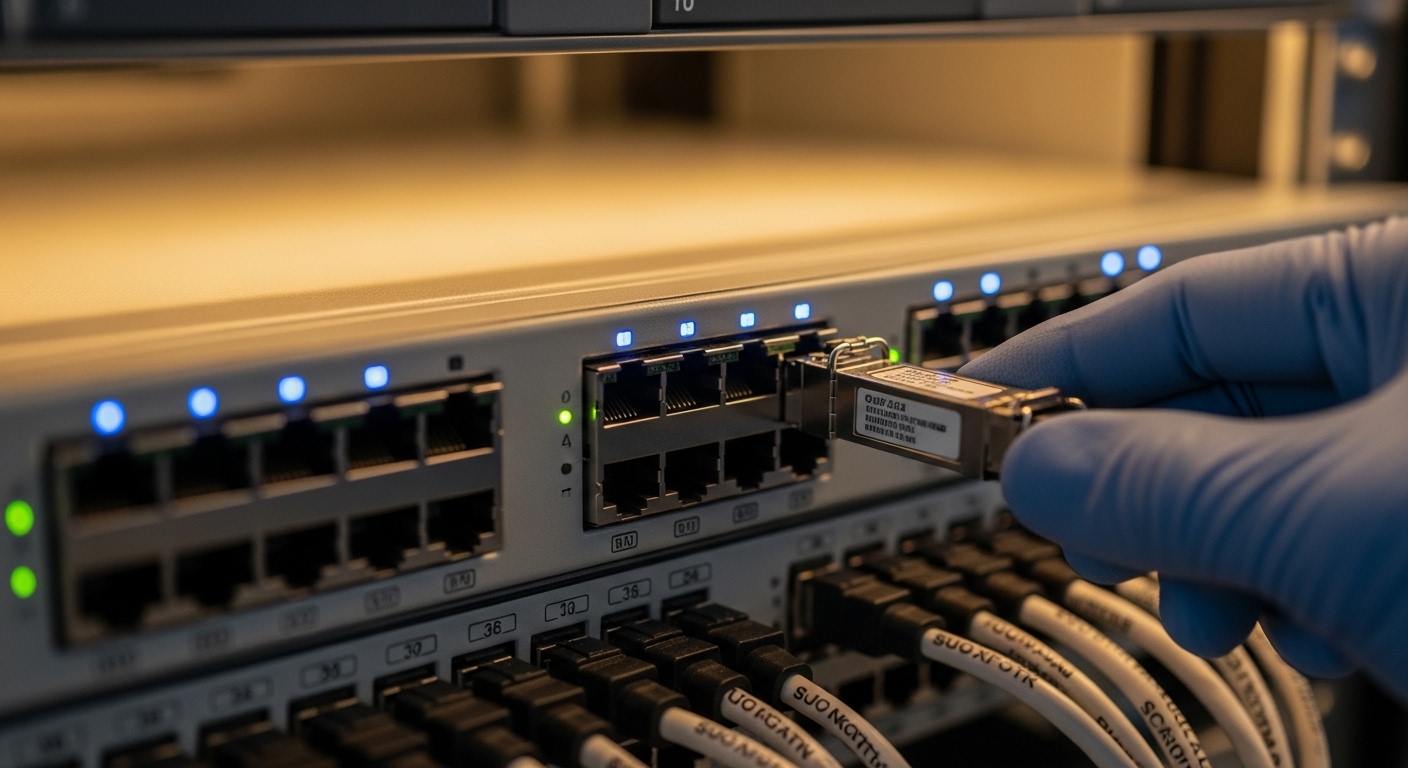
Before ordering optics or inserting a coherent module, confirm that your switches, optics management, and fiber path can support a ZR coherent transport mode. Coherent ZR optics are more sensitive to host compatibility, DOM visibility, and link budget than simpler direct-detect optics. Also confirm whether you are using vendor-supported optics or a third-party transceiver with explicit firmware compatibility.
What you need on day one
Collect these items so Step 2 through Step 5 can be executed safely and repeatably. Keep a change ticket open and capture the pre-change optical and interface counters.
- Host switch model and exact optics part numbers it supports (with firmware release notes).
- Fiber plant details: fiber type (single-mode OS2), measured end-to-end loss, and connector cleanliness checklist.
- Patch panel loss budget: expected splice count and patch cord lengths.
- Optics management access: vendor CLI or API for transceiver diagnostics (DOM/EEPROM readings, alarms).
- Coherent partner module on the far end (same generation and vendor line if possible).
Legal and compliance note
This is engineering guidance, not legal advice. If you are subject to procurement, export controls, or regulated telecom requirements, confirm obligations with counsel and your compliance team. For warranty and liability, follow the vendor terms for optics and coherent transport gear.
Step-by-step: install and activate a 400G ZR coherent link
This section is written like a field runbook. Follow it in order; each step includes an expected outcome so you can stop early if something is off.
Verify host and line-side capability
Confirm the switch port supports the exact form factor and data rate mapping required by your coherent ZR mode. For many platforms, a QSFP-DD or similar high-speed cage is used for 400G-class coherent optics, and the host may require a specific lane mapping profile. If the switch has multiple optics profiles, choose the one documented for ZR coherent operation.
Expected outcome: Port is administratively available, and the switch recognizes the transceiver family as supported (no “unsupported optics” alarms).
Validate optics compatibility and DOM visibility
Insert the transceiver into a test port or the intended port (depending on your change window policy) and verify DOM readings. You are looking for basic sanity checks: presence detect, vendor ID, temperature, supply voltage, and laser bias status. If the switch supports it, check that the coherent mode is set to the correct ZR profile.
Expected outcome: DOM data populates in the switch interface diagnostics, and no “DOM read failure” or “optics mismatch” events appear.
Build and confirm the fiber loss budget
ZR coherent optics typically operate over long spans, but they still require a realistic link budget. Gather your measured loss for the full path: splice loss, connector insertion loss, and any patch cord lengths. If you have OTDR traces, use them to identify hotspots or excessive attenuation. Clean connectors before mating; coherent receivers can be unforgiving when you have micro-scratches or dust.
Expected outcome: Your estimated total insertion loss is within the optics and system budget for the chosen ZR reach profile, after accounting for aging margin.
Configure the interface and coherent mode
Configure the port for 400G and ensure the modulation/forward error correction profile matches the far-end configuration. Some platforms require enabling FEC explicitly or selecting an optics profile that sets the coherent DSP behavior. If your gear supports it, align settings for training sequences or link establishment parameters.
Expected outcome: The interface transitions to an operational state (for example, “up/up” or “carrier detected”) and begins coherent training.
Perform link bring-up and verify performance counters
After the link comes up, monitor key counters: receive optical power, signal-to-noise-related metrics (if exposed), FEC counters, and error rate counters. In a healthy coherent link, you should see stable laser power and a low error floor after training completes. If the link flaps, capture the exact timestamps and correlate them with transceiver alarms and interface events.
Expected outcome: FEC is locked, error counters remain within acceptable thresholds, and optical diagnostics remain stable over at least 15 to 30 minutes.
Technical specs that matter for 400G ZR transceiver planning
ZR coherent optics are designed for long reach using coherent detection and DSP. The practical differences across vendors and models are not just the headline reach; they include wavelength grid support, optical interface type, power consumption, and operating temperature. Always cross-check the datasheet for the exact part number you plan to deploy.
Comparison table: common 400G ZR coherent module characteristics
Specs vary by vendor generation, but this table shows the key fields engineers compare during procurement and design review. Use it as a planning template rather than assuming every model matches these exact numbers.
| Spec | Typical 400G ZR Coherent Module | What to verify in the datasheet |
|---|---|---|
| Data rate | 400G class (coherent transport) | Supported line rate and host lane mapping |
| Reach | Commonly 80 km to 120 km class | Exact reach for your modulation and FEC profile |
| Wavelength | Single wavelength coherent operation (often tunable grid support) | ITUT grid compatibility and center frequency support |
| Connector | LC duplex (single-mode) | LC type and adapter requirements in your patch panel |
| Fiber type | OS2 single-mode | Compliance with your carrier network fiber spec |
| Transmit power | Vendor-specific; ensure match to receiver sensitivity | Min/max Tx power, Rx sensitivity, and link budget |
| Receive power range | Defined by sensitivity and overload limits | Overload protection limits with local reflections |
| Operating temperature | Often 0 to 70 C or extended industrial bands | Whether your site uses cold aisle, hot aisle, or outdoor shelters |
| Power | Typically tens of watts class | Host power budget and airflow constraints |
| DOM | Digital optical monitoring via I2C/EEPROM | DOM fields and whether switch firmware reads them fully |
For authoritative baseline definitions, align your procurement and validation with coherent optics and Ethernet transport guidance from standards and vendor documentation. See [Source: IEEE 802.3] for Ethernet PHY framing context and [Source: vendor datasheets] for exact optical parameters. For a practical overview of coherent transport concepts, you can also reference [Source: Ciena coherent networking brief] and vendor technical application notes.
Real-world DCI and metro backhaul scenario: making it work on Monday morning
In a 3-tier data center leaf-spine topology used for DCI, a team might connect two sites with 10 km to 70 km of single-mode fiber through a metro aggregation layer. Imagine two fabrics each using 48-port 400G ToR switches feeding a pair of aggregation routers; the DCI interconnect uses 4 parallel 400G coherent ZR links for redundancy. Each link runs over an OS2 path with an estimated 0.20 dB/km attenuation plus patching and splices totaling 2.5 dB insertion loss, measured via OTDR and connector inspection results.
On the day of cutover, the engineer installs a 400G ZR transceiver pair, configures the port for 400G and the matching coherent profile, and checks that FEC locks within a few minutes. Over the first hour, they monitor received optical power and error counters; they also verify that the transceiver temperature stays within the module operating range despite a high ambient in the equipment room. If a link fails, they validate connector cleanliness, confirm patch cord polarity, and re-run the optical diagnostics before touching configuration again.
Decision checklist: how engineers choose the right 400G ZR transceiver
Even when the reach looks right on paper, coherent links can fail due to compatibility mismatches, temperature constraints, or an overly optimistic link budget. Use this ordered checklist during design review and final acceptance testing.
- Distance and span loss: confirm measured path loss (OTDR preferred) and include splice/connector margin; avoid assuming “typical” fiber attenuation.
- Switch and port compatibility: verify the exact host firmware release supports the transceiver vendor and the specific optics profile.
- Reach profile and modulation settings: ensure the configured ZR mode matches the far-end coherent DSP capabilities and FEC scheme.
- DOM and alarms behavior: check that your switch can read DOM fields and that alarms map correctly to interface events.
- Operating temperature and airflow: confirm the module’s spec band matches your rack thermal conditions and that the host airflow is adequate.
- Connector and patch panel fit: ensure LC duplex orientation and cleaning workflow are compatible with your patching standard.
- DOM support and firmware updates: plan for maintenance windows because coherent optics may require specific host firmware compatibility.
- Vendor lock-in risk: if using third-party optics, require a compatibility statement and run a proof-of-acceptance test with your exact switch models.
Pro Tip: In field deployments, the most time-consuming coherent bring-up issues are often not “bad optics” but connector contamination and marginal link budgets. Clean LC endfaces, verify patch cord length and count, and only then chase DSP or FEC settings—because a slightly degraded optical signal can prevent training, leading to misleading configuration troubleshooting.
Common mistakes and troubleshooting for 400G ZR links
Below are three high-frequency failure modes seen in real installations, with root causes and practical fixes. If you follow these in order, you usually recover quickly without excessive configuration churn.
Troubleshooting failure point 1: Link never reaches “up” after insertion
Root cause: Host rejects the optics profile or switch firmware cannot negotiate the coherent mode, sometimes triggered by a mismatch in supported optics generation. Solution: confirm the exact switch OS version and check the transceiver compatibility matrix; reseat the module and re-check DOM readings. If your platform supports it, apply the vendor-recommended optics profile; otherwise, schedule a firmware update within the maintenance window.
Troubleshooting failure point 2: Link flaps or FEC never locks
Root cause: link budget mismatch due to higher-than-expected loss, fiber bends, or excessive patch panel attenuation; alternatively, one connector is dirty or mis-terminated. Solution: run OTDR review, inspect both ends with an endface scope, re-clean and re-terminate if needed, and verify patch cord lengths and splice counts. After cleaning and loss verification, re-run training by toggling the interface admin state per your vendor procedure.
Troubleshooting failure point 3: Receiver overload or low receive power alarms
Root cause: wrong fiber path mapping, patch cord polarity confusion, or an unexpected reflection environment causing receive overload or insufficient signal. Solution: confirm which fiber pair corresponds to Tx and Rx at each end; verify patch panel labeling; if you have access to transceiver optical power diagnostics, compare Rx power against the module’s safe range from the datasheet. Replace suspicious patch cords and remove any unnecessary adapters.
Cost and ROI note: what to budget for a 400G ZR transceiver rollout
Pricing varies widely by vendor, reach class, and whether the module is bundled with activation support. In typical enterprise and metro procurement, 400G coherent ZR optics can land in a broad range, often from several hundred to over a few thousand USD per module depending on brand and volume. Total cost of ownership depends on more than unit price: coherent optics can draw more power than simpler optics, and they may require specific host firmware and airflow validation.
ROI is strongest when you avoid major fiber rebuilds or complex intermediate regeneration sites. If your alternative is deploying additional transponders or hiring extended construction for dark fiber, the coherent ZR approach can reduce both CapEx and timeline risk. However, factor in test labor, spares strategy, and the probability of rework due to connector or configuration mismatches.
FAQ about 400G ZR transceiver selection and deployment
What is a 400G ZR transceiver used for?
A 400G ZR transceiver is used to carry 400G-class traffic over long distances using coherent optics and DSP-based detection. It is commonly deployed for DCI and metro backhaul where you want reach without intermediate regeneration.
How do I confirm compatibility with my switch?
Check your switch vendor’s optics compatibility matrix and the firmware release notes for the host OS version you will use. Then validate DOM visibility and interface optics profile behavior during a controlled test before the production cutover.
Do I need special fiber beyond standard single-mode OS2?
In most metro and DCI deployments, OS2 single-mode is sufficient, but you must verify loss and connector/splice quality. Use OTDR measurements and clean LC connectors to avoid training failures or elevated error counters.
What is the most common cause of a coherent link failing to train?
In practice, connector contamination and an optimistic link budget are frequent culprits. Even if the reach seems adequate, marginal optical power due to extra patching or dirty endfaces can prevent coherent training from completing.
Can I mix vendors for the two ends of a 400G ZR link?
Sometimes it works, but you should not assume interoperability across vendors or generations. For best results, match coherent generations and confirm interoperability through proof-of-acceptance testing with your exact switch models and firmware.
What should I monitor after the link is up?
Monitor receiver optical power, FEC lock status, and error counters over time. If your platform exposes coherent diagnostics, also track temperature and any transceiver alarm flags that could indicate drift.
If you want the next step, review coherent-optics-link-budget-checklist to turn your measurements into a repeatable acceptance test plan. For legal risk management, ensure procurement and warranty terms explicitly cover optics compatibility and support for coherent transceiver operation.
About the author: I am a practicing attorney with hands-on experience advising on vendor selection, warranty disputes, and telecom compliance for live network deployments. I also support engineers by translating datasheet requirements into field-ready acceptance criteria and documentation practices.
About the author: I have worked with teams deploying coherent DCI and metro links, including switch firmware alignment, DOM diagnostics, and failure analysis workflows. My goal is to help you ship a working link faster with fewer surprises.
Sources: [Source: IEEE 802.3] for Ethernet framing context; [Source: vendor datasheets for coherent ZR optics] for reach, power, DOM, and temperature; [Source: ANSI/TIA-568 series] for structured cabling considerations; [Source: vendor application notes] for coherent training and interoperability guidance.
