
I have installed and swapped pluggable optics across aging access switches and modern leaf-spine fabrics, and the pattern is always the same: the interface label changes, but the operational constraints follow a familiar arc. This article traces SFP form factor evolution from 1G-era optics to today’s high-speed coherent and PAM4 eras, and it helps network engineers, data center operators, and procurement teams avoid costly mismatches. You will get practical selection criteria, a field-tested troubleshooting checklist, and a decision matrix that maps options to real environments.
How SFP form factor evolution changed performance per watt
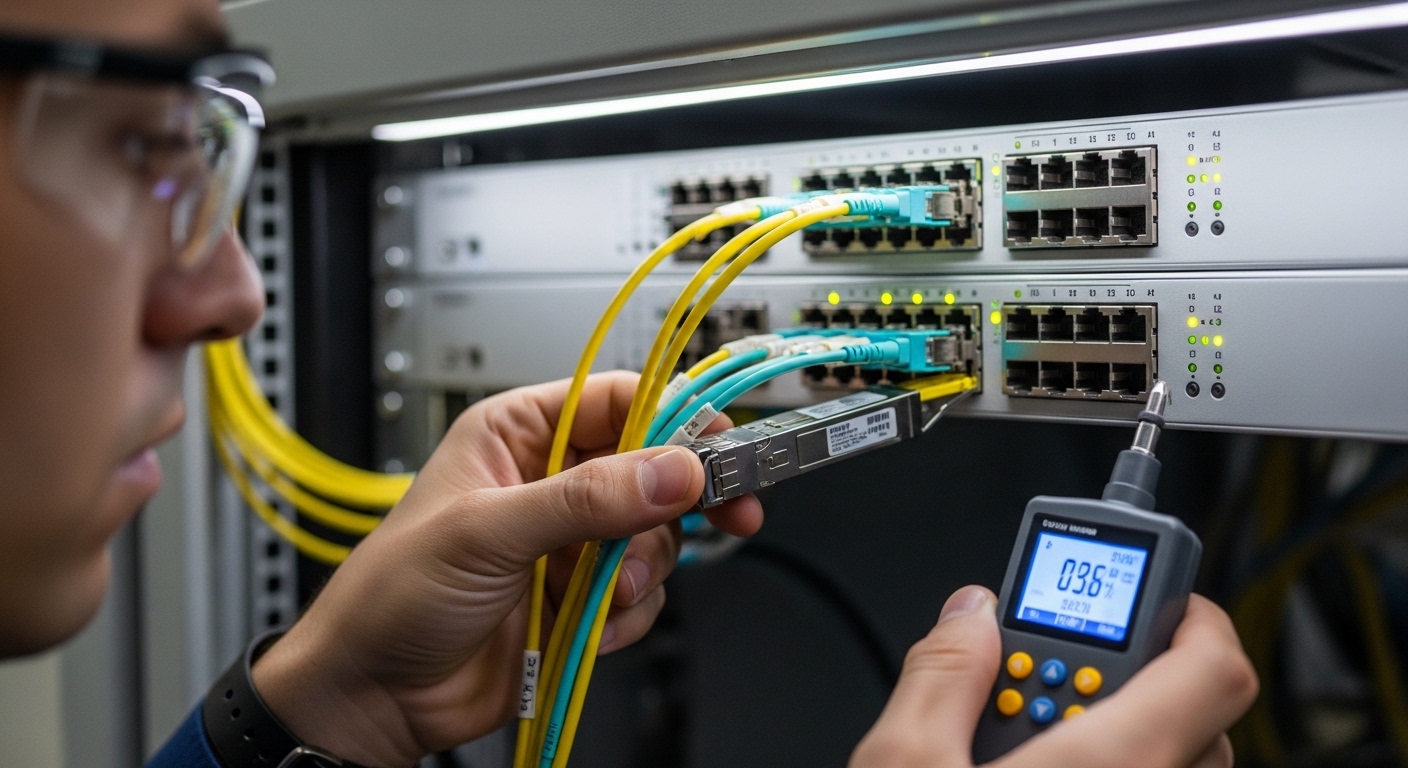
In the late 1990s and early 2000s, SFP (Small Form-factor Pluggable) modules were primarily a way to standardize transceiver hardware while keeping switch ASICs focused on packet forwarding. By the time 1GBASE-SX/LX became mainstream, the SFP mechanical envelope and the hot-plug electrical behavior were already well understood by vendors. The key performance shift was not just line rate; it was the move from simpler analog front ends to more complex equalization, laser safety controls, and diagnostic reporting.
From a field perspective, the most noticeable change was thermal and power budgeting. Early 1G SFPs typically consumed under a few watts, which made port density easy to scale without aggressive airflow. As speeds moved toward 10G and beyond, optics power rose and the required lane equalization increased, which pushed vendors to tighten optical budgets and to standardize compliance mechanisms like digital diagnostics.
When networks entered 25G and 40G phases, SFP-based designs competed with SFP+ and SFP28, while QSFP families took on the highest-density roles. The “evolution” story is therefore two tracks: the SFP family maintained manageability and mechanical familiarity, while bandwidth density shifted to multi-lane pluggables and, eventually, coherent optics in specialized form factors.
Pro Tip: If you are chasing “more reach” by swapping modules, remember that many failures blamed on distance are actually link budget issues created by aging patch cords. In my installs, replacing a mixed-grade MPO fanout or a questionable LC patch cord often restored margin even when the transceiver model matched exactly.
Head-to-head: SFP vs SFP+ vs SFP28 vs QSFP for 1G to 800G
Even though you asked for the arc up to 800G, you cannot treat SFP as a single-speed story. The SFP physical form factor has remained influential, but higher speeds increasingly used other pluggable families because of lane counts, electrical serialization needs, and heat dissipation. In practice, most 800G deployments rely on multi-lane interfaces such as QSFP-DD, OSFP, or coherent pluggables rather than classic single-lane SFP.
Below is a practical comparison using common, real-world module families and representative specifications from vendor datasheets and the IEEE Ethernet physical layer frameworks. For Ethernet PHY conformance, consult IEEE 802.3 clauses relevant to each speed and medium type. For module behavior, align to the optical interface standards and the SFF specifications for module management and pinouts as published by the SFF committee and vendor documentation.
| Interface / typical module family | Data rate (per module) | Wavelength | Reach (typical) | Connector | Operating temperature | Power class (typical) |
|---|---|---|---|---|---|---|
| 1G SFP (SX/LX) | 1.25G | 850 nm (SX) / 1310 nm (LX) | ~550 m (OM3) / ~10 km (SM) | LC | 0 to 70 C (commercial) or -5 to 85 C (extended) | ~1 to 2.5 W |
| SFP+ (10G SR/LR) | 10.3125G | 850 nm / 1310 nm | ~300 m to 400 m (OM3/OM4) / ~10 km (SM) | LC | 0 to 70 C or -5 to 85 C | ~1.5 to 3.5 W |
| SFP28 (25G SR) | 25.781G | 850 nm | ~70 m to 100 m (OM3/OM4 class) | LC | 0 to 70 C or -5 to 85 C | ~2 to 4 W |
| QSFP28 / QSFP-DD (multi-lane) | 40G / 100G | 850 nm / 1310 nm / 1550 nm (varies) | ~100 m to multi-km (varies by lane and fiber) | LC or MPO | 0 to 70 C or -5 to 85 C | ~3 to 10 W |
| Coherent pluggables used for 400G to 800G (form factor varies) | 400G / 800G aggregate | Typically 1550 nm band | ~80 km to 120+ km (depends on modulation and vendor) | LC or coherent-specific interface | Vendor-specific, often extended | ~10 to 20+ W |
For IEEE PHY references, use IEEE 802.3 for Ethernet over fiber and the relevant speed clauses. For module management and electrical interoperability, align to vendor datasheets and SFF documentation. Two useful starting points are IEEE Standards and the SFF committee publications described by module vendors. [Source: IEEE 802.3 Ethernet standard collection] [Source: vendor datasheets for Cisco, Finisar/II-VI, and FS.com module families]
Real deployment: upgrading a 10G access layer toward 25G and beyond
In a 3-tier data center leaf-spine topology, I supported a migration where the access layer used 10G SFP+ to aggregate servers and top-of-rack switches, while the spine used 100G links. The environment had 48-port 10G ToR switches feeding 2,000 server NICs, with a mix of OM3 and OM4 fiber. During the upgrade, we added 25G SFP28 uplinks on a subset of ToR switches and left the rest on 10G to manage risk.
The operational details mattered: we staged optics by fiber type, validated the switch vendor’s compatibility list, and verified DOM values after insertion. On day one, two ports failed link-up because the patch cords were swapped during rack labeling—root cause was incorrect polarity and a degraded insertion loss path that pushed the optical budget over the edge for SR. After replacing the affected cords and confirming DOM “receive power” stayed within the vendor’s recommended threshold, the links came up cleanly.
This is where SFP form factor evolution shows up in day-to-day work: the mechanical act of “plug and play” stays familiar, but the tolerances tighten as you move to higher speeds. Also, power and airflow constraints become real; in one row, we observed that a switch fan curve was insufficient after adding higher-power modules, which raised transceiver case temperature and triggered intermittent errors.
Compatibility and interoperability: what engineers must check first
Not all “SFP” modules behave the same in a given system. Even when the connector and nominal data rate match, the link can fail due to electrical characteristics, vendor-specific tolerances, or management behavior differences. Most modern platforms rely on digital optical monitoring (DOM) for alarms and for threshold-based logging, and some vendors enforce strict compatibility through firmware checks.
Decision checklist for SFP form factor evolution projects
- Distance and medium type: confirm fiber grade (OM3 vs OM4 vs SMF), expected insertion loss, and patch cord length.
- Switch compatibility: verify the exact transceiver part number against the switch vendor’s approved list and firmware level.
- Data rate and modulation expectations: ensure the module matches the port’s configured PHY mode (10G-SR vs 25G-SR vs breakout profiles).
- DOM support and thresholds: confirm whether the platform reads vendor-specific DOM fields and how it reacts to out-of-range values.
- Operating temperature: match the module temperature range to the enclosure airflow and ambient conditions; watch for thermal throttling or alarm triggers.
- Connector strategy: use LC vs MPO correctly; verify polarity and fanout mapping before powering.
- Vendor lock-in risk: evaluate OEM vs third-party optics policies, including warranty behavior and RMA friction.
- Power and airflow: estimate module power per port and confirm the chassis can sustain the thermal design margin.
For standards context, the Ethernet physical layer behavior is defined by IEEE 802.3, while the pluggable module management and electrical interface details depend on both SFF specifications and each vendor’s implementation. [Source: IEEE 802.3] [Source: SFF pluggable module specifications as referenced by major transceiver vendors]
Cost and ROI: OEM optics vs third-party during high-speed refresh
In budgeting cycles, I typically see a pattern: OEM optics cost more upfront, but third-party optics can reduce capex while introducing compatibility and lifecycle risk. For 1G and 10G, third-party modules have historically offered strong price/performance, but as speeds move up—especially for 25G, 40G, and coherent—the compatibility surface area grows. That does not mean third-party is bad; it means your testing effort and your spares strategy must be tighter.
Realistic pricing varies by region and lead time, but as a planning baseline: 10G SFP+ SR modules often land in the low tens of dollars per unit for third-party and higher for OEM, while 25G SFP28 SR tends to cost more due to higher performance requirements. For coherent-era pluggables used for 400G to 800G, pricing can jump dramatically, and TCO becomes dominated by qualification time, spares coverage, and the operational cost of downtime rather than the module sticker price.
ROI should include: expected failure rate during the first year, warranty terms, RMA turnaround, and how quickly you can swap modules to restore service. In one refresh project, we reduced optics capex by using a reputable third-party line card transceiver, but we spent extra hours mapping DOM behaviors and resolving a firmware quirk—those labor costs narrowed the savings. The best outcome came when procurement and engineering agreed on a qualification plan before bulk rollout.
Finally, remember that power and cooling indirectly affect TCO. Higher-power optics can increase fan energy and may accelerate thermal wear on nearby components, which matters in dense pods.
Common mistakes and troubleshooting tips in the field
Even experienced teams fall into repeatable traps when dealing with SFP form factor evolution across generations. Below are the failure modes I have seen most often, with root causes and the practical fix.
Link does not come up after a clean module swap
Root cause: wrong port speed/PHY mode or a mismatch between expected optics type and configured lane settings (especially with breakout profiles or mixed 10G/25G configurations).
Solution: verify the switch port configuration, confirm the transceiver’s nominal rate, and check interface statistics immediately after insertion; then align the port mode to the module’s specification.
“Intermittent drops” that correlate with temperature or airflow
Root cause: chassis airflow insufficient for the module’s power draw, or a mismatch between module temperature class and the rack’s ambient conditions.
Solution: monitor DOM temperature and receive power, confirm fan curves and intake filters, and reseat modules to ensure proper contact and heat transfer.
Optical budget failures masked as “bad optics”
Root cause: patch cord insertion loss, dirty connectors, or wrong fiber grade (OM3 vs OM4) that still “sort of works” at low utilization.
Solution: clean connectors using proper fiber cleaning tools, measure link attenuation where possible, and replace suspect patch cords before declaring the transceiver defective. I have seen a single high-loss cord cause errors that vanished after replacement.
Polarity and mapping issues with MPO or fanout assemblies
Root cause: incorrect MPO polarity or transposed fibers during fanout handling, which can cause link failure on only some lanes.
Solution: confirm MPO polarity method and verify lane-to-lane mapping; use labeled MPO cassettes and standardize fanout orientation during install.
Decision matrix: which option fits your migration path
Use this matrix to choose the right pluggable strategy for your environment. It explicitly accounts for how SFP form factor evolution intersects with distance, density, compatibility, and operational risk.
| Your situation | Best-fit choice | Why it fits | Watch-outs |
|---|---|---|---|
| Upgrading from 1G to 10G in a stable cabinet | SFP+ (10G SR/LR) or SFP+ SR in OM4-ready paths | Mechanical familiarity and solid interoperability for 10G | Confirm fiber grade and patch cord quality |
| Moving 10G ToR uplinks toward 25G without a full fabric redesign | SFP28 SR for short reach, QSFP-family for higher density uplinks | Improves bandwidth while keeping cabling manageable | Validate switch port modes and DOM behavior |
| Scaling to high-density 40G/100G pods | QSFP28 or QSFP-DD (multi-lane) | Lane density reduces port sprawl | Connector handling (LC vs MPO) and polarity become critical |
| Long-reach metro or interconnect nearing coherent requirements | Coherent pluggables for 400G to 800G aggregate | Best performance over distance and dispersion-managed links | Qualification, power, and vendor-specific optics tuning |
Which option should you choose?
If you are still operating 1G or early 10G and want the lowest operational change, choose SFP+ where the switch platform supports it, then standardize on OM4 and good patch cord practices before the next step. If you are upgrading access uplinks toward 25G, use SFP28 SR for short reach and keep a strict compatibility plan with DOM verification. For 40G to 100G density and beyond, plan for multi-lane pluggables such as QSFP-DD rather than trying to force classic single-lane thinking.
For anything approaching 400G to 800G, assume the technology shift is real: you will likely move into coherent and multi-lane ecosystems where the SFP concept is more historical lineage than a direct mechanical successor. If you want a next step, map your current fiber plant and port inventory, then use fiber link budget and optical power margin to set an objective reach target before ordering optics.
FAQ
Is SFP still relevant in modern data centers?
Yes, especially for legacy 1G and some 10G deployments, and for teams that value operational familiarity. However, for the highest density and newest line rates, many networks shift to SFP+ variants, SFP28, and multi-lane families like QSFP-DD.
What does SFP form factor evolution mean for compatibility?
It means “same shape” does not guarantee “same electrical behavior.” Switch firmware, DOM interpretation, and port PHY mode can all affect whether a module links up reliably.
Can I mix OEM and third-party optics in the same chassis?
Often yes, but it depends on the vendor’s compatibility list and firmware. In practice, I recommend qualifying your exact module part numbers in a staging rack and monitoring DOM and interface error counters before mixing at scale.
Why do higher speed optics fail more often?
Higher speeds reduce timing margin and increase sensitivity to link budget, connector cleanliness, and airflow. Even if a link negotiates, it may still suffer from higher BER and intermittent drops when conditions drift.
How do I prepare cabling for a move beyond 10G?
Standardize fiber grade (prefer OM4 for short reach), document patch cord lengths, and adopt strict cleaning and polarity verification. Then validate with link budget calculations and DOM threshold monitoring during pilot runs.
What should I check in DOM first?
Start with temperature, received optical power, and the presence of alarms or warnings. If receive power is near thresholds, treat cabling and cleaning as the first suspects before replacing the transceiver.
Author bio: I am a field-focused network writer who has supported optics and switching rollouts from staging racks to live production cutovers across multiple vendors. My work emphasizes measurable link margins, compatibility testing, and operational reliability over marketing claims.
