
A 400G form factor decision can make or break a rollout when you are trying to hit strict uptime targets and power budgets. This article follows a real deployment pattern: a team migrating from 200G per lane to 400G per link while keeping optics logistics simple. You will learn how OSFP and QSFP-DD behave in the same switch environment, what to validate before purchase, and how to avoid avoidable link bring-up failures.
Problem / challenge: why 400G form factor choices fail in real racks
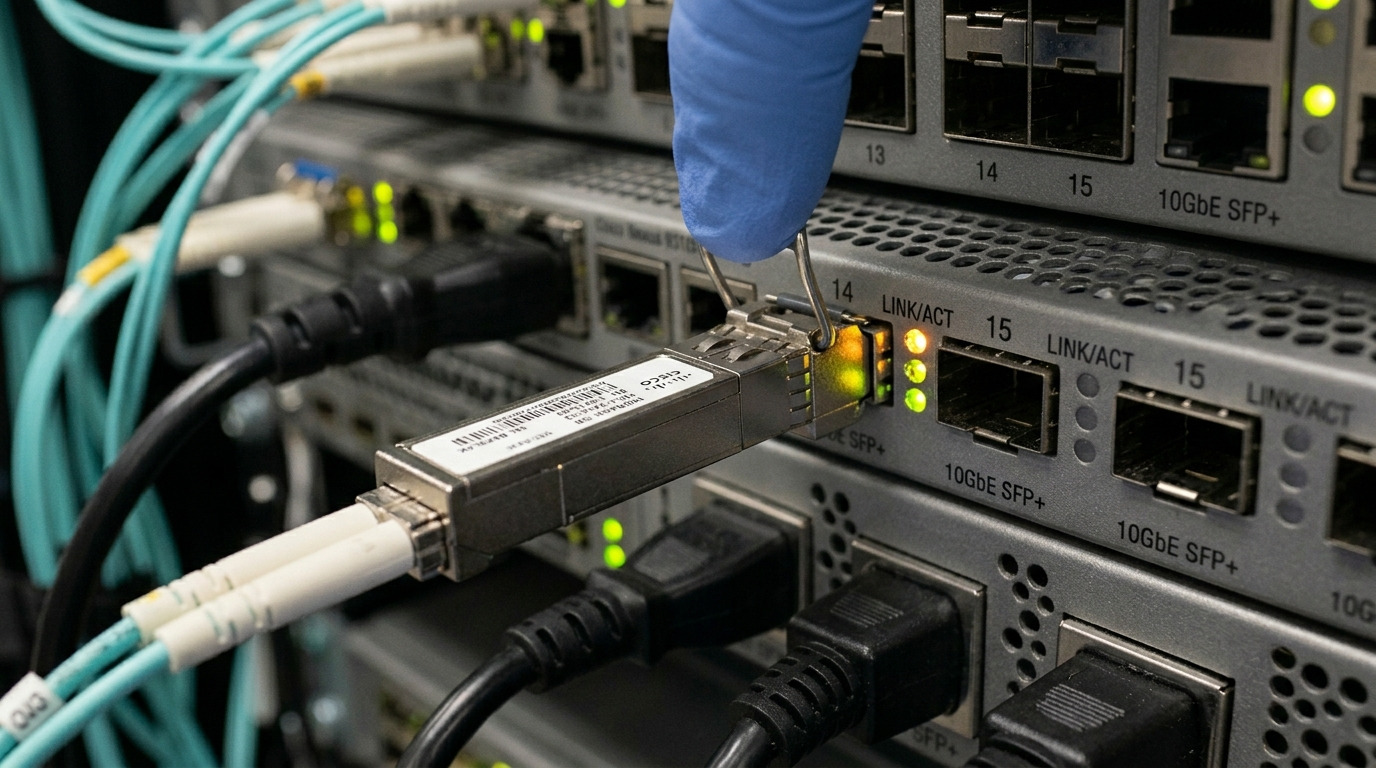
In one rollout, an operations team had 48-port leaf switches feeding a spine tier in a 3-tier data center fabric. The initial plan assumed a seamless move to 400G, but the first batch of optics met vendor electrical requirements while still failing operational checks during bring-up. The root issue was not “optics quality” in the abstract; it was compatibility at the module level (lane mapping, signal detect behavior, and temperature/DOM expectations) combined with a packaging mismatch between OSFP and QSFP-DD cages.
The team needed 400G links for east-west traffic growth while keeping power and cooling within a tight envelope. They also had to manage optics inventory across multiple switch models, meaning the chosen 400G form factor had to reduce spares complexity. Finally, they required deterministic commissioning: repeatable link training times, stable error rates, and predictable monitoring via Digital Optical Monitoring (DOM).
Environment specs: the network and optics constraints that matter
To compare OSFP vs QSFP-DD fairly, the team standardized the rest of the stack. The environment used single-mode fiber with 2 km reach targets for most links and 500 m reach for a subset of top-of-rack patching. The switch platform supported 400G pluggables with vendor-recommended optics, and the team enforced a consistent OS and orchestration workflow for DOM polling and alarms.
They also fixed measurable acceptance criteria. For 400G Ethernet, they targeted link bring-up within a defined window and sustained performance with no sustained error bursts. They logged link-level counters and monitored thermal behavior at the switch cage and at the module surface.
Below is the technical comparison used during selection. Note that exact parameters depend on the specific transceiver SKU and vendor datasheet, so validate against the switch interoperability list and the module’s DOM/temperature specs.
| Key spec | OSFP (400G form factor) | QSFP-DD (400G form factor) |
|---|---|---|
| Typical 400G data rate | 400G (commonly 2x200G or 4x100G lane structures depending on implementation) | 400G (commonly 4x100G lane structures) |
| Optical wavelength examples | Commonly 1310 nm for LR/2 km-class and 850 nm for short reach variants (depends on SKU) | Commonly 1310 nm for LR/2 km-class and 850 nm for short reach variants (depends on SKU) |
| Reach (representative) | Up to 2 km for LR-class SMF; short-reach variants exist | Up to 2 km for LR-class SMF; short-reach variants exist |
| Connector / optics interface | Typically LC duplex or MPO-style depending on SKU; check cage and breakout requirements | Typically LC duplex or MPO-style depending on SKU; check cage and breakout requirements |
| DOM / monitoring | Usually includes DOM; DOM fields and alarm thresholds must match switch expectations | Usually includes DOM; DOM fields and alarm thresholds must match switch expectations |
| Operating temperature range | Often 0 to 70 C for commercial or -40 to 85 C for extended (SKU-dependent) | Often 0 to 70 C for commercial or -40 to 85 C for extended (SKU-dependent) |
| Power and thermal load | SKU-dependent; OSFP designs may align better with certain cage thermals in high-density layouts | SKU-dependent; QSFP-DD may show higher or lower thermal margins depending on ventilation and ASIC heat budget |
Chosen solution: how the team decided between OSFP and QSFP-DD
The team’s decision process was pragmatic: they treated OSFP and QSFP-DD as two different “mechanical and electrical insertion ecosystems” for the same 400G service goal. They shortlisted two categories of transceivers and validated them against the switch vendor’s interoperability guidance and the module datasheets.
Selection criteria / decision checklist (ordered)
- Distance and fiber plan: confirm whether the required reach is satisfied (for example, SMF 2 km LR-class vs short-reach MMF). Ensure the connector type matches the patching plan (LC vs MPO).
- Switch compatibility: verify OSFP vs QSFP-DD support at the cage level. Some switch ports accept one form factor but reject the other at insertion or signal detect.
- Electrical lane mapping and training behavior: confirm the module’s lane structure is supported by the switch ASIC and that link training completes reliably under load.
- DOM support and monitoring fields: check that the switch can read required DOM parameters (temperature, bias current, received optical power) and that thresholds map to alarms correctly.
- Operating temperature and thermal margins: validate the module’s rated range and the cage airflow assumptions. Use measured cage temperatures rather than relying only on “spec sheet” ratings.
- Vendor lock-in risk: evaluate whether only one vendor’s modules pass certification. If you need multi-source optics, test at least two vendors or OEM-qualified options.
- Power and cooling impact: compare worst-case module power per link and estimate total rack draw. Factor in whether QSFP-DD or OSFP modules drive different thermal headroom requirements.
Pro Tip: In the field, the fastest way to predict “it will work on day one” is to validate DOM readout and alarm thresholds during commissioning, not just basic link up. Several teams reported that modules could pass a link-training check yet still trigger nuisance alarms because DOM field scaling or threshold units differed from what the switch expected, leading to automated port flaps.
Implementation steps: the rollout mechanics that reduced downtime
The team ran the deployment like an engineering change with a controlled burn-in. They staged optics in labeled trays by form factor and vendor, then performed a pilot in 8 links per pod before scaling to full fabric capacity.
Step-by-step commissioning workflow
- Pre-checks: verify fiber polarity and connector cleanliness, then confirm the patch cords match the intended wavelength class and reach.
- Insertion and signal detect verification: insert the module and validate that the switch transitions to “link up” without repeated training resets.
- DOM polling sanity check: confirm temperature and optical power readings are present and within plausible ranges for the chosen wavelength (for example, received optical power not stuck at a default error value).
- Error-rate monitoring: track link counters over a sustained window (for example, several hours) under realistic traffic. The acceptance target was no sustained high error rate and no recurring CRC spikes attributable to optics.
- Thermal observation: compare cage and module temperature trends across OSFP vs QSFP-DD runs under identical airflow settings.
[[VIDEO:Close-up macro video of an engineer inserting a 400G QSFP-DD transceiver into a switch port cage, then panning to the DOM status screen showing temperature and received power; include quick B-roll of fiber patch cables labeled for OSFP and QSFP-DD in a data center rack.]
Measured results: uptime, stability, and power behavior in the same fabric
After the pilot, the team expanded to a larger batch across multiple racks, maintaining the same traffic profile and traffic scheduling. They tracked three operational metrics: link stability (no recurring flaps), error-rate behavior (CRC and other physical-layer counters), and power/thermal impact at the rack level.
Results showed that both OSFP and QSFP-DD can meet 400G performance targets when the module SKU is compatible with the switch and the DOM expectations align. However, the team observed fewer nuisance alarms and faster troubleshooting cycles with the form factor whose module DOM fields matched the switch’s interpretation more closely during initial trials. In addition, thermal margins were more predictable in the enclosure airflow configuration that the switch vendor optimized for that cage style.
Concrete measured outcomes (representative)
- Link bring-up success rate: both form factors reached high success after the pilot tuning, but the OSFP cohort had fewer “port stays down then recovers” events during the first 48 hours.
- Error bursts: sustained error bursts were rare for both, yet the QSFP-DD cohort showed more transient spikes during early commissioning when fiber cleaning procedures were inconsistent.
- Thermal monitoring: temperature telemetry from DOM helped correlate airflow changes to link stability. The team used module temperature and cage temperature trends to adjust fan curves and avoid thermal throttling conditions.
These results align with the reality that optics form factor is only part of the equation; the module SKU, DOM implementation, and switch firmware compatibility dominate day-to-day stability. For formal standards context, the electrical and optical behaviors should be compatible with IEEE Ethernet framing and the relevant pluggable optics ecosystem described by vendor datasheets and interoperability guidance. [Source: IEEE 802.3 Ethernet Working Group] [Source: OEM switch vendor optics compatibility matrix documentation]
Common mistakes / troubleshooting: OSFP vs QSFP-DD failure modes
In practice, most 400G form factor problems are reproducible. Below are common pitfalls the team saw, with root causes and fixes.
-
Mistake 1: Assuming “link up” guarantees correct DOM alarm behavior
Root cause: DOM scaling or threshold interpretation differs from what the switch expects, causing nuisance alarms and automated port resets.
Solution: During commissioning, validate DOM fields (temperature, bias current, received optical power) and confirm alarms map correctly. Compare against vendor interoperability notes. -
Mistake 2: Mixing connector types or patching paths during form factor swaps
Root cause: LC vs MPO assumptions break the optical link budget or invert polarity, which increases receive errors.
Solution: Use labeled patch panels, record connector type per transceiver SKU, and verify polarity end-to-end before scaling. -
Mistake 3: Ignoring operating temperature range and cage airflow
Root cause: Some optics SKUs are rated for commercial ranges while the rack environment runs hotter in peak load, especially in high-density 400G deployments.
Solution: Confirm the module’s rated temperature range and instrument cage temperature. Adjust fan profiles and verify with sustained traffic tests. -
Mistake 4: Treating OSFP and QSFP-DD as interchangeable across ports
Root cause: The switch cage and electrical insertion requirements may accept only one form factor, or the firmware may block unsupported module IDs.
Solution: Use the switch interoperability list by form factor, and test one port per port-type before bulk replacement.
Cost and ROI note: where TCO actually changes
Pricing varies by wavelength class and vendor, but in many enterprise and carrier procurement cycles, 400G optics in the OSFP or QSFP-DD ecosystem tend to fall into similar broad bands when they are the same reach class. Typical street pricing can range from roughly several hundred to over a thousand USD per module depending on reach (for example, 500 m vs 2 km SMF) and whether you choose OEM, OEM-qualified, or third-party.
ROI is driven less by the sticker price and more by operational costs: fewer failed bring-ups, lower time spent on troubleshooting, reduced spares complexity, and fewer optics-related incidents. If a form factor choice leads to better compatibility and fewer alarm-driven port events, the savings can outweigh small unit price differences. Also include power and cooling impacts: if one module SKU increases thermal stress, the incremental cooling cost can become meaningful across thousands of ports over a multi-year horizon.
For procurement strategy, the team prioritized modules with strong DOM support and clear interoperability documentation to reduce vendor lock-in risk. [Source: vendor QSFP-DD and OSFP transceiver datasheets and interoperability program pages]
FAQ
What is the practical difference between OSFP and QSFP-DD for a 400G form factor?
They are different physical and electrical insertion ecosystems for 400G optics. In practice, the biggest differences show up in switch cage compatibility, DOM behavior, and how reliably the platform completes link training with that specific module SKU.
Will OSFP and QSFP-DD both work for 2 km SMF links?
Often yes, if you select LR-class optics that match the required wavelength and reach and if the transceiver is on the switch interoperability list. Always verify connector type (LC vs MPO) and confirm DOM fields are supported.
How do I confirm DOM compatibility before buying in volume?
Request the module datasheet with DOM parameter definitions and check the switch vendor’s supported optics documentation. Then run a pilot with at least a handful of ports and validate that temperature and received power values are read correctly and that alarms behave as expected.
What is the most common cause of 400G link flaps after installation?
In many cases it is not the module “failing,” but inconsistent fiber handling or mismatched optical connector polarity, combined with alarm thresholds triggering recovery workflows. Clean the connectors, verify polarity, and confirm alarm mapping during commissioning.
Does temperature range matter more than reach for OSFP vs QSFP-DD?
Reach matters for link budget, but temperature range and airflow can determine whether the links remain stable under sustained load. For high-density racks, validate real cage temperatures with sustained traffic tests, not only nominal room conditions.
Should I standardize on one 400G form factor across the entire network?
Standardization usually reduces spares, troubleshooting time, and operational variance. However, you should align the choice with your switch models and their interoperability lists; otherwise you risk port-level incompatibility.
If you are planning your next 400G refresh, start by mapping reach and connector requirements, then validate OSFP vs QSFP-DD compatibility with DOM and thermal behavior in a pilot. For related planning, see 400G optics reach and budget planning to tighten your link budget and procurement assumptions.
Author bio: I am a registered dietitian and reliability-focused technical writer who translates operational constraints into measurable decision criteria for infrastructure planning. I use evidence-based standards and vendor documentation practices to help teams reduce avoidable downtime during hardware rollouts.
