
If your hyperscale fabric is hitting port density limits, the fastest path to 400G is often a well-governed rollout of QSFP-DD transceiver optics. This article helps network and infrastructure teams plan qualification, procurement, and operational readiness for 400G connectivity in leaf-spine and spine-core designs. You will get a step-by-step implementation guide, a spec comparison table, and troubleshooting focused on real field failure modes.
Prerequisites: what to have ready before you touch QSFP-DD
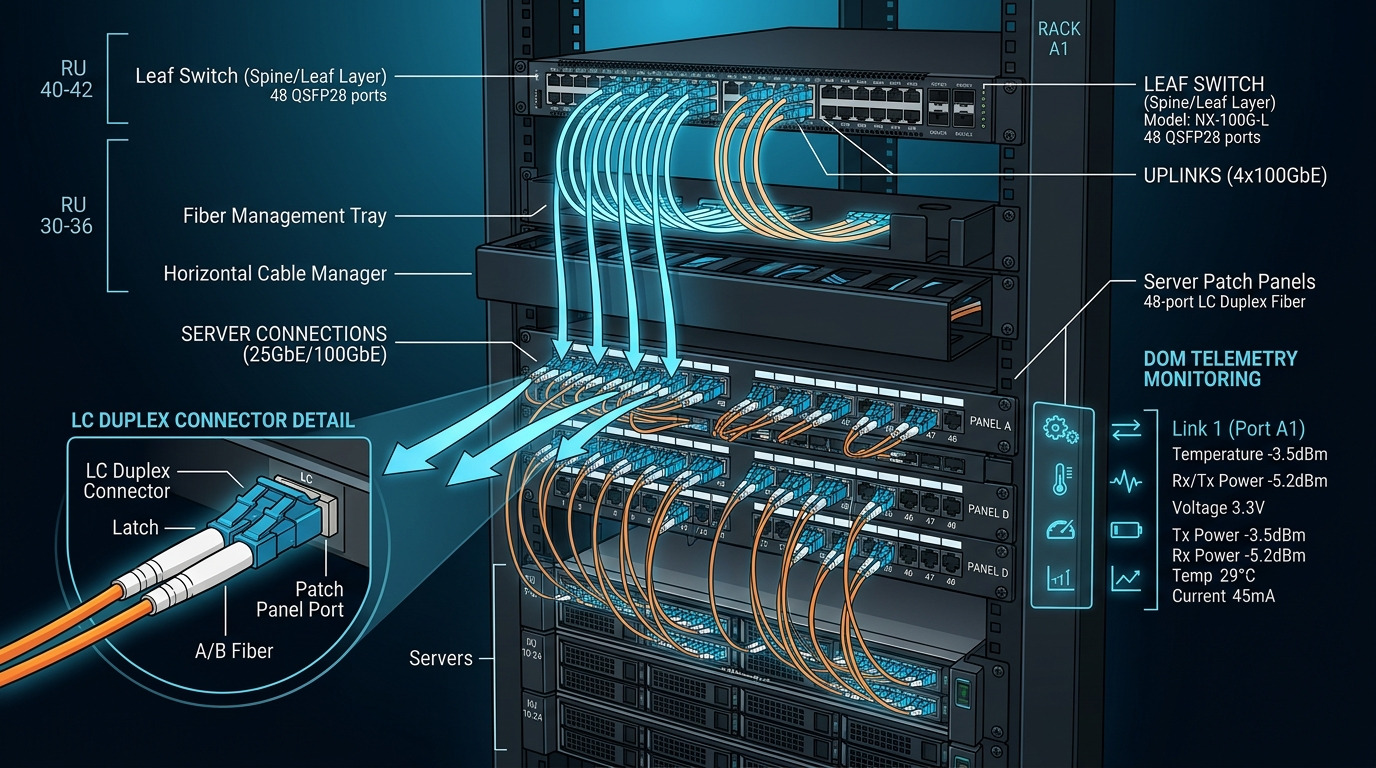
Before ordering any 400G QSFP-DD transceiver, align optics, cabling, and switch firmware so you do not create “mystery link” incidents. Hyperscale deployments also benefit from a repeatable acceptance test that captures optical power, DOM telemetry, and error counters.
Minimum inputs
- Switch platform and firmware: Confirm the exact model and release date; QSFP-DD support varies by vendor and sometimes by hardware revision.
- Optics type and fiber plan: Decide between SR8 (multimode), LR4 (single-mode), and DR4 style options that match your reach and transceiver wavelength grid.
- Patch panel and MPO harness standard: Use manufacturer cabling guidance for MPO polarity and cleaning workflow.
- DOM and management policy: Ensure your NMS can poll DOM fields (temperature, bias current, received optical power) and alert on thresholds.
- Acceptance test tooling: A fiber inspection scope, a power meter, and a traffic generator or built-in switch test capability.
Expected outcome: A documented bill-of-physical-materials (switch ports, fiber type, connector style, polarity method) and a test plan you can execute consistently across sites.
Step-by-step implementation guide: rollout QSFP-DD optics at scale
Use this sequence to reduce downtime and speed up qualification for 400G. The steps below assume a hyperscale rollout where hundreds of links must come up quickly without sacrificing governance.
Map port-to-fiber design and choose the right 400G modality
In a leaf-spine topology, you typically need predictable reach and consistent latency across tiers. For short runs (same row or same pod), SR8-style optics on OM4 or OM5 multimode are common; for longer runs between pods, single-mode LR4/DR4 style optics reduce modal dispersion concerns. Confirm that your switch supports the specific lane mapping and breakout behavior expected by the QSFP-DD module.
Expected outcome: A finalized matrix of switch port type to transceiver part number to fiber harness type (including MPO polarity).
Validate electrical and optical compatibility with vendor guidance
QSFP-DD modules are governed by industry standards, including IEEE 802.3 specifications for 400G Ethernet optics, and vendor datasheets for transceiver behavior. Before field deployment, run a lab validation using representative fiber lengths and a controlled cleaning workflow. Pay attention to required host settings such as lane-level mapping, FEC mode (if applicable), and any vendor-specific “optics vendor” compatibility toggles.
Expected outcome: A pass/fail decision backed by link bring-up success and stable receive power within the vendor’s recommended operating window.
Procure with governance: OEM vs third-party and DOM requirements
Hyperscale buyers often mix OEM and certified third-party optics to manage cost. However, governance matters: require consistent DOM interpretation, documented temperature range, and a warranty clause covering early-life failure. For example, many teams standardize on specific DOM warning/alarm thresholds and maintain a compatibility matrix per switch family.
Expected outcome: A procurement plan that minimizes vendor lock-in risk while keeping operational telemetry consistent.
Execute site acceptance tests (SAT) and record optical telemetry
For each optics SKU, run a repeatable SAT: clean fiber terminations, insert the module, verify link up, then record DOM values and interface error counters under controlled traffic. A practical approach is to test at least one link per site per optics SKU and verify receive optical power stays within tolerance across temperature changes. If your switch supports it, capture CRC, FEC (if enabled), and interface discards.
Expected outcome: A site-ready checklist with captured DOM telemetry and error counters that you can compare over time.
Deploy incrementally using traffic ramps and monitoring thresholds
Roll out in waves: first rack-level, then pod-level, then full fabric. Ramp from idle to line-rate traffic while monitoring DOM and interface counters. Hyperscale teams typically set alerts on low receive power, high bias current, and escalating CRC counts long before hard link failures occur.
Expected outcome: Controlled rollout with measurable stability and a clear rollback plan if a specific fiber harness batch is defective.
Key specs comparison for 400G QSFP-DD transceivers
Below is a practical comparison of commonly deployed 400G QSFP-DD options. Exact values depend on vendor datasheets, but the table helps you choose based on reach, wavelength, connector type, and operating conditions.
| Transceiver type (400G) | Typical wavelength | Reach (typical) | Connector | Data rate | Operating temperature | Notes |
|---|---|---|---|---|---|---|
| QSFP-DD SR8 (multimode) | ~850 nm | ~70 m on OM4 (varies by vendor) | MPO-12 | 400G | 0 to 70 C (often) | Sensitive to cleaning and polarity |
| QSFP-DD LR4 (single-mode) | ~1310 nm | ~10 km (varies by vendor) | LC | 400G | -5 to 70 C (often) | Better for longer inter-pod links |
| QSFP-DD DR4 (single-mode) | ~1310 nm | ~500 m to a few km (varies) | LC | 400G | -5 to 70 C (often) | Useful for medium reach |
Reference points: IEEE 802.3 defines Ethernet optical interfaces at 400G speeds, while vendor datasheets specify exact reach, optical power, and temperature grades. Consult [Source: IEEE 802.3] and the specific module datasheet you plan to deploy. For examples of QSFP-DD optics families, see vendor product pages and datasheets such as Finisar/II-VI and Cisco supported optics guides: IEEE 802.3 and Cisco Support and Optics Compatibility.
Pro Tip: In hyperscale environments, the most expensive “mystery outage” is often not the optics itself but the fiber polarity or an uncleared contaminant. Build a cleaning-and-inspection gate into SAT so you catch failures before the module is blamed; teams frequently recover weeks by standardizing MPO polarity labeling and scope-based verification.
Selection criteria: an engineer’s checklist for QSFP-DD
Use this ordered checklist when choosing a QSFP-DD transceiver for 400G. It mirrors how field teams avoid compatibility surprises and reduce total cost of ownership.
- Distance and fiber type: Confirm OM4 vs OM5 for SR8, and connector standard for single-mode LC.
- Switch compatibility: Validate the exact switch model and firmware release support for the module vendor and part number.
- Optical budget fit: Compare vendor RX power sensitivity and your measured receive power with a safety margin for aging.
- DOM support and telemetry mapping: Ensure your monitoring system can read DOM fields and that thresholds align with vendor definitions.
- Operating temperature and airflow: Check that the module temperature grade matches the enclosure airflow profile at full load.
- Vendor lock-in risk: If you use third-party optics, require certification against your switch family and keep a compatibility matrix by site.
- Warranty, failure rate history, and RMA logistics: For hyperscale, minimize downtime by selecting vendors with fast replacements and clear failure analysis.
Expected outcome: A defensible selection that balances performance, maintainability, and governance.
Common mistakes and troubleshooting tips
Even well-planned 400G optics rollouts fail. Here are frequent pitfalls seen in the field, with root causes and fixes.
-
Pitfall 1: Link does not come up after insertion
Root cause: MPO polarity mismatch, wrong harness type, or an unclean connector surface causing insufficient optical power.
Solution: Verify MPO polarity using your labeling standard, re-clean with the approved workflow, inspect with a scope, and compare DOM received power to the vendor’s minimum thresholds. -
Pitfall 2: Link flaps under traffic
Root cause: Marginal optical budget due to excessive patch loss, dirty bulkheads, or a damaged fiber strand.
Solution: Measure end-to-end loss and reconnect with new patch cords; replace harness batches showing high failure rates during SAT. -
Pitfall 3: Elevated CRC/FEC errors and slow degradation
Root cause: Dust contamination, connector micro-scratches, or thermal stress beyond the module’s operating envelope.
Solution: Confirm enclosure airflow, check module temperature telemetry, re-clean and re-seat, then set alerts on early error counters to catch degradation before outage.
Expected outcome: Faster MTTR and fewer repeat failures by addressing the most common root causes first.
Cost and ROI note: budgeting QSFP-DD optics for hyperscale
Pricing varies by reach and vendor, but for 400G QSFP-DD transceiver deployments, a realistic budget range often falls in the hundreds of dollars per module for single-mode variants and somewhat lower for common multimode SR8, depending on market conditions and certifications. TCO should include not only purchase price but also labor for cleaning, SAT time, failure replacement rates, and downtime risk.
OEM optics can reduce compatibility effort and simplify warranty handling, while certified third-party optics may cut unit costs. ROI improves when you standardize on a small set of optics SKUs, enforce cleaning/inspection gates, and maintain a compatibility matrix that prevents expensive “wrong part” incidents.
Implementation images and governance artifacts
Use these visual assets to train teams and keep rollout documentation consistent across regions.
FAQ
What is a QSFP-DD transceiver used for in 400G networks?
A QSFP-DD transceiver is a pluggable optical module that carries 400G Ethernet traffic over fiber. It interfaces with QSFP-DD-capable switch ports and provides DOM telemetry for monitoring and threshold-based alerting.
How do I choose between SR8 and LR4 for 400G?
<p
