
When a fiber link starts flapping or starts failing at higher temperatures, the root cause is often not bandwidth—it’s signal quality. This article explains how SNR optical transceiver performance ties to receiver sensitivity, link margin, and real-world reliability across SFP, SFP+, QSFP, and pluggable coherent optics. It helps network engineers and field technicians select optics by measured link behavior, not just nominal reach.
SNR vs reach: why the same distance can fail differently
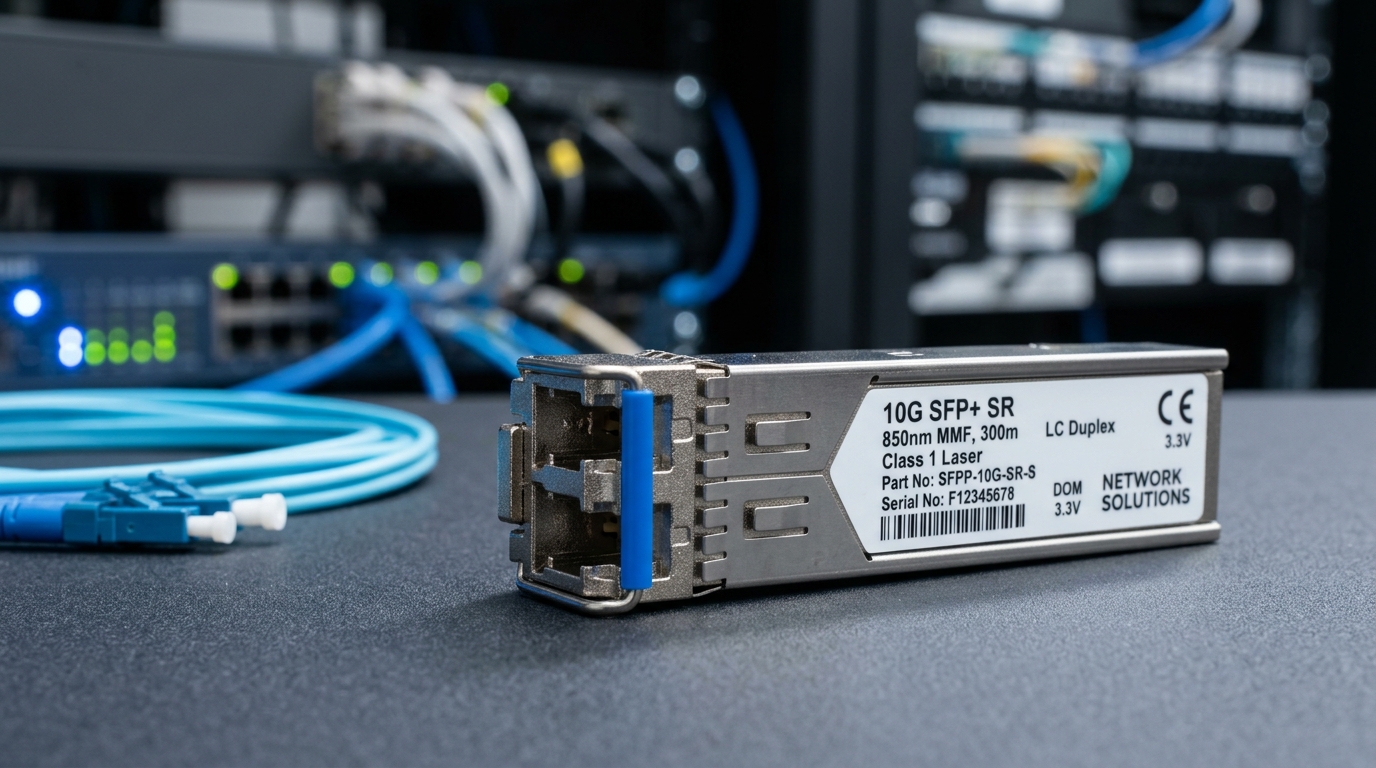
Reach ratings assume a particular optical budget and a target bit error rate (BER). In practice, SNR is shaped by transmitter power, fiber attenuation, chromatic dispersion (for certain modulation formats and bit rates), connector losses, and receiver electrical noise. Even if two transceivers share the same wavelength and nominal launch power, their effective SNR can differ due to laser relative intensity noise (RIN), receiver front-end design, and DSP equalization strength.
For typical intensity-modulated direct-detection (IM-DD) optics (for example, 10G SR on multimode), the receiver sensitivity is often specified as a minimum optical power to achieve a target BER such as 1e-12 or 1e-15 depending on the standard. Sensitivity implicitly includes the noise floor and therefore correlates with SNR at the receiver. For coherent optics (for example, 100G/200G/400G coherent), SNR is more directly connected to demodulation quality and symbol decision metrics, and the link design uses different margins.
Operationally, SNR is what determines whether your link can tolerate impairments like aging optics, dirty connectors, or higher-than-expected splitter loss. A field engineer often sees this as “it worked yesterday, then started degrading after a patch change,” because the patch panel introduced extra insertion loss that reduced received optical power and SNR simultaneously.
Head-to-head: SNR optical transceiver options by architecture
Below is a practical comparison of common pluggable categories. The key idea is that SNR is not a single spec you can read on every vendor page; you infer it through sensitivity, output power, and sometimes DOM telemetry. Engineers should also check whether the module provides digital diagnostics (DOM) and whether the host switch enforces optical compliance thresholds.
| Transceiver class | Typical data rate | Wavelength | Connector | Nominal reach | How SNR shows up in practice | Operating temperature |
|---|---|---|---|---|---|---|
| SFP / SFP+ | 1G to 10G | 850 nm (MM), 1310/1550 nm (SM) | LC | Up to a few km (SM) or tens to hundreds of meters (MM) | Receiver sensitivity and equalization margin dominate; connector dirt strongly impacts SNR | Commercial and industrial variants often available |
| QSFP+ / QSFP28 | 40G to 100G | 850 nm (MM) or 1310/1550 nm (SM) | LC (usually) | ~100 m to multiple km depending on optics and fiber type | DSP and lane-level noise budgets; higher sensitivity requirements at high bit rates | Typically commercial (0 to 70 C) unless specified |
| Coherent pluggables (where available) | 100G to 400G | Typically C-band or tuned bands | Varies; often fiber-specific connectors | Multiple tens of km with proper design | SNR is tied to demodulation quality; OSNR and effective optical SNR matter more than raw power | Vendor-dependent; often tighter thermal stability requirements |
Concrete examples include vendor-validated modules like Cisco SFP-10G-SR (10G SR), Finisar-style long-running SR families such as FTLX8571D3BCL, and third-party equivalents from retailers like FS.com (for example, FS.com SFP-10GSR-85 style offerings). Always verify that the exact part number matches your host switch optics compatibility list and that the DOM behavior is supported by your platform.
How to interpret “SNR” when vendors do not publish it
Many vendors do not publish a direct SNR number because SNR depends on the system test conditions and receiver bandwidth. Instead, they publish transmitter output power, receiver sensitivity, and compliance to IEEE or vendor test procedures. Engineers can approximate the SNR impact by tracking received optical power via DOM and comparing it to the module’s sensitivity floor, then adding margin for connector aging and temperature drift.
For IM-DD optics, a common field method is to measure Rx power at install and then after any change. If Rx power moves closer to sensitivity by more than the expected budget drift (often a few dB over time depending on cleaning practices and patch panel quality), you should treat it as an SNR risk even if link nominally stays up.
Pro Tip: If your host switch reports “Rx power low” or increments FEC/BER error counters as temperature rises, do not immediately swap the module. First clean both ends and re-seat the patch cords; the resulting SNR recovery is often larger than what you get by switching between two “similar” third-party transceivers with different receiver front-end noise figures.
Compatibility and cost tradeoffs: OEM vs third-party SNR behavior
OEM optics are validated against specific switch and backplane conditions, including DOM interpretation and host-side thresholds. Third-party modules can be excellent, but SNR-relevant behavior may differ subtly: different laser RIN, different receiver amplification stages, and different DSP equalization settings. These differences can affect link margin under marginal conditions, especially at the ends of the supported temperature range.
Cost is also a TCO problem, not just a purchase price. OEM modules may cost more per unit, but the field failure rate and the time spent troubleshooting incompatibilities can dominate. In many operations, the “hidden cost” is labor: a truck roll to replace a module or to re-terminate fibers can exceed the price delta within a single incident.
Typical street pricing varies by generation and density. As a rough planning range, 10G SR pluggables may land in the low tens of dollars per unit for third-party, while OEM can be higher. QSFP28 and coherent-class modules are dramatically more expensive, so the ROI calculation shifts toward minimizing downtime and ensuring deterministic compatibility.
Selection criteria checklist for SNR-aware transceiver choice
- Distance and optical budget: confirm fiber attenuation, patch cord loss, splice loss, and any splitter or harness loss; compute received power at worst case.
- Required sensitivity / BER target: align with the host’s FEC mode and its expected pre-FEC BER or error counter behavior.
- Switch compatibility: verify the exact part number on the host vendor’s compatibility list; check whether DOM is read correctly.
- DOM support and telemetry granularity: confirm you can read Tx power, Rx power, temperature, and alarm thresholds; ensure alarm events are actionable.
- Operating temperature: match module temperature class to chassis ambient; watch for bias current drift at high temperature.
- Vendor lock-in risk: consider procurement strategy; if you standardize on one OEM, plan for lifecycle replacement and lead-time buffers.
- Connector ecosystem: confirm LC type, polish grade, and cleaning tooling; poor polishing can erase your SNR margin regardless of module choice.
Comparison matrix: which factor most impacts SNR in your network
Engineers often focus on optical budget first, but SNR sensitivity is also strongly affected by physical layer hygiene and host behavior. The matrix below maps common failure modes to the most influential SNR driver.
| Scenario | Most likely SNR driver | What to check | Likely fix |
|---|---|---|---|
| New patch installed, link flaps under load | Connector insertion loss and back-reflection noise | DOM Rx power delta vs baseline; inspect patch panel; verify polarity | Clean and re-terminate; replace patch cords; verify correct transmit/receive direction |
| Link works at room temp, fails in summer | Laser bias drift and receiver noise increase | DOM temperature and bias; compare to module temperature class | Use industrial-rated modules; improve airflow; re-check thermal derating |
| High error counts after a chassis move | Mechanical stress-induced microbends | Optical return loss symptoms; check cable routing radius | Re-route cables to avoid tight bends; inspect fiber for stress |
| Only third-party modules fail on one switch model | Host-side threshold or DOM compatibility | Alarms, vendor logs; compare DOM values across modules | Use compatible part numbers; update firmware; standardize on validated optics |
Real-world deployment: SNR margin in a leaf-spine data center
In a 3-tier data center leaf-spine topology with 48-port 10G ToR switches, each leaf uplinks to spines using 10G SR over OM3 multimode fiber. During a rollout, the team targeted a conservative optical design: average patch cord loss of 0.5 dB per cord, 0.2 dB per mated adapter, and typical fiber attenuation around 3.5 dB/km for OM3 at 850 nm. They validated that baseline DOM Rx power sat around -6 dBm, with sensitivity margin of roughly 3 to 5 dB depending on module family.
Six months later, a subset of ports began showing rising error counters during peak traffic and cooler-to-warmer transitions. The investigation showed that several patch panel ports had been re-cabled without using end-face inspection. After cleaning with proper fiber inspection and re-terminating two LC pairs, Rx power returned to the earlier range and the error counters stabilized. This is a classic SNR optical transceiver lesson: small physical changes can collapse SNR margin even when nominal reach and budget calculations still “should” work.
Common mistakes and troubleshooting: SNR-related failure modes
Below are concrete pitfalls seen in the field, with root causes and targeted fixes. Treat each as a hypothesis test: measure first, then swap or rework.
Ignoring connector cleanliness and polishing grade
Root cause: Dirty LC end faces add insertion loss and increase back-reflection, degrading SNR and sometimes triggering receiver overload or noisy decision thresholds. Symptom: Rx power is lower than baseline by more than expected budget drift, while transmitted power remains normal. Solution: Inspect end faces with a fiber microscope, clean using correct lint-free methods, and replace patch cords if scratches or contamination persist.
Using modules outside the intended temperature class
Root cause: Laser bias current drift and receiver noise figure changes reduce effective SNR at high ambient. Symptom: Errors correlate with chassis temperature or time-in-service under warm conditions. Solution: Deploy modules with temperature rating aligned to the chassis airflow plan; improve cooling and confirm that the switch meets its own ambient spec.
Assuming “same part number family” equals identical SNR behavior
Root cause: Different revisions, DSP settings, or vendor-selected component lots can shift receiver sensitivity and noise characteristics. Symptom: One module brand works reliably; another “compatible” module shows intermittent link drops. Solution: Lock to validated part numbers, standardize procurement, and use DOM alarms to compare Rx power and temperature/bias trends across vendors.
Misinterpreting DOM telemetry units and thresholds
Root cause: Some platforms display optical power in different sign conventions or update rates; alarms may trigger on thresholds that are not aligned with your expected margin. Symptom: Engineers chase the wrong culprit because the telemetry looks “normal” even while errors rise. Solution: Confirm units and alarm meanings in the host switch documentation, then correlate telemetry to error counters over time.
Which option should you choose?
If you run a mature enterprise or data center network with stable fiber plants and you need predictable behavior, choose the option with the strongest compatibility validation: validated OEM optics or third-party modules explicitly listed for your switch model. If you are optimizing procurement cost while keeping reliability, choose third-party optics that match the exact part number family and temperature class, and enforce a strict fiber inspection and cleaning workflow to protect SNR margin. If you operate long-haul or metro links using coherent architectures, prioritize vendors that publish link performance methodology aligned with optical OSNR and the system’s FEC behavior, since “power only” budgeting will not capture SNR degradation.
For the next step, review your host switch optics requirements and align them with a measurement-driven process using DOM; start with how to read DOM telemetry for transceiver health.
FAQ
What does SNR mean for an optical transceiver in real deployments?
In practice, SNR reflects the quality of the received signal relative to noise in the receiver front end and DSP. Vendors may not publish a direct SNR value, so you infer it from receiver sensitivity, measured Rx power, and error counter behavior under your actual fiber and temperature conditions.
Can I compare two SNR optical transceivers using only reach and wavelength?
No. Reach is an engineering target under assumed budgets and test conditions; SNR depends on noise figure, RIN, connector losses, and host-side thresholds. Two modules with the same reach can behave differently when margins shrink due to aging patch cords or higher ambient temperature.
How do DOM telemetry values help with SNR troubleshooting?
DOM provides operational metrics like Tx power, Rx power, temperature, and sometimes bias current. By correlating Rx power trends and temperature with error counters, you can identify whether SNR degradation is caused by optical budget loss, thermal drift, or a compatibility issue.
Are third-party SNR optical transceivers safe to use in enterprise switches?
Often yes, but only when the exact part number is validated for your switch model and firmware. Even then, differences in receiver sensitivity and DOM interpretation can affect marginal links, so start with non-critical ports and monitor error counters during rollout.
What is the fastest way to recover link stability when SNR margin collapses?
Clean and inspect both fiber ends first, then verify patch cord polarity and seating. Next, compare Rx power to baseline across temperature changes; if the drift is thermal, plan airflow improvements or switch to the correct temperature class.
Do coherent optics require a different SNR approach than SR or LR?
Yes. Coherent systems are sensitive to OSNR and demodulation quality, and the relevant margins often tie to FEC and symbol decision metrics rather than only received optical power. You should follow the system vendor’s optical design methodology for OSNR and dispersion assumptions.
Author bio: I work with deployed fiber systems and pluggable optics in production networks, focusing on measurement-first troubleshooting using DOM telemetry and error counters. I update this guidance based on field failures, vendor datasheet constraints, and IEEE-aligned interoperability lessons.
