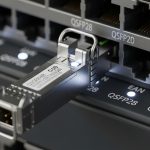
Choosing the right transceiver module is critical for optimizing data center network performance. This article delivers a comprehensive SFP module comparison focused on SFP and QSFP form factors, helping network engineers select the best fit for their high-density environments. Whether upgrading ToR switches or designing spine-leaf fabrics, understanding these modules’ specs and use cases is vital.
Understanding SFP and QSFP: Form Factor and Functionality
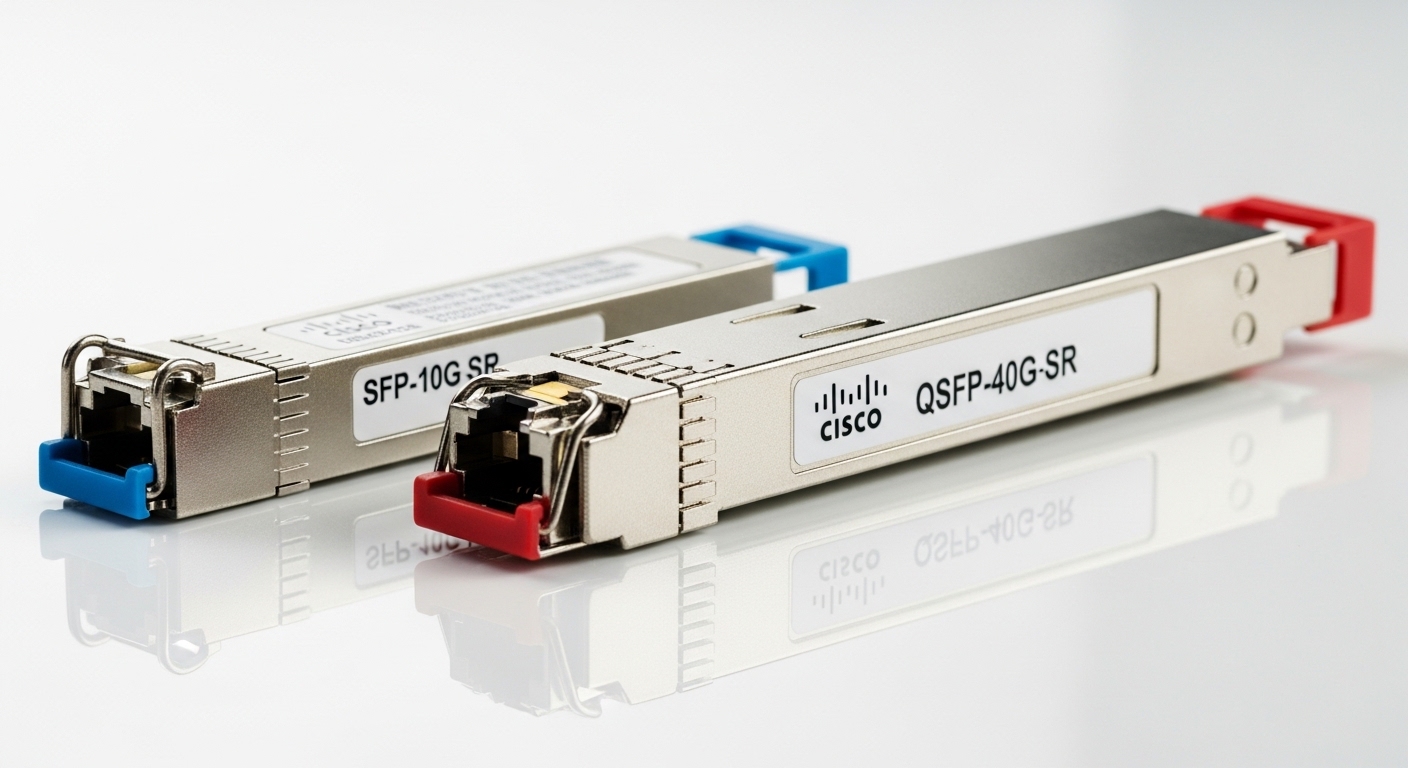
Small Form-factor Pluggable (SFP) and Quad Small Form-factor Pluggable (QSFP) transceivers are hot-swappable optical modules used widely in data centers. SFP modules typically support speeds of 1G to 10G, while QSFP modules bundle four lanes, supporting 40G, 100G, or more. The choice between SFP and QSFP depends on bandwidth requirements, port density, and infrastructure compatibility.
Technical Overview
SFP modules, such as the Cisco SFP-10G-SR, support 10Gbps over multimode fiber with a typical reach of 300 meters at a wavelength of 850nm. QSFP modules like the Finisar FTLX8571D3BCL aggregate four 10G channels for 40Gbps total throughput, often using MPO/MTP connectors. The IEEE 802.3 standard governs specifications for both, ensuring interoperability among vendors.
Detailed Specifications Comparison
| Specification | SFP-10G-SR | QSFP-40G-SR4 | QSFP-100G-SR4 |
|---|---|---|---|
| Data Rate | 10 Gbps | 40 Gbps (4x10G) | 100 Gbps (4x25G) |
| Wavelength | 850 nm | 850 nm | 850 nm |
| Max Reach | 300 m over OM3 fiber | 100 m over OM3 fiber | 70 m over OM3 fiber |
| Connector Type | LC Duplex | MPO/MTP | MPO/MTP |
| Operating Temp | 0 to 70°C (Standard) | 0 to 70°C (Standard) | 0 to 70°C (Standard) |
| Power Consumption | 1.5 W typical | 3.5 W typical | 4 W typical |
| DOM Support | Yes | Yes | Yes |
Note: OM3 fiber is a common multimode fiber type in data centers, aligning with IEEE 802.3 standards for short reach.
Real-World Deployment Scenario: Leaf-Spine Data Center Using SFP and QSFP
Consider a 3-tier data center topology with a leaf-spine architecture using 48-port 10G ToR (Top-of-Rack) switches connected to 100G spine switches. Here, SFP-10G-SR modules populate the ToR switches, providing 10G connectivity per rack. QSFP-100G-SR4 modules are installed in spine switches to aggregate traffic from multiple leaf switches via breakout cables (1x100G QSFP to 4x10G SFP). This setup balances high port density and bandwidth aggregation efficiently.
In this environment, the choice of modules directly impacts cable management, power budget, and upgrade paths. The QSFP’s MPO connector streamlines cabling, while SFP modules maintain backward compatibility with legacy 10G links.

Selection Criteria for SFP vs QSFP Modules
- Required Bandwidth: Determine if 10G per port suffices or if aggregation (40G, 100G) is necessary for spine or core layers.
- Reach and Fiber Type: Match module wavelength and max distance to fiber infrastructure (OM3, OM4, single-mode).
- Switch Compatibility: Confirm vendor and model support for specific transceiver part numbers (Cisco SFP-10G-SR, FS.com SFP-10GSR-85, etc.).
- Digital Optical Monitoring (DOM): Choose modules with DOM if real-time diagnostics are needed.
- Operating Environment: Consider temperature ranges, especially for edge or non-AC data center rooms.
- Vendor Lock-in and Warranty: Evaluate OEM vs third-party modules for cost, warranty, and interoperability risks.
Common Mistakes and Troubleshooting Tips
- Mismatch of Fiber and Module Type: Using single-mode modules on multimode fiber leads to severe signal loss. Always verify fiber type compatibility before deployment.
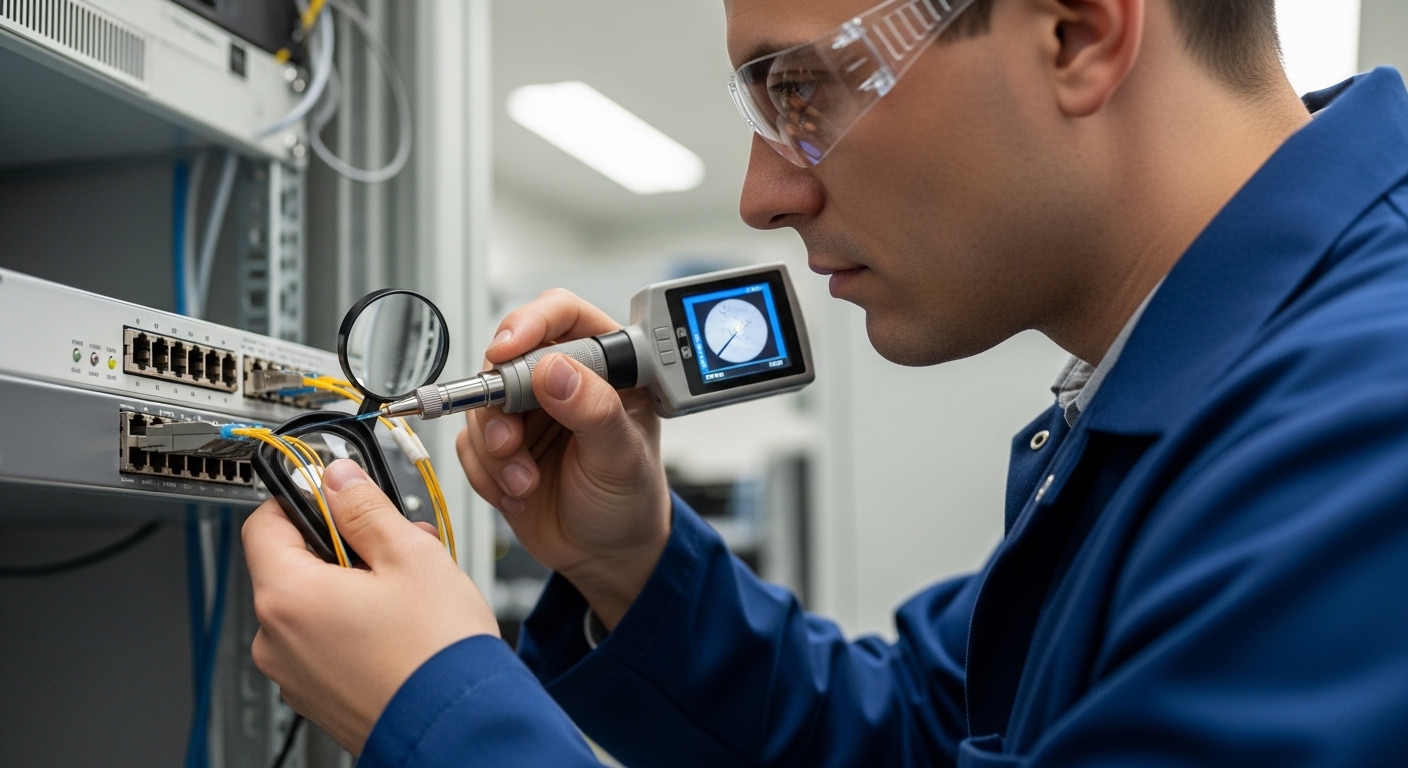
- Incorrect Connector Cleaning: Dirty LC or MPO connectors cause high insertion loss. Use lint-free wipes and isopropyl alcohol for cleaning before installation.
- Ignoring DOM Alarms: Overlooking digital diagnostics alerts can mask faults. Monitor transmit power, temperature, and voltage regularly via switch interfaces.
- Firmware or Compatibility Issues: Some switches require specific transceiver firmware versions. Validate compatibility with switch OS releases to avoid link flapping.
Cost and ROI Considerations
OEM SFP modules like Cisco SFP-10G-SR typically cost between $200-$300 per unit, whereas third-party alternatives such as FS.com SFP-10GSR-85 can be 30-50% cheaper. QSFP modules, due to higher complexity and bandwidth, range from $800 to $1500 depending on speed and vendor. While initial savings with third-party modules are attractive, consider total cost of ownership (TCO) factoring in power consumption, failure rates, and vendor support.
QSFP modules consume roughly twice the power of SFPs, influencing cooling budgets in large deployments. However, their bandwidth aggregation often reduces the number of physical ports and cables, simplifying management and lowering operational expenses in the long run.
Pro Tip: In high-density data centers, deploying QSFP modules with breakout cables to SFP ports can extend switch lifespan by enabling flexible speed migration without costly full chassis upgrades.
FAQ
- Q: Can I use SFP modules in QSFP ports with adapters?
A: Typically, no. QSFP ports are designed for 4-lane operation and different connectors. Breakout cables are used instead to split QSFP into multiple SFP lanes. - Q: How do I verify if a third-party SFP module is compatible with my switch?
A: Check the switch vendor’s transceiver compatibility list and verify EEPROM information using CLI commands to ensure the module is recognized. - Q: What factors limit the maximum reach of SFP modules?
A: Fiber type, wavelength, connector quality, and optical power budget all influence reach. For example, standard 10G SR modules over OM3 fiber typically max out at 300 meters. - Q: Are QSFP modules future-proof for next-gen data centers?
A: QSFP modules, especially 100G variants, support evolving standards like IEEE 802.3bs and 802.3cd, making them a solid choice for scaling bandwidth. - Q: How important is DOM support in choosing SFP modules?
A: DOM provides vital real-time monitoring of optical parameters, improving troubleshooting speed and network reliability, highly recommended in critical environments.
In summary, the right choice between SFP and QSFP modules depends heavily on network design goals, budget, and future scalability. For detailed deployment strategies and advanced optical network insights, explore our Data Center Optical Networking resources.
Author Bio: Alex Thornton is a network infrastructure engineer with over 12 years of experience designing and optimizing large-scale data center networks. He specializes in optical transceiver technologies and vendor interoperability testing.