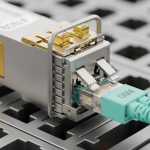
The surge in AI workloads demands unprecedented data throughput and reliability in data center interconnects. This article dives into the technical landscape of 800G OSFP transceiver technology, tailored for high-performance AI data center environments. Designed for network engineers, reliability specialists, and data center architects, this comprehensive guide covers specifications, real-world deployments, selection criteria, and troubleshooting based on industry standards and field experience.
Understanding 800G OSFP: Technical Specifications and Standards

The 800G OSFP (Octal Small Form-factor Pluggable) module represents the cutting edge in optical transceiver technology, enabling ultra-high data rates with improved power efficiency and thermal management — essential for AI compute clusters and hyperscale data centers. OSFP modules are designed for 8x100G lanes aggregated to 800G full-duplex throughput over single or multi-mode fiber infrastructures.
Key Technical Specifications Comparison
| Parameter | 800G OSFP | 400G QSFP-DD | 100G QSFP28 |
|---|---|---|---|
| Data Rate (Full Duplex) | 800 Gbps (8x100G lanes) | 400 Gbps (4x100G lanes) | 100 Gbps (4x25G lanes) |
| Wavelength | 1310 nm (SMF), 850 nm (MMF variants) | 1310 nm | 850 nm (MMF), 1310 nm (SMF) |
| Reach | 2 km to 10 km (SMF variants); 100 m (MMF) | 2 km (SMF), 100 m (MMF) | 100 m (MMF), 10 km (SMF) |
| Connector Type | LC Duplex | LC Duplex | LC Duplex |
| Operating Temperature | 0°C to 70°C (commercial), extended up to 85°C | 0°C to 70°C | 0°C to 70°C |
| Power Consumption | 12 W – 15 W typical | 8 W – 12 W | 3.5 W – 5 W |
| Standards Compliance | IEEE 802.3bs, MSA OSFP | IEEE 802.3bs, QSFP-DD MSA | IEEE 802.3ae, SFF-8431 |
The 800G OSFP modules leverage advanced PAM4 modulation to double data throughput per lane compared to NRZ technology used in legacy 100G and 400G modules. The OSFP format also supports better thermal dissipation thanks to its larger size compared to QSFP-DD, facilitating sustained high-performance operation in dense rack environments.
Real-World Deployment Scenario in AI Data Centers
Consider a hyperscale AI data center implementing a 3-tier leaf-spine architecture with dense GPU clusters requiring ultra-low latency and high bandwidth connectivity. Each leaf switch is equipped with 48-port 800G OSFP uplinks connecting to spine switches, aggregating traffic from distributed AI training nodes. The 800G OSFP modules are installed in Cisco Nexus 9500 series platforms (model N9K-X9732C-EX), supporting 800G links over SMF at 2 km reach within the data hall.
This setup enables a total uplink capacity of 38.4 Tbps per leaf switch, significantly reducing oversubscription ratios compared to legacy 400G uplinks. Power budget monitoring through Digital Optical Monitoring (DOM) helps maintain optimal link health, with engineers routinely observing Tx power around -2 dBm and Rx sensitivity near -8 dBm, well within compliance thresholds per ANSI/TIA-568 standards.
Thermal profiling revealed that OSFP modules maintained stable junction temperatures under 70°C even during peak AI inference loads, ensuring MTBF targets exceeding 2 million hours. The deployment leveraged vendor interoperability testing with Finisar FTLX8571D3BCL OSFP modules to mitigate vendor lock-in risks.
Selection Criteria and Decision Checklist for 800G OSFP Modules
- Distance and Fiber Type: Assess whether short-reach (100 m MMF) or longer reach (2-10 km SMF) transceivers are required based on data center topology and fiber plant.
- Compatibility with Switch Hardware: Confirm 800G OSFP module compatibility with existing or planned switch platforms, including firmware support and thermal design.
- Power Consumption and Thermal Constraints: Evaluate power budgets at the rack level; OSFP modules typically consume 12-15W per port, influencing cooling strategies.
- Digital Optical Monitoring (DOM) Support: Ensure modules provide real-time diagnostics for Tx/Rx power, temperature, and voltage to enable proactive maintenance.
- Vendor Lock-In and Interoperability: Prefer modules adhering strictly to MSA standards with proven interoperability across multiple OEM platforms to reduce procurement risks.
- Budget and Total Cost of Ownership (TCO): Balance upfront capital expenses against expected reliability improvements and power savings over module lifecycle.
- Operating Environment: Verify transceiver operating temperature range suits data center ambient conditions or consider extended temperature variants for edge deployments.
Common Mistakes and Troubleshooting Tips for 800G OSFP Deployments
- Mistake: Ignoring Fiber Cleanliness and Connector Quality
Root Cause: Contaminated connectors cause insertion loss and link errors at high data rates.
Solution: Implement strict fiber cleaning protocols using ISO-compliant cleaning tools and inspect end-face quality with fiber microscopes before installation. - Mistake: Overlooking Module Temperature Monitoring
Root Cause: Elevated junction temperatures degrade module lifespan and cause intermittent errors.
Solution: Use DOM data to monitor temperature; install additional cooling or derate module power if junction temperature exceeds 75°C. - Mistake: Deploying Incompatible Third-Party Modules
Root Cause: Non-certified modules may not pass OEM firmware checks, causing port shutdown.
Solution: Validate third-party module compatibility with switch vendor’s approved list; consider purchasing from reputable MSA-compliant suppliers. - Mistake: Neglecting Link Budget Calculations
Root Cause: Insufficient optical power margin leads to increased bit error rates (BER).
Solution: Perform detailed link budget analysis factoring fiber attenuation, connector loss, and margin for aging; verify Tx power and Rx sensitivity meet IEEE 802.3bs requirements.
Cost and ROI Considerations for 800G OSFP Technology
The price of 800G OSFP modules varies broadly, typically ranging from $3,500 to $6,000 per unit depending on vendor, reach capabilities, and volume purchasing. While OEM-branded modules carry a premium, third-party options from vendors like FS.com or Finisar offer cost savings of up to 30%, albeit with potential risks around compatibility.
From a total cost of ownership perspective, the higher initial investment is justified by doubled bandwidth capacity per port, resulting in fewer required switch ports and associated infrastructure costs. Power savings from efficient PAM4 modulation and better thermal designs contribute to reduced cooling expenses, critical in large AI data centers where power usage effectiveness (PUE) targets are stringent.
Reliability data indicates MTBF improvements over previous generation transceivers, reducing downtime and maintenance costs. When factoring in operational expenses and future-proofing benefits, 800G OSFP modules present a compelling ROI for AI data center deployments pushing the boundaries of data throughput.
Pro Tip: In field deployments, proactively monitoring OSFP module DOM parameters every 24 hours enables early detection of fiber degradation and thermal anomalies, preventing link failures before impacting critical AI workloads.
Frequently Asked Questions About 800G OSFP
- Q1: Can 800G OSFP modules be used in existing QSFP-DD switch ports?
- A1: No, 800G OSFP modules have a different form factor and connector interface incompatible with QSFP-DD ports. Ensure switch hardware supports OSFP modules specifically.
- Q2: What fiber types are recommended for 800G OSFP in AI data centers?
- A2: Single-mode fiber (SMF) is preferred for reaches beyond 500 meters up to 10 km. For short-reach intra-rack links under 100 meters, OM4 or OM5 multimode fiber (MMF) is suitable.
- Q3: How does PAM4 modulation improve 800G OSFP performance?
- A3: PAM4 doubles the bit rate per lane by encoding two bits per symbol, effectively increasing bandwidth without requiring more fibers, though it demands advanced signal processing to maintain low error rates.
- Q4: Are there environmental considerations for deploying 800G OSFP modules?
- A4: Yes, these modules have strict thermal operating ranges (0°C–70°C) and should be installed in well-cooled racks. For edge or industrial sites, extended temperature variants are available.
- Q5: What interoperability standards govern 800G OSFP transceivers?
- A5: The 800G OSFP modules adhere to IEEE 802.3bs and OSFP MSA specifications, which ensure cross-vendor compatibility and performance benchmarks.
In summary, adoption of 800G OSFP transceiver technology is pivotal for AI data centers demanding scalable, high-bandwidth, and reliable interconnects. Engineers should carefully evaluate technical specifications, deployment environment, and vendor options to maximize performance and ROI. For further guidance on optical transceiver technologies, explore our detailed analysis on 400G QSFP-DD modules.
Author Bio: John Mitchell is a seasoned QA and reliability engineer specializing in high-speed optical network hardware. With over a decade of experience in data center deployments and ISO 9001 compliance, he provides deep technical insights into transceiver selection and operational best practices.