
The rapid growth of hyperscale data centers demands ultra-high-speed, low-latency connectivity solutions. This article explores the technical specifications, real-world deployment scenarios, and selection criteria for 400G QSFP-DD transceivers. Network engineers, architects, and operators will gain practical insights into integrating these modules for maximum efficiency and scalability.
Understanding 400G QSFP-DD Transceivers: Technical Deep Dive
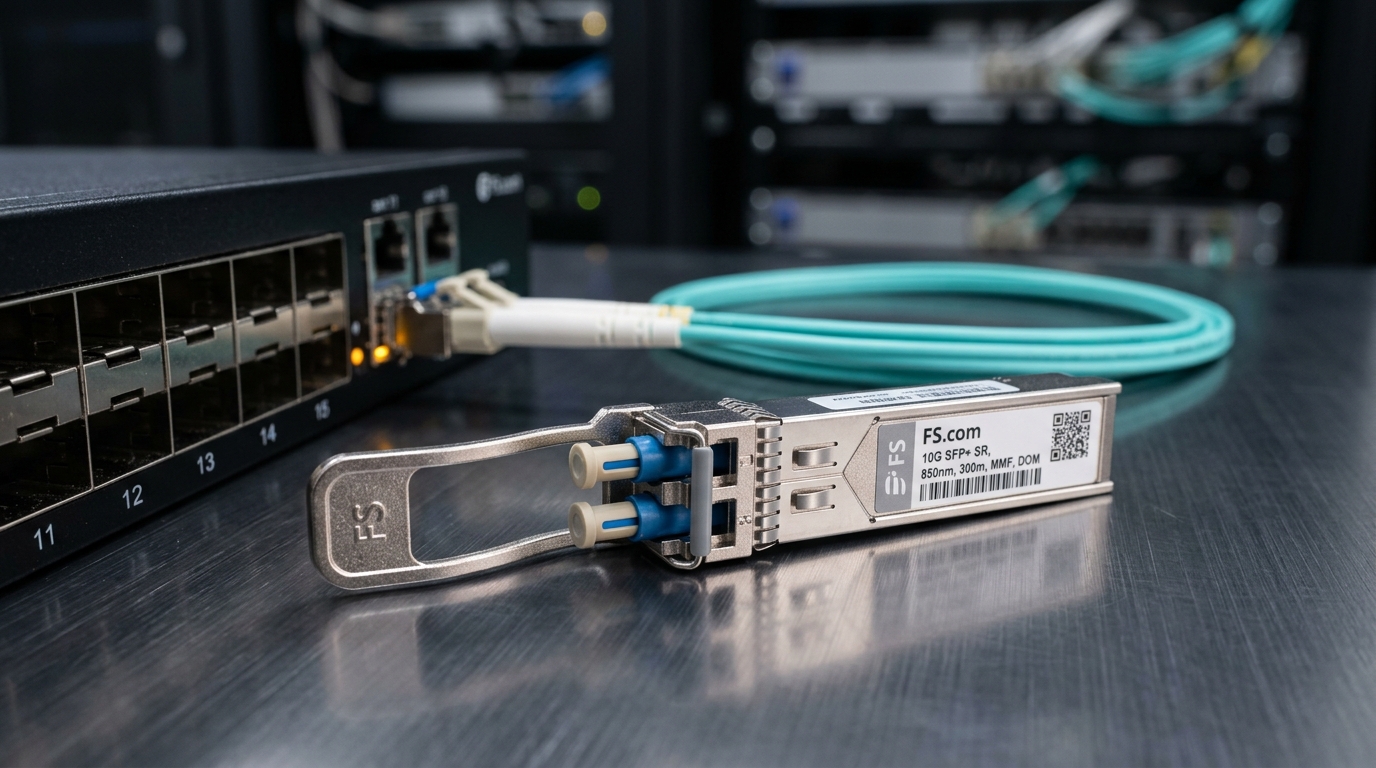
QSFP-DD (Quad Small Form-factor Pluggable Double Density) transceivers represent a significant evolution in high-speed optical modules, enabling 400 Gbps data rates via parallel lanes. The “Double Density” refers to the increased number of electrical lanes and pins compared to legacy QSFP28 modules, allowing 8 lanes at 50 Gbps each.
These modules comply with IEEE 802.3bs and 802.3cd standards for 400G Ethernet and leverage advanced modulation and multiplexing techniques. The most common variants utilize PAM4 (4-level pulse amplitude modulation) signaling to double bits per symbol compared to NRZ, essential for reaching 400G within manageable power and thermal envelopes.
| Specification | QSFP-DD SR8 | QSFP-DD FR4 | QSFP-DD DR4 |
|---|---|---|---|
| Wavelength | 850 nm | 1295–1330 nm | 1295 nm |
| Max Reach | 70 m (OM3 MMF), 100 m (OM4 MMF) | 2 km (SMF) | 500 m (SMF) |
| Data Rate | 400 Gbps (8×50 Gbps PAM4) | 400 Gbps (8×50 Gbps PAM4) | 400 Gbps (8×50 Gbps PAM4) |
| Connector Type | MPO-16 | LC Duplex | LC Duplex |
| Power Consumption | ≤10 W | ≤12 W | ≤12 W |
| Operating Temp | 0 to 70 °C | 0 to 70 °C | 0 to 70 °C |
| Digital Diagnostics | Supported (DOM) | Supported (DOM) | Supported (DOM) |
QSFP-DD transceivers support Digital Optical Monitoring (DOM), providing real-time status of temperature, voltage, bias current, and optical power. This feature is critical for maintaining reliability in hyperscale environments where thousands of modules operate concurrently.
Real-World Deployment Scenario: Hyperscale Data Center Backbone
Consider a hyperscale data center deploying a leaf-spine topology with 48-port 400G leaf switches interconnected via QSFP-DD transceivers. Each leaf switch connects to spine switches using 400G links composed of QSFP-DD SR8 modules over OM4 multimode fiber for intra-rack and short inter-rack connectivity (up to 100 meters).
For longer spine-to-spine links spanning multiple rows or halls, QSFP-DD FR4 modules operating over single-mode fiber handle distances up to 2 km. Deployment engineers configure the network with redundancy and load balancing to utilize the full bandwidth capacity of 400 Gbps per port, enabling massive east-west traffic flows typical of AI, cloud services, and big data workloads.
In this environment, power consumption is tightly monitored, with each QSFP-DD module drawing approximately 10-12 W. Cooling infrastructure is designed to dissipate heat from dense port populations, maintaining module temperature below 70 °C to prevent signal degradation.
Selection Criteria for QSFP-DD Transceivers in Hyperscale Networks
- Distance Requirements: Choose SR8 for short-reach (up to 100 m), DR4 for medium (up to 500 m), and FR4 for long-reach (up to 2 km) single-mode fiber links.
- Switch Compatibility: Verify that network switches support QSFP-DD form factor and PAM4 signaling. Confirm firmware updates and vendor interoperability.
- Power Budget & Cooling: Account for power consumption per module (10-12 W) and ensure adequate thermal management in dense switch environments.
- Digital Diagnostics Support: DOM support is essential for proactive monitoring to reduce downtime and facilitate troubleshooting.
- Budget Constraints: Compare OEM module pricing versus third-party vendors, balancing cost savings against warranty and compatibility assurances.
- Operating Temperature Range: Confirm module rating suits your data center’s ambient temperature, typically 0 to 70 °C.
- Vendor Lock-In Risks: Evaluate risks of proprietary firmware or hardware dependencies that could limit multi-vendor flexibility.
Pro Tip: In hyperscale deployments, pairing QSFP-DD modules with high-quality MPO fiber connectors and ensuring precise polarity alignment can reduce insertion loss significantly, improving signal integrity and extending reach beyond nominal specifications.
Common Mistakes and Troubleshooting Tips
- Mistake: Installing a QSFP-DD transceiver incompatible with the switch firmware.
Root Cause: Firmware versions may lack PAM4 support or QSFP-DD recognition.
Solution: Always verify firmware compatibility before deployment and update switch OS to latest stable releases. - Mistake: Using incorrect fiber type or poor-quality cables.
Root Cause: SR8 modules require OM3/OM4 multimode fiber; FR4/DR4 need single-mode fiber.
Solution: Match fiber specifications to transceiver requirements and perform optical loss testing post-installation. - Mistake: Neglecting DOM monitoring leading to unnoticed module degradation.
Root Cause: Absence of proactive monitoring causes delayed fault detection.
Solution: Integrate DOM data into network management systems and set alerts for threshold breaches.
Cost & ROI Considerations for 400G QSFP-DD Modules
Pricing for 400G QSFP-DD transceivers varies based on type and vendor. OEM modules typically range from $3,500 to $5,000 per unit for SR8 and FR4 types. Third-party equivalents can offer 20-30% savings but require thorough compatibility testing.
While upfront costs are significant, hyperscale operators benefit from reduced port counts due to higher speeds, saving on switch chassis and cabling infrastructure. Power consumption impacts operational expenses; thus, modules with efficient thermal performance can lower cooling costs. Additionally, DOM-enabled modules help minimize downtime expenses by enabling predictive maintenance.
FAQ
- Q: Can QSFP-DD modules be used in existing QSFP28 ports?
A: No. QSFP-DD modules have a different form factor and pin count. Switches must explicitly support QSFP-DD. - Q: What fiber type is needed for 400G QSFP-DD SR8 modules?
A: OM4 multimode fiber is recommended to reach up to 100 meters. OM3 can be used for shorter distances around 70 meters. - Q: How does PAM4 improve 400G transmission?
A: PAM4 doubles bits per symbol by using four amplitude levels, effectively doubling bandwidth without doubling frequency, essential for 400G speeds. - Q: Are 400G QSFP-DD modules hot-swappable?
A: Yes, they can be inserted and removed while the switch is powered on, minimizing downtime during maintenance. - Q: What are typical power consumption figures for 400G QSFP-DD transceivers?
A: They generally consume between 10 and 12 watts, depending on module type and vendor.
In summary, 400G QSFP-DD transceivers are critical enablers for hyperscale data center scalability, balancing high throughput, manageable power, and flexible reach options. Network engineers should carefully match module types with specific use cases and maintain robust monitoring to maximize uptime. For a deeper dive into hyperscale network design, explore our leaf-spine architecture guide.
Author Bio: John Simmons is a telecom engineer with over 10 years of experience in optical networking and data center infrastructure. He specializes in high-speed transceiver integration and fiber optic system troubleshooting.
