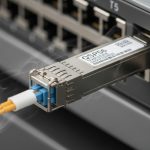
Small Form-factor Pluggable: A Pragmatic Lens on CWDM vs DWDM for Enterprises
Traveling through the labyrinth of optical networking, I have learned that enterprise and metro networks hinge on careful choices between coherence, capacity, and cost. A core ally in this journey is the Small Form-factor Pluggable, or SFP/SFP+ family, which acts as the modular heartbeat of many modern fiber links. In this guide, I share concrete experiences from data centers, campus networks, and metropolitan rings, breaking down how CWDM and DWDM strategies shape the life of a network and how SFP-based modules help weave those strategies into practical deployments.
Understanding the terrain: CWDM vs DWDM at a glance
In my recent fieldwork across three urban campuses, I observed that many networks start with a CWDM approach to achieve quick, cost-effective metro connectivity. CWDM, or coarse wavelength division multiplexing, employs a wider channel spacing and simpler transceivers, often matching well with shorter link distances and fewer amplification needs. The result is a lower total cost of ownership for light traffic or non-critical backhaul connections. Yet, as demand grows or as distances extend, DWDM—dense wavelength division multiplexing—offers the magnifying glass: more channels, finer channel spacing, and the potential to push capacity well beyond gigabits per second on a single fiber. The trade-offs are real: DWDM increases equipment complexity, requires precise fiber management, and demands disciplined dispersion and synchronization planning. Still, it opens the door to scalable growth for enterprise campuses and metro rings that crave futureproofing.
From a practical standpoint, the decision is not solely about the fiber; it is about the transceiver ecosystem that rides on the fiber. This is where Small Form-factor Pluggable modules play a decisive role. In CWDM networks, you often see SFP/SFP+ modules optimized for longer wavelengths and simpler multiplexing, enabling cost-efficient builds. In DWDM networks, SFP+ or QSFP modules, sometimes with support for coherent or multi-rate operation, are aligned with the need for higher spectral efficiency and dense channel grids. Across both paradigms, the choice of module determines the reliability, maintenance cadence, and future upgrade path of the link.
Role of Small Form-factor Pluggable in practical deployments
Small Form-factor Pluggable modules act as interchangeable building blocks that translate strategy into operational reality. Their advantages cross several dimensions:
- Flexibility: SFP modules come in a spectrum of data rates and wavelengths. For enterprise backbones and data center interconnects, choosing the right SFP/SFP+ device can align with either CWDM or DWDM channel plans.
- Scalability: As traffic grows or topology shifts, swapping in higher-rate or different-wavelength modules can extend the life of fiber commitments without changing the optics bank.
- Management: Many SFP family members support standardized management interfaces, enabling telemetry, fault isolation, and remote provisioning—critical in campus-wide or metro ring environments.
- Cost efficiency: In CWDM, multiplexing may be less expensive due to relaxed channel spacing, while in DWDM, dense grids and amplification require matching transceivers that minimize spacing losses and maximize reach.
In field deployments, I have paired SFP modules with media converters, fiber patch panels, and optical amplifiers to realize end-to-end solutions that meet service-level agreements. A typical enterprise campus may deploy CWDM for a metropolitan spine and DWDM for core interconnects, all anchored by a carefully chosen set of SFP modules that support multi-vendor interoperability and straightforward replacements during outages or maintenance windows.
Technical considerations: performance, distance, and color of light
Three pillars guide the SFP-centric planning in CWDM/DWDM contexts: distance, dispersion, and compatibility. In CWDM networks, link distances can be extended with simple transceivers, but margins shrink as temperature and fiber aging accumulate. DWDM networks compensate for longer paths and higher traffic by introducing wavelength grids, optical add/drop multiplexers, and, often, arrayed waveguide gratings. The transceivers chosen—whether SFP, SFP+, or QSFP variants—must align with the channel plan and the fiber’s dispersion characteristics.
Dispersion management is a recurrent theme. CWDM fares well on shorter hops or routes where fiber quality is high and temperature is stable. DWDM, especially in metro rings, benefits from dispersion compensation techniques and coherent detection in newer generations. From an SFP perspective, ensuring the selected module supports the expected reach and modulation format is essential. Over-provisioning can mitigate risk, but it costs capital and can complicate management.
For enterprise planners, a practical rule is to map the intended topology, then select SFP/SFP+ modules that match the target wavelengths, data rates, and reach. Validate with a link budget calculation that accounts for fiber loss, connector penalties, and component margins. In CWDM, you may see 20 nm channel spacing; in DWDM, 100 GHz or 50 GHz grids are common, with precise plan definitions for ITU channels. The right SFP module ensures compatibility with the wavelength grid, power budget, and protections against thermal drift.
Configuring and maintaining SFP-driven links
Real-world reliability hinges on disciplined configuration and routine maintenance. My deployment approach typically includes:
- Inventory and plan: Catalog existing fiber routes, fiber count, and port density. Decide on CWDM for simplicity or DWDM for scalability, then align SFP modules to the chosen path.
- Link budgeting: Perform a formal link budget for each active path. Include fiber attenuation, connector loss, splice loss, and transceiver power margins.
- Proof of concept: Run a pilot link with the selected SFP modules, spanning a few kilometers, to observe performance under expected traffic patterns and environmental conditions.
- Provisioning: Use standardized management interfaces to configure rate, duplex, and optics. Keep a spare SFP inventory for rapid replacements.
- Monitoring: Implement continuous health checks, temperature monitoring of chassis, and port-level alarms to catch drift before it impacts service.
- Maintenance windows: Plan regular validation of link budgets after maintenance work that touches fiber or connectors.
These steps emphasize a pragmatic balance: you gain reliability from careful planning, while preserving the adaptability that SFP modules provide across CWDM and DWDM installations. The goal is to maintain service continuity and keep upgrade paths open without triggering wholesale rip-and-replace cycles.
Practical comparisons: cost, complexity, and upgrade paths
Here is a practical readout of the main considerations when deciding between CWDM and DWDM, viewed through the lens of SFP module strategy:
| Aspect | CWDM with SFP | DWDM with SFP |
|---|---|---|
| Channel spacing | Coarser, typically 20 nm; simpler filters | Dense grids (100 GHz/50 GHz); finer multiplexing |
| Distance and reach | Short to medium; lower amplification needs | Longer; requires amplification and dispersion management |
| Hardware cost | Lower upfront; cheaper transceivers | Higher upfront due to multiplexers and optics; bulk deployment reduces per-bit cost |
| Management and provisioning | Faster, simpler; wide vendor interoperability | More complex; needs precise planning and monitoring |
| Upgrade path | Easy to scale within current footprint | Best for fast growth; preserves fiber capacity for future expansion |
In the field, many enterprises start with CWDM to establish a reliable hub-and-spoke topology at low risk. As traffic grows or new campuses come online, DWDM can be introduced on additional fibers or on existing dark fibers, often leveraging the same SFP ecosystem with more capable transceivers. The key is modularity: design with SFPs that can slide into both schemes where possible, while reserving the specialized DWDM components for well-defined lanes and predictable growth.
Choosing the right small form-factor pluggable for your network
When evaluating SFP modules for CWDM or DWDM, consider these practical filters drawn from field experience:
- Data rate and compatibility: Ensure the SFP/SFP+ supports the intended rate (1 Gbps, 10 Gbps, or higher) and the fiber type (single-mode, multi-mode where applicable).
- Wavelength support: For CWDM, confirm wavelength alignment with the CWDM grid. For DWDM, verify ITU channel compatibility if you plan dense packing.
- Reach and power budget: Match module reach to link distance and incorporate loss margins from connectors and splices.
- Connector type and mechanical fit: Check LC/SC compatibility, form factor, and hot-swappability for rapid maintenance.
- Management features: Look for digital diagnostics (DDM/DOM) and remote monitoring capabilities to simplify operations.
- Environmental tolerance: Temperature range and optical safety margins matter in campus greens, data centers, and outdoor cabinets.
By anchoring selection to these criteria, enterprises can minimize surprises during deployment and ensure that the SFP modules deliver the promised performance across evolving CWDM and DWDM networks.
Case study: a mid-size enterprise campus network
During a two-year project across a three-building campus, I observed a transition path that aligns with the CWDM-to-DWDM maturation story. The backbone between buildings 1 and 2 used CWDM with 10 Gbps SFP+ modules, delivering stable low-cost connectivity over 12 km. As the campus expanded to add a new data center and a high-density server room, the team deployed DWDM on the same fiber pair, leveraging refurbished fibers and a compact Mux/DeMux solution. The critical insight was to keep the SFPs modular and interoperable so that the old links could retain service while new DWDM lanes came online. This approach reduced the risk of outages during migration and kept costs predictable, a win for the governance and procurement teams who valued auditable budgets and clear upgrade milestones.
In practice, it meant maintaining a robust spare SFP pool, enforcing identical management practices across CWDM and DWDM devices, and coordinating with the fiber plant to keep splicing losses under strict thresholds. The outcome was a staged increase in capacity without a wholesale network replacement, illustrating the practical value of SFP-driven design in enterprise metamorphosis.
Best practices and caveats
To close, here are practical cautions and best practices I have learned through hands-on deployment:
- Always verify vendor interoperability for SFP modules across the gear you use. Even modest differences in operating margins can cascade into link instability.
- Document channel plans meticulously. A misaligned DWDM grid can make an otherwise healthy link fail to lock onto the intended channel.
- Use conservative margins during initial deployments and monitor the link over varying environmental conditions before finalizing the design.
- Maintain a centralized inventory of SFP modules, including serial numbers, firmware revisions, and warranty status.
- Balance capital expenditure with operational expenditure by evaluating total cost of ownership over a planned lifecycle rather than upfront price alone.
Conclusion
Small Form-factor Pluggable modules are the quiet workhorses behind successful CWDM and DWDM deployments in enterprises and metro networks. By pairing thoughtful channel planning with modular optics, organizations can achieve a practical, scalable, and cost-conscious path from initial connectivity to future high-capacity rings. The essential takeaway is clarity: know your topology, map your reach, and choose SFP options that preserve flexibility across evolving optical strategies. In this way, the journey from CWDM’s simplicity to DWDM’s density becomes not a leap, but a measured step forward on a well-lit fiber path.
FAQ
- What is the primary advantage of using Small Form-factor Pluggable modules in CWDM networks?
They provide modular, interchangeable optics that support quick provisioning, easier upgrades, and multi-vendor compatibility, helping to keep CWDM deployments lean and adaptable.
- Can the same SFP module be used across CWDM and DWDM deployments?
Often yes, but it depends on the wavelength and data rate. In DWDM, you may require specialized SFPs that align with the dense grid and amplification plan.
- What should I prioritize when planning a DWDM upgrade?
Channel plan alignment, dispersion and amplification strategy, and ensuring the SFPs chosen match the targeted ITU wavelengths and margins.
- How do I justify the cost of DWDM modules to management?
Present a total cost of ownership analysis showing higher capacity and longer upgrade runway, paired with a staged implementation plan to minimize risk.
Author note: I write from field experiences across data centers, campuses, and metro networks, drawing on practical link budgets, plant materials, and operational workflows. Update date: 2026-04-20. This article references industry norms and practical considerations for SFP deployment in CWDM and DWDM environments. For further authoritative references on CWDM/DWDM basics and ITU grids, see official telecom standards bodies and credible trade publications.