
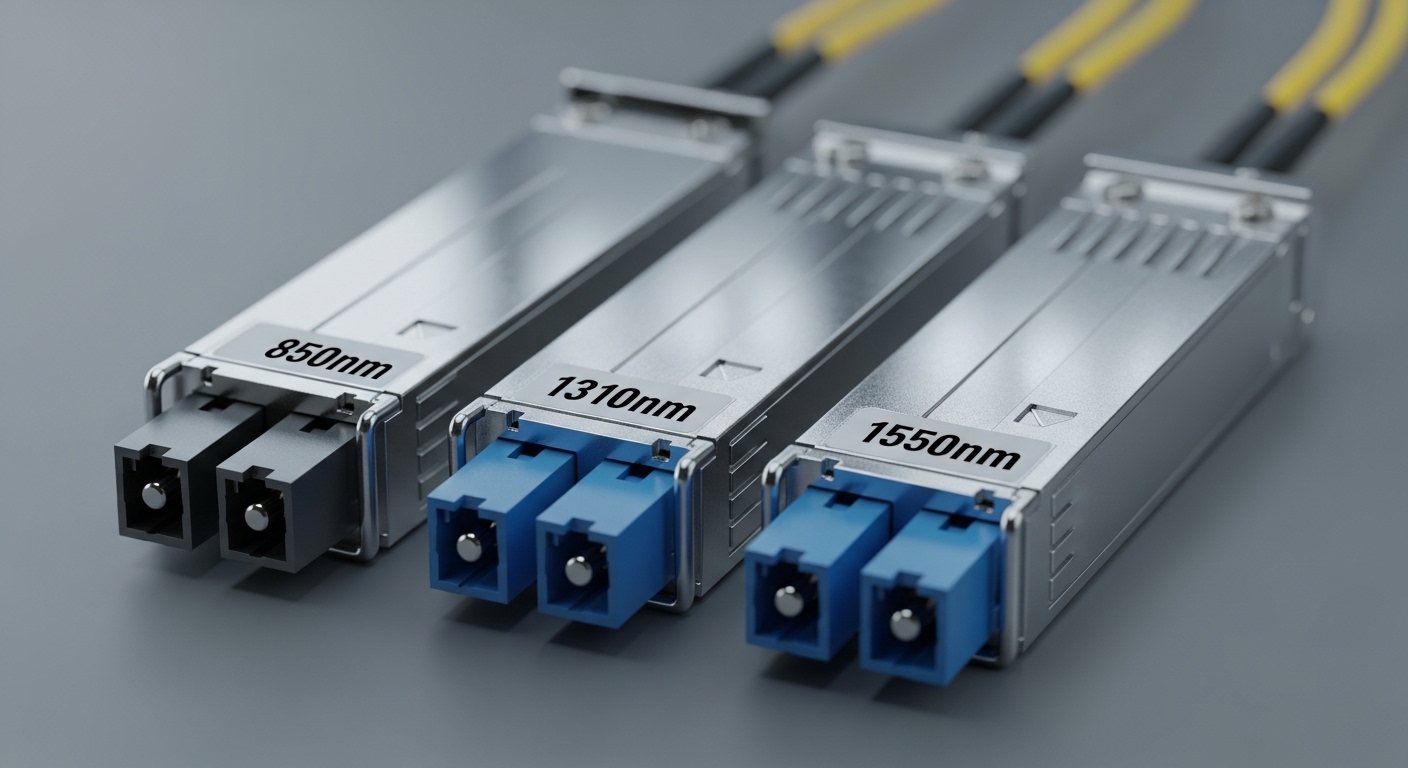
In leaf-spine data centers, metro aggregation, and campus backbones, choosing the wrong optics wavelength can turn a stable link into intermittent errors within weeks. This article helps network engineers compare wavelength 850nm 1310nm transceiver options against 1550nm by reach, power, fiber plant constraints, and operational risk. You will leave with a selection checklist, a decision matrix, and field-tested troubleshooting steps.
Wavelength tradeoffs: what 850nm, 1310nm, and 1550nm change
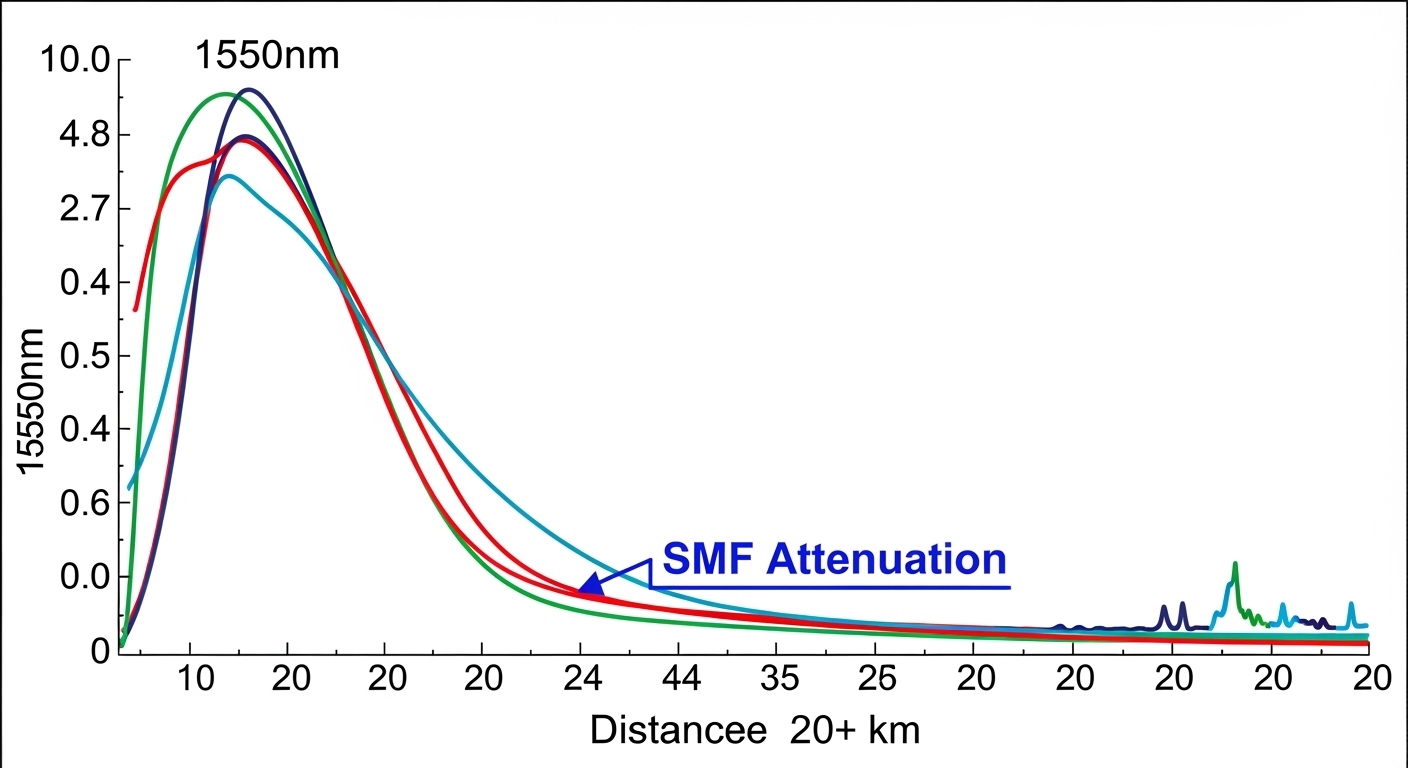
Wavelength determines how fiber loss and dispersion behave, which directly impacts link budget and allowable span length. For multimode fiber, 850nm is typically the practical choice for short reach because inexpensive MMF and optics dominate cost. For single-mode fiber, 1310nm and 1550nm shift the loss curve: 1310nm often balances dispersion and attenuation, while 1550nm usually reaches farther due to lower attenuation per kilometer.
Engineering reality: many “it should work” failures come from assuming that a wavelength swap behaves like a plug-and-play replacement. In practice, 850nm optics are usually designed for OM3/OM4 multimode with tight modal bandwidth requirements, while 1310nm/1550nm optics are designed for SMF with different connector and dispersion expectations. Vendor datasheets also define transmitter output power, receiver sensitivity, and safety compliance that must align with your switch optics profile.
Spec anchor points from IEEE and vendor datasheets
Ethernet optics profiles are standardized by IEEE 802.3 for electrical/optical link behavior, while the exact transceiver parameters come from vendor datasheets. For example, 10GBASE-SR/SW uses multimode with 850nm optics, while 10GBASE-LR/LW uses single-mode around 1310nm/1550nm. Reference: IEEE 802.3 standard home. For reach and power, check specific part numbers such as Cisco SFP-10G-SR, Finisar FTLX8571D3BCL, or FS.com SFP-10GSR-85 and their datasheets.
Performance and reach: head-to-head by fiber type and link budget
Performance is not just “distance”; it is how much margin you have after aging, connector contamination, and patch panel losses. For multimode, 850nm links depend on modal bandwidth and differential mode delay (DMD) constraints; for single-mode, 1310nm and 1550nm depend on attenuation and dispersion over the fiber type (G.652D, G.657). A wavelength comparison must therefore include fiber category, connector loss, and your switch’s expected optical budget.
| Parameter | 850nm (MMF typical) | 1310nm (SMF typical) | 1550nm (SMF typical) |
|---|---|---|---|
| Common Ethernet profile | 10GBASE-SR (MM) | 10GBASE-LR (SM) | 10GBASE-ER/LW (SM) |
| Typical fiber | OM3/OM4 multimode | SMF G.652D | SMF G.652D or long-haul SMF |
| Typical reach at 10G | ~300 m (OM3) to ~400 m (OM4) | ~10 km class links | ~40 km to 80 km class links (varies by rate) |
| Optical power behavior | Higher loss on MMF with distance; sensitive to DMD | Balanced attenuation and dispersion | Lowest fiber attenuation; requires careful dispersion/OSNR for long spans |
| Connector style | LC duplex common | LC duplex common | LC duplex common |
| Temperature range | Commercial: ~0 to 70 C; Industrial variants exist | Commercial and extended options | Commercial and extended options |
| DOM/telemetry | Usually available; confirm switch support | Usually available; confirm switch support | Usually available; confirm switch support |
What to measure in the field
For multimode 850nm, validate OM3/OM4 plus patch panel cleanliness; measure end-to-end insertion loss and verify that link budget includes worst-case connector loss. For single-mode 1310nm/1550nm, clean and inspect the end faces, then measure optical power at the far end if your test plan allows. If you are upgrading from 1310nm to 1550nm, confirm that your fiber plant and splices meet expected attenuation and that you are not introducing unexpected dispersion penalties.
Cost and ROI: why 850nm often wins locally, and 1550nm wins at scale
Cost is driven by optics complexity, fiber type, and the transceiver ecosystem your vendor supports. In many enterprise and regional deployments, 850nm transceivers on OM3/OM4 MMF are the lowest-cost path per port for short reach, especially when you already have MMF trunks. 1310nm optics on SMF cost more than 850nm, but they reduce risk when you need longer spans across racks, rooms, or buildings.
1550nm optics typically cost the most per port and are frequently used for long reach where pulling or leasing long SMF is cheaper than adding intermediate aggregation sites. In TCO terms, the ROI often hinges on how expensive downtime is and how quickly you can standardize optics across the fleet. OEM modules may carry higher unit pricing but can reduce operational friction if your switch enforces strict optics compatibility. Reference: Cisco transceiver module compatibility and technical notes.
Typical pricing and failure-rate considerations (realistic ranges)
As of recent market pricing, 10G 850nm SFP+ modules commonly fall into a relatively low unit-cost band; third-party options can be materially cheaper than OEM, but you must validate DOM behavior and switch compatibility. 1310nm SMF modules cost more, and 1550nm long-reach modules can be the highest. For ROI, include spares stocking: if you cannot hot-swap without breakage due to compatibility checks, your “saved dollars” on optics can become lost labor time.
Compatibility and security: DOM, vendor locks, and safety limits
Compatibility is the hidden tax. Many switches validate transceiver identity via EEPROM fields and may block modules that fail authentication or do not match expected vendor IDs. Even when a module “works,” mismatched DOM formats can cause alarms or incorrect thresholds, masking degradation until errors spike.
From a security standpoint, treat optics as a supply-chain component. Use authenticated procurement, keep module firmware/data-sheet evidence in your change management system, and track serial numbers for incident response. Also ensure compliance with laser safety class requirements specified by the vendor; do not assume that “same wavelength” implies identical power levels and eye-safety behavior.
Pro Tip: Before rolling out a wavelength change, validate DOM telemetry fields on a single port and compare received power and temperature behavior against the baseline module. Engineers often discover that “link comes up” while DOM thresholds remain miscalibrated, leading to delayed detection of fiber contamination or aging lasers.

Selection criteria: ordered checklist engineers actually use
- Distance and fiber type: If you have OM3/OM4, start with 850nm; if you need SMF reach, evaluate 1310nm first, then 1550nm for long spans.
- Budget and spares strategy: Estimate unit cost plus operational cost of stocking and testing spares; include compatibility validation time.
- Switch compatibility profile: Confirm DOM support, EEPROM expectations, and whether the platform enforces vendor locks.
- DOM support and monitoring: Validate that alarms map to your monitoring stack (power, temperature, laser bias).
- Operating temperature and airflow: Check transceiver temperature range and your chassis thermal design; high-density ToR often runs hot.
- Vendor lock-in risk: Decide whether to standardize on OEM for critical links or accept third-party optics with a validated test matrix.
- Power and link budget margin: Use vendor optical budget numbers and add conservative connector/patch losses; leave margin for aging and cleaning events.
Common mistakes and troubleshooting tips
Mistake 1: Using 850nm optics on the wrong fiber plant
Root cause: 850nm multimode transceivers are designed for MMF modal bandwidth; if you connect them to SMF or to degraded/incorrect MMF, you can get link flaps or elevated BER. Solution: Verify fiber type (OM3 vs OM4 vs SMF), trace the cable path, and confirm polarity and patching.
Mistake 2: Ignoring connector contamination and patch panel loss
Root cause: Dirty LC end faces can collapse receive margin, especially on marginal-length links or low-power optics. Solution: Use a fiber inspection scope, clean with lint-free wipes and approved cleaning tools, then re-test link metrics after each cleaning cycle.
Mistake 3: Assuming DOM alarms are interchangeable across vendors
Root cause: DOM telemetry fields can differ in scaling/threshold defaults; monitoring may show “normal” while optical power is drifting. Solution: Establish baseline DOM readings for each module type, then set alert thresholds based on measured values rather than defaults.
Mistake 4: Overlooking switch optics profiles during wavelength swaps
Root cause: Some platforms require specific EEPROM vendor/product IDs or enforce optics compatibility policies. Solution: Test in a staging environment with the exact switch model and firmware version; track approved optics in a runbook.
Decision matrix: which wavelength fits your deployment
Use this matrix to quickly align wavelength with your fiber plant, distance, and operational constraints.
| Reader profile | Best default | Why | Watch-outs |
|---|---|---|---|
| Data center within a room, MMF already present | 850nm | Lowest cost per port; high availability for common Ethernet rates | Validate OM3/OM4 only; cleanliness still matters |
| Inter-room or campus aggregation across SMF | 1310nm | Strong reach with good dispersion tolerance; common SMF ecosystem | Confirm link budget margin and SMF type |
| Long-haul or metro reach with SMF and limited intermediate sites | 1550nm | Lowest attenuation supports long spans | Higher module cost; more stringent long-span engineering |
| Strict compatibility requirements and conservative ops | Match OEM to switch (any wavelength) | Reduces optics authentication and DOM mismatch risk | Higher unit cost; still validate link budget |
Which option should you choose?
If your fiber plant is already OM3/OM4 and the distance is within the common 10G short-reach envelope, choose 850nm for best cost and operational simplicity. If you are standardizing SMF across buildings or aggregation tiers and want a robust middle ground, choose 1310nm. If you must push long reach with fewer intermediate sites and you can justify the optics and engineering effort, choose 1550nm. For any choice, validate DOM telemetry and switch compatibility in staging before scaling.
FAQ
Is wavelength 850nm transceiver compatible with OM3 and OM4?
Most 850nm multimode transceivers are intended for OM3 and OM4. You
