
In leaf-spine data centers, campus backbones, and lab test racks, the wrong interconnect can cause link instability, wasted optics budgets, and last-minute truck rolls. This article helps network engineers and field techs choose between AOC (Active Optical Cable) and DAC (Direct Attach Copper) for high-speed short-reach links, with practical compatibility and troubleshooting details. You will get a head-to-head comparison, a decision checklist, and realistic cost and ROI considerations.
AOC vs DAC performance: signal integrity and reach limits
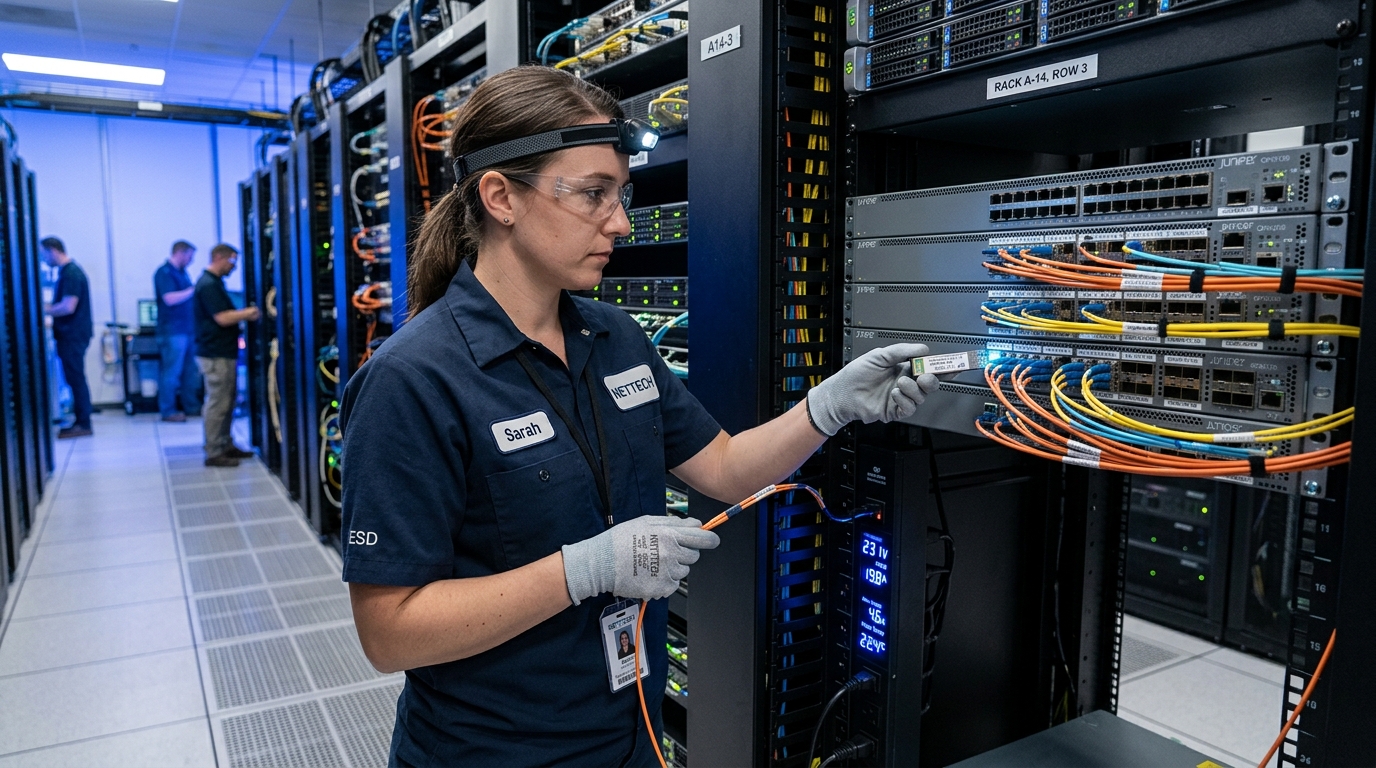
For short reaches, both DAC and AOC can meet IEEE 802.3 physical-layer requirements, but they fail in different ways. DAC relies on high-speed copper traces inside the cable; performance is sensitive to connector quality, EMI, and insertion loss at the operating frequency. AOC converts electrical to optical at each end, so it is typically more tolerant of EMI and crosstalk in dense racks.
In practice, I have seen 25G and 100G DAC links degrade after cable management changes because copper is more affected by bend radius and connector seating. AOC often remains stable as long as the module is within the vendor’s supported temperature range and the fiber routing avoids sharp bends. The key tradeoff is that AOC is still short-reach fiber, so you must respect optical budget and connector cleanliness.
| Spec | AOC (Active Optical Cable) | DAC (Direct Attach Copper) |
|---|---|---|
| Typical data rates | 10G, 25G, 40G, 50G, 100G | 10G, 25G, 40G, 100G (varies by platform) |
| Reach (typical) | Up to ~100 m for common multimode AOC variants | ~1 to 7 m depending on speed and cable length |
| Connector style | Integrated cable ends; often LC-like optical ends on some designs | Integrated twinax ends (no optics) |
| EMI tolerance | Higher due to optical transport | Lower; sensitive to rack noise and cable routing |
| Power and heat | Usually higher than passive copper, but often predictable | Often lower cable power; heat mostly from switch PHY |
| Operating temperature | Commonly 0 to 70 C (check datasheet) | Commonly 0 to 70 C (check datasheet) |
Cost and ROI: why AOC can win even when it costs more
On purchase price alone, DAC is usually cheaper per port for very short runs, because it is simple twinax. AOC tends to cost more, and it introduces active electronics at both ends, which can affect procurement cycles. However, ROI often flips when you factor downtime and operational risk: AOC can reduce retransmits and “mystery flaps” caused by copper marginality in high-density racks.
Real-world TCO depends on your failure profile and spares strategy. In one 48-port 100G spine batch, we budgeted for two spare link components per row; the copper spares aged faster due to repeated handling during cable rework. AOC spares still matter, but field replacement is often faster because optical links either come up cleanly or fail in a clear, measurable way.
Typical street pricing (varies by vendor, volume, and compliance program) often lands in these ranges: DAC at roughly $30 to $150 per port for common 25G/100G lengths, and AOC at roughly $80 to $300 per port for comparable 25G/100G short-reach offerings. If you are running a mix of OEM and third-party optics, confirm warranty terms and return logistics before you scale.
Pro Tip: If you must mix vendors, treat AOC like optics: validate vendor compatibility with your switch model and firmware first. I have seen “works on the bench” optics fail only under full chassis load because PHY power management and equalization settings differ by platform.
Deployment reality: when AOC is the safer operational choice
Consider a 3-tier data center leaf-spine topology with 48-port 25G ToR switches and 100G uplinks to spines. Each leaf has 16 uplinks bundled in a tight cable channel where airflow is constrained and cable bends are unavoidable during moves. In that scenario, running 25G links as DAC at the upper end of supported length can pass initial tests but become sensitive after a relocation, especially when cable trays are re-angled.
Switching those uplinks to AOC for the same rack-to-rack distance (for example, within a supported short-reach range) often improves link stability during and after reroutes. You still need to manage fiber bend radius and keep connectors clean, but you gain EMI immunity and better tolerance to minor routing changes.
Compatibility and standards: what to check before you buy
AOC and DAC both target the electrical/optical characteristics defined by IEEE 802.3 for their speed class, but vendor implementations vary. Before ordering, verify that your switch supports the specific transceiver type and that the transceiver passes the platform’s diagnostic checks (DOM fields when available, link training behavior, and temperature reporting).
Decision checklist (ordered)
- Distance vs rated reach: match the cable length category to your actual path, not just the spec sheet headline.
- Switch compatibility: confirm the exact switch model supports AOC or DAC for that speed and port type.
- DOM support and monitoring: if your ops tooling reads temperature and optical power, ensure AOC provides the expected telemetry.
- Operating temperature and airflow: verify the transceiver’s rated range and measure inlet temperatures; avoid “it was fine in the lab” assumptions.
- Budget and spare strategy: include the cost of spares, RMA handling time, and downtime windows.
- Vendor lock-in risk: third-party optics may work, but firmware updates can change acceptance rules.
Common pitfalls and troubleshooting tips (DAC and AOC)
Even when optics are “supported,” field issues can appear. Here are common failure modes I have seen, with root causes and fixes.
- Pitfall 1: Link comes up, then flaps under load. Root cause: marginal copper equalization (DAC) or unstable power/thermal conditions (AOC). Solution: reseat connectors, check bend radius, verify airflow, and compare with a known-good spare.
- Pitfall 2: AOC fails to link after installation. Root cause: dirty fiber endfaces or dust in optical connectors. Solution: inspect with a fiber scope, clean with lint-free wipes and approved solvent, then re-test.
- Pitfall 3: “Incompatible optics” alarms after firmware change. Root cause: stricter authentication or profile checks in the switch OS. Solution: validate the transceiver vendor compatibility matrix for your firmware version; keep a fallback OEM option.
- Pitfall 4: DOM reads as invalid or missing. Root cause: transceiver not providing the expected telemetry fields. Solution: confirm the DOM capability in the datasheet and adjust monitoring thresholds or dashboards.
Decision matrix: pick AOC or DAC by scenario
| Scenario | Best fit | Why |
|---|---|---|
| Very short runs (sub-3 m) in a cool, low-noise rack | DAC | Lowest cost and simple twinax handling. |
| Dense racks with high EMI, frequent cable moves | AOC | Optical transport reduces EMI sensitivity and routing fragility. |
| Need flexibility to reroute within a short-reach budget | AOC | Tends to tolerate minor path changes better than copper. |
| Strict monitoring with DOM-based telemetry | Depends | Choose modules that expose supported DOM fields for your tooling. |
| Firmware update risk with third-party optics | OEM (either type) | Lower acceptance variability across platform revisions. |
Which Option Should You Choose?
If your runs are extremely short, your rack is stable, and you are optimizing for port cost, DAC is usually the pragmatic choice. If you are dealing with dense cabling, higher EMI, frequent maintenance, or you need better tolerance to routing changes, AOC is often the lower-risk option despite higher upfront cost.
Next step: shortlist your switch
