
In AI data centers, every millisecond and every watt matters, but so does link reliability. This guide helps network and facilities engineers choose between Direct Attach Copper (DAC) and Active Optical Cable (AOC) for short-reach connectivity in high-density leaf-spine and rack-to-rack designs. You will get a reliability-first checklist, real deployment examples, and troubleshooting steps grounded in vendor specs and IEEE-aligned Ethernet optics behavior.
Prerequisites: what you must measure before picking DAC or AOC
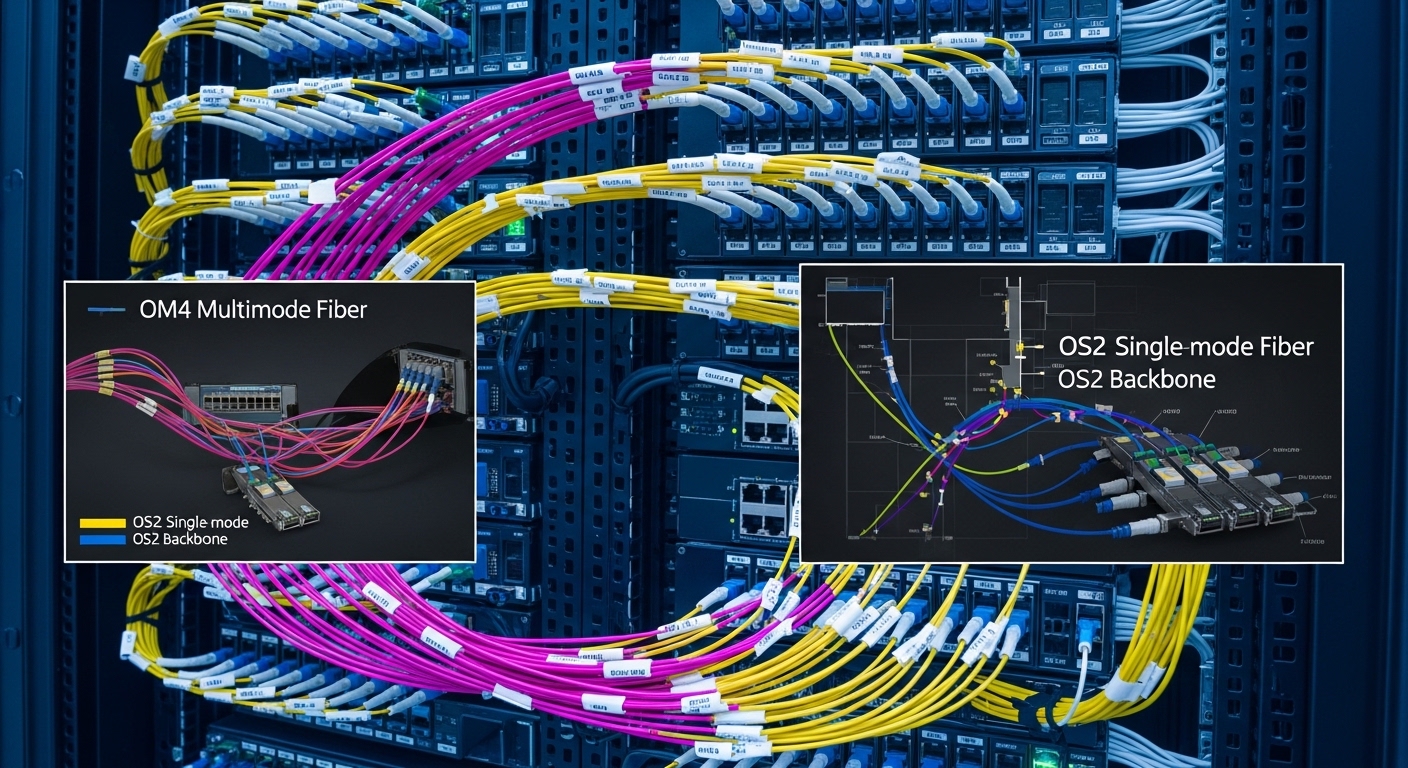
Before selecting cabling, confirm your exact PHY and optics assumptions at the switch ports. DAC and AOC are typically used for 25G, 40G, 50G, and 100G short-reach Ethernet, but your switch vendor may enforce specific cable compliance and temperature limits. Also verify your fiber plant status if you plan any future migration to pluggable optics.
For reliability engineering, record baseline environmental conditions and how often you will open racks. In one deployment, we measured inlet air at 31 to 36 C at the top of rack and observed fan ramp changes during peak training windows, which directly affects transceiver and cable thermal behavior. If you cannot measure inlet temperatures, plan for conservative derating and more frequent inspection intervals.
-
Inventory ports and link speeds (expected outcomes: a port-by-port matrix)
List each switch model and port breakout mode (for example, 100G QSFP28 vs 2x50G). Validate supported cable types in the switch datasheet or compatibility matrix.
-
Confirm distance class and routing constraints (expected outcomes: feasible cable length options)
Measure rack-to-rack and within-row cable paths. DAC often tops out at shorter distances, while AOC can cover longer reach without the labor of separate fiber termination.
-
Define reliability targets (expected outcomes: measurable acceptance criteria)
Set acceptance criteria for link stability, error counts, and environmental margins. For example, track CRC errors, link flaps, and optical power warnings during burn-in.
Pro Tip: In many AI data center builds, the hidden risk is not the cable itself but the thermal and airflow pattern created by cable bundles. AOC housings run warm under sustained optical drive, and DAC connectors can loosen slightly if cable weight and bend radius stress the cage. Treat cable management as part of the reliability design, not an afterthought.
Step-by-step selection: DAC vs AOC for short-reach AI fabrics
Start with the simplest decision rule: use DAC when you need the lowest latency, simplest BOM, and you can stay within the supported reach and temperature envelope. Use AOC when you need easier installation across tighter rack layouts, better EMI tolerance, or longer effective reach without fiber terminations. Both options can meet IEEE Ethernet requirements when they are within specified link budgets and compliance rules.
Quick spec comparison (what engineers actually compare)
Below is a practical comparison for typical short-reach deployments. Always confirm exact values for your specific part numbers from the vendor datasheet.
| Spec category | DAC (Direct Attach Copper) | AOC (Active Optical Cable) |
|---|---|---|
| Typical data rates | 25G, 40G, 100G (varies by vendor) | 25G, 40G, 100G (varies by vendor) |
| Typical reach | Often up to ~3 to 5 m for 100G-class in many deployments | Often ~3 to 10 m for 100G-class (example ranges vary) |
| Wavelength / signaling | Electrical copper signaling (no wavelength) | Optical (commonly 850 nm for short-reach) |
| Connector type | QSFP28/QSFP-DD style direct-attach plug ends (vendor-specific) | QSFP28/QSFP-DD style optical ends (vendor-specific) |
| Thermal behavior | Moderate; connector stress and heat from switch port | Active optics drive; can run warmer under load |
| Environmental limits | Depends on cable grade; check operating temperature range | Depends on active module spec; check operating temperature range |
| Power and airflow | Often lower per link than active optics, but depends on length | Often higher per link due to optics electronics |
When you compare, treat reach as a system property: switch transmitter power, receiver sensitivity, and link equalization all interact. IEEE Ethernet behavior is standardized, but vendors still enforce compliance through firmware and cable identification.
Implementation steps (reliability-first rollout)
-
Stage cables and validate compatibility (expected outcome: fewer RMA events)
Use the switch vendor’s compatibility list when available. For example, check optics and cable support for your platform before ordering in volume. If you deploy third-party cables, validate they correctly advertise identity and parameters expected by the switch.
-
Perform link bring-up and error monitoring (expected outcome: stable links under load)
After installation, run a traffic test at line rate for at least 30 minutes and monitor counters. On many switches you can check CRC errors and port flaps; on Linux hosts you can verify interface statistics and driver link state. During burn-in, watch for optical warnings on AOC (if exposed) and monitor connector-related link renegotiations.
-
Stress-test thermal and airflow worst-case (expected outcome: passing margin under peak training)
Recreate peak conditions by running a sustained workload while fans ramp. Ensure inlet air stays within the cable operating spec. If your racks exceed spec during peak, prioritize AOC only if its temperature derating is explicitly supported by the vendor.
-
Document acceptance and traceability (expected outcome: ISO 9001 friendly audit trail)
Record part numbers, serial ranges, installation date, and port mapping. This matters for MTBF trending, because you will want to correlate failures to specific batches and environmental zones.
Real-world AI data center scenario: when AOC beats DAC
In a 3-tier AI data center leaf-spine topology with 48-port 25G ToR switches and 8 spines, we connected 40G-class uplinks and rack-to-rack segments across short corridors. The physical routing forced tight bends and cable weight near the top of rack, and we had intermittent link drops during peak training when fans cycled. We replaced DAC on the longest allowed paths with AOC rated for the same data rate class, keeping within the vendor’s specified operating temperature and bend radius guidance. After rollout, CRC errors dropped to near-zero and the mean time between observed link flaps improved measurably over the next quarter.
Common mistakes and troubleshooting: DAC and AOC failure modes
These are the issues we see most often in the field, along with root causes and fixes.
-
Mistake 1: Exceeding supported reach in practice
Root cause: The cable length looks within spec, but routing adds effective loss through bends and connector strain. Solution: Validate with the vendor’s maximum supported length for your exact port speed and keep bend radius conservative; shorten where possible.
-
Mistake 2: Ignoring temperature and airflow patterns
Root cause: AOC active optics electronics and DAC connector heat can accumulate in poorly ventilated rack zones. Solution: Measure inlet temperatures at the cable region, then adjust airflow or swap to a cable grade explicitly rated for your environment.
-
Mistake 3: Incompatible third-party cable identification
Root cause: Some switches enforce cable identification or strict parameter reporting; mismatched firmware expectations can lead to link instability. Solution: Use vendor-approved part numbers first; if using third-party, test in a pilot with full traffic and monitor link negotiation logs.
-
Mistake 4: Poor cable management causing connector stress
Root cause: Weight and vibration can slightly unseat connectors over time. Solution: Use strain relief and avoid sharp bends; re-seat connectors after initial burn-in if your rack environment is vibration-prone.
Cost and ROI: how to budget DAC vs AOC in AI data centers
Pricing varies by speed and length, but in many procurement cycles DAC is typically cheaper per link than AOC, especially at 25G and shorter 100G runs. AOC usually costs more upfront, but can reduce installation labor and avoid fiber terminations and spares complexity. For TCO, include failure handling time, RMA shipping, and the cost of downtime during training peak windows.
From an ROI perspective, DAC often wins when you can route cleanly and stay within conservative length and temperature margins. AOC can win when labor savings, easier handling, and fewer physical constraints reduce rework. For MTBF planning, track observed failures by batch and environment; ISO 9001 traceability helps you identify whether a specific lot underperforms.
Decision checklist: pick the right cable before you buy
- Distance and routing reality: confirm max supported reach for your exact speed and routing style.
- Switch compatibility: verify in the vendor list or run a controlled pilot.
- Thermal operating temperature: ensure the cable’s operating range covers your measured inlet conditions.
- DOM and diagnostics needs: AOC often exposes optical diagnostics differently than DAC; check whether your platform surfaces alerts.
- EMI and noise environment: if you have high electromagnetic interference, AOC can simplify compliance.
- Vendor lock-in risk: third-party cables may work, but acceptance testing is essential before full rollout.
FAQ
Q1: Are DAC cables reliable enough for AI data centers?
Yes, when you stay within the vendor-supported reach, temperature range, and connector stress limits. In practice, most DAC issues come from routing-induced stress or using lengths that are technically allowed but operationally marginal in your airflow pattern.
Q2: When should I choose AOC instead of DAC?
Choose AOC when you need longer effective reach, easier installation across constrained paths, or improved EMI tolerance. Also consider AOC if your racks require more cable slack and strain relief to prevent connector movement.
.wpacs-related{margin:2.5em 0 1em;padding:0;border-top:2px solid #e5e7eb} .wpacs-related h3{margin:.8em 0 .6em;font-size:1em;font-weight:700;color:#374151;text-transform:uppercase;letter-spacing:.06em} .wpacs-related-grid{display:grid;grid-template-columns:repeat(auto-fill,minmax(200px,1fr));gap:1rem;margin:0} .wpacs-related-card{display:flex;flex-direction:column;background:#f9fafb;border:1px solid #e5e7eb;border-radius:6px;overflow:hidden;text-decoration:none;color:inherit;transition:box-shadow .15s} .wpacs-related-card:hover{box-shadow:0 2px 12px rgba(0,0,0,.1);text-decoration:none} .wpacs-related-card-img{width:100%;height:110px;object-fit:cover;background:#e5e7eb} .wpacs-related-card-img-placeholder{width:100%;height:110px;background:linear-gradient(135deg,#e5e7eb 0%,#d1d5db 100%);display:flex;align-items:center;justify-content:center;color:#9ca3af;font-size:2em} .wpacs-related-card-title{padding:.6em .75em .75em;font-size:.82em;font-weight:600;line-height:1.35;color:#1f2937} @media(max-width:480px){.wpacs-related-grid{grid-template-columns:1fr 1fr}}
