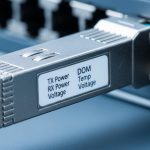
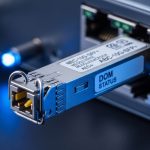
When supply chain shortages hit, optical module procurement stops being a spreadsheet exercise and becomes an operational risk problem. This article helps network engineers, procurement leads, and field technicians understand how lead times, DOM/compatibility constraints, and vendor allocation policies ripple into link uptime. You will get a practical selection checklist, a spec comparison table, and troubleshooting patterns I have seen during deployments in leaf-spine data centers and campus aggregation closets.
How shortages propagate through optical module procurement
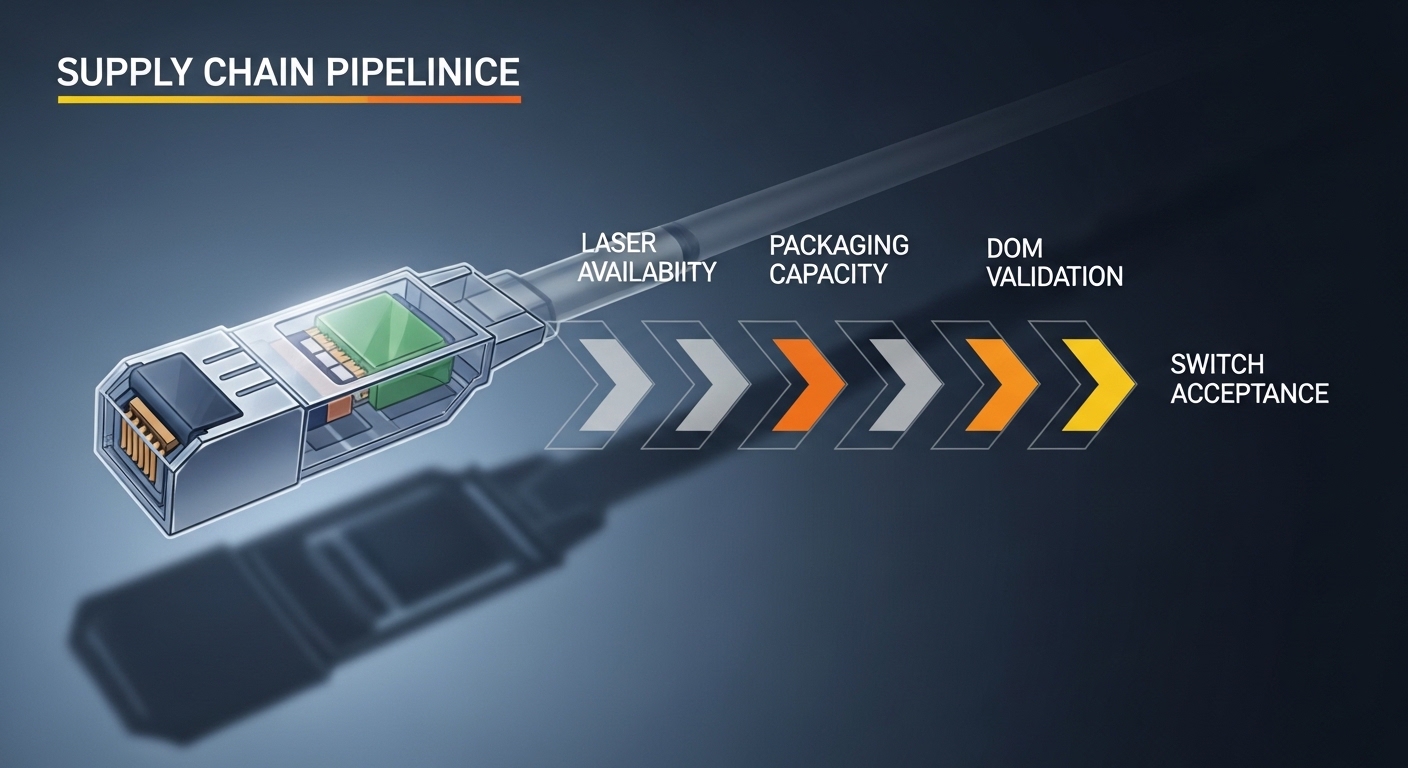
Optical transceivers and pluggables behave like tight-coupled components: switches expect specific electrical signaling, firmware expectations, and optical power levels, while vendors manage wafer supply, laser availability, and packaging throughput. During supply chain shortages, allocation often targets the highest-volume SKUs first, leaving long-tail distances (for example, 2 km reach) or specific vendor DOM formats with delayed availability. The result is a procurement lag that can cascade into site commissioning delays, link budget overruns, or last-minute part substitutions.
In real deployments, I have watched a rollout slip when 400G QSFP-DD optics arrived weeks late, forcing temporary bandwidth reductions and rerouting traffic through higher-latency aggregation. Even when modules arrive, compatibility can be brittle: some switch platforms reject optics that do not match expected vendor IDs or that report DOM fields outside the vendor’s tolerance window. IEEE 802.3 defines physical layer behavior, yet vendor implementations differ in diagnostics thresholds and EEPROM interpretation; that gap becomes visible only when shipments are scarce and “close enough” optics are tempting. anchor-text: IEEE 802.3 standard
Spec tradeoffs that matter when lead times stretch
During shortages, teams often choose between “available now” modules and “ideal later” modules. Your decision should start with the link type: Ethernet over fiber profiles like 10GBASE-SR, 25GBASE-SR, and 100GBASE-SR4 are defined by wavelength, reach, and signaling, but the actual optics you can buy may vary in connector type, DOM behavior, and laser safety class. The table below compares common optics that frequently appear in shortage-driven substitutions.
| Module family (examples) | Data rate | Wavelength | Typical reach | Connector | DOM / diagnostics | Operating temperature | Power (typ.) |
|---|---|---|---|---|---|---|---|
| Cisco SFP-10G-SR / Finisar FTLX8571D3BCL | 10G | 850 nm | 300 m (OM3) / 400 m (OM4) | LC | Yes (I2C EEPROM) | 0 to 70 C | ~0.9 to 1.5 W |
| FS.com SFP-10GSR-85 (85 C class) | 10G | 850 nm | 300 m (OM3) / 400 m (OM4) | LC | Yes | Up to 85 C variant | ~1.0 to 2.0 W |
| QSFP28 SR (vendor-specific) | 25G | 850 nm | 70 m (OM1) / 100 m (OM2) / 300 m (OM3) / 400 m (OM4) | LC | Yes | 0 to 70 C (typ.) | ~2 to 4 W |
| QSFP-DD SR4 / LR4 (vendor-specific) | 100G | 850 nm (SR4) / 1310 nm (LR4) | ~100 m (SR4 OM4) / up to 10 km (LR4) | LC (opt.) | Yes | 0 to 70 C (typ.) | ~6 to 12 W |
In shortage scenarios, power and temperature ratings become operational constraints. If your switch room has hotspots, a module qualified only for 0 to 70 C can trigger thermal derating or higher bit error rates under stress. Meanwhile, connector mismatches (LC vs MPO) or fiber grade assumptions (OM3 vs OM4) can turn a “short substitution” into a full recertification cycle with an OTDR and an insertion-loss budget review.

Procurement decisions: a checklist engineers can execute
When supply chain shortages constrain availability, speed matters, but so does repeatability. Use this ordered checklist to reduce the chance that an “available” module becomes an outage driver.
- Distance and fiber grade first: verify OM3/OM4/OS2 and measure insertion loss and end-to-end link budget with a qualified method before ordering.
- Switch compatibility: confirm the switch model’s transceiver support list and expected DOM behavior; do not assume all “SR” optics are interchangeable.
- Data rate and lane mapping: ensure the optics match the port speed (for example, 25G vs 10G) and the breakout mode for QSFP/QSFP-DD.
- DOM support and threshold behavior: validate that key DOM fields (Tx/Rx power, temperature, voltage) fall within the platform’s tolerance window.
- Operating temperature margin: match or exceed chassis ambient and airflow profile; consider 85 C variants if your airflow is constrained.
- Vendor lock-in risk: weigh OEM part numbering against third-party optics, then test in a pilot rack before scaling.
- Supply reliability and lead-time evidence: request allocation timelines and shipment commitments; avoid “in-stock” claims without lot traceability.
Pro Tip: In shortage-driven substitutions, the most common failure mode is not optical reach; it is DOM threshold mismatch. I have seen ports that “link up” but later degrade because the switch vendor’s monitoring expects specific EEPROM calibration ranges, so run a 24-hour BER and optical power stability test, not just a link detection check.
Common pitfalls and troubleshooting patterns during shortages
Even with correct specs on paper, shortages encourage substitutions and hurried installs. Here are concrete failure modes and how to resolve them, based on field patterns.
Pitfall 1: Link up, then intermittent drops
Root cause: Tx/Rx optical power or fiber attenuation is marginal for the substituted module, often amplified by connector cleanliness issues. Solution: clean LC/MPO endfaces, verify polarity, then measure optical power at the switch and confirm the link budget with real attenuation numbers.
Pitfall 2: “Unsupported transceiver” alarms
Root cause: DOM EEPROM fields or vendor IDs do not match the switch’s compatibility expectations, especially when mixing OEM and third-party optics. Solution: check the switch transceiver compatibility list, update platform software if supported, and test the exact optic SKU in a non-critical port before replacing dozens of units.
Pitfall 3: Thermal throttling or elevated error counters
Root cause: the module is rated only for 0 to 70 C but installed in a high-ambient airflow path, pushing temperature beyond safe operating points. Solution: measure ambient and inlet temperatures, adjust airflow baffles, and consider higher temperature-qualified optics (for example, 85 C class variants) if your chassis supports them.
Pitfall 4: Wrong fiber profile or connector type
Root cause: OM3 vs OM4 assumptions or MPO polarity errors during fast swaps. Solution: recertify with an OTDR and verify MPO polarity mapping; label fibers before removal and keep a polarity diagram at the rack.
Cost and ROI when the market is constrained
During supply chain shortages, pricing can swing based on allocation and scarcity, and that affects total cost of ownership (TCO). OEM optics for common 10G SR modules can range roughly from $60 to $150 per unit, while third-party equivalents often land lower, sometimes $25 to $90, but the savings can evaporate if you incur extra testing labor, truck rolls, or compatibility failures. In a 48-port ToR deployment, even a small failure rate matters: replacing 10 optics due to DOM incompatibility can cost more in downtime and labor than the unit price difference.
ROI improves when you combine two practices: (1) pre-qualification of a small batch of third-party optics on your exact switch model, and (2) maintaining a buffer stock sized to your lead-time variability. If your procurement cycle is 6 to 10 weeks and lead times extend unpredictably, engineers often target a rolling buffer for spares rather than bulk “just in case” buys that become obsolete when platform revisions land. Always account for power and cooling impact too: higher power optics can marginally increase fan curves and energy use, though the dominant cost is usually labor and risk.
FAQ: optical modules under supply chain shortages
How do supply chain shortages affect optical module lead times?
They often extend lead times from weeks to months due to allocation of laser/VCSEL capacity, packaging bottlenecks, and stricter vendor shipment policies. Even when units arrive, they may not match the exact DOM behavior your switches expect.
Can I substitute a different “SR” optical module during shortages?
Sometimes, but treat it as a compatibility engineering task. Confirm fiber grade, reach, connector type, and DOM fields, then validate with a pilot test for at least a day under normal traffic patterns.
What should I verify first: reach or DOM compatibility?
Verify reach and link budget first, because marginal power can cause intermittent failures. Then validate DOM compatibility because a module that “works” but reports calibration outside thresholds can trigger monitoring alarms and link flaps.
Are higher temperature optics worth it in hot data center rows?
Yes when inlet temperatures run hot or airflow is constrained, because thermal stress accelerates degradation and increases error rates. If your chassis supports it, using 85 C class variants can prevent nuisance faults during peak seasons.
Does IEEE 802.3 guarantee interoperability among optics?
It defines physical layer behavior, but interoperability also depends on switch vendor implementations, EEPROM parsing, and diagnostics thresholds. That is why field validation on your specific switch model is essential.
What is the safest next step for a procurement team facing shortages?
Create a short list of approved optics per switch model, then request allocation evidence and DOM details. Pair that with a small pilot purchase so you can prove compatibility before you scale replacements to production racks.
In the real world, supply chain shortages turn optical module procurement into a systems engineering problem spanning fiber physics, switch acceptance logic, and operational constraints. Next, align your procurement plan with optical-module-compatibility-checklist.
Author bio: I have deployed and validated Ethernet over fiber optics in production leaf-spine and campus aggregation networks, running power/BER diagnostics and DOM compatibility tests during live rollouts. My work focuses on measurable link budgets, switch-specific acceptance behavior, and pragmatic risk controls when parts availability is unstable.