In high-power fiber links, engineers can hit an unexpected ceiling where signal power triggers Stimulated Brillouin Scattering (SBS), compressing optical reach and flattening performance. This article helps network and optical teams select SBS threshold fiber and validate it against real transmitter power, link budgets, and temperature conditions. You will get field-oriented selection criteria, a deployment scenario with measured operating numbers, and troubleshooting steps for the most common failure modes. Update date: 2026-05-01.
Why SBS threshold fiber matters in power-limited networks
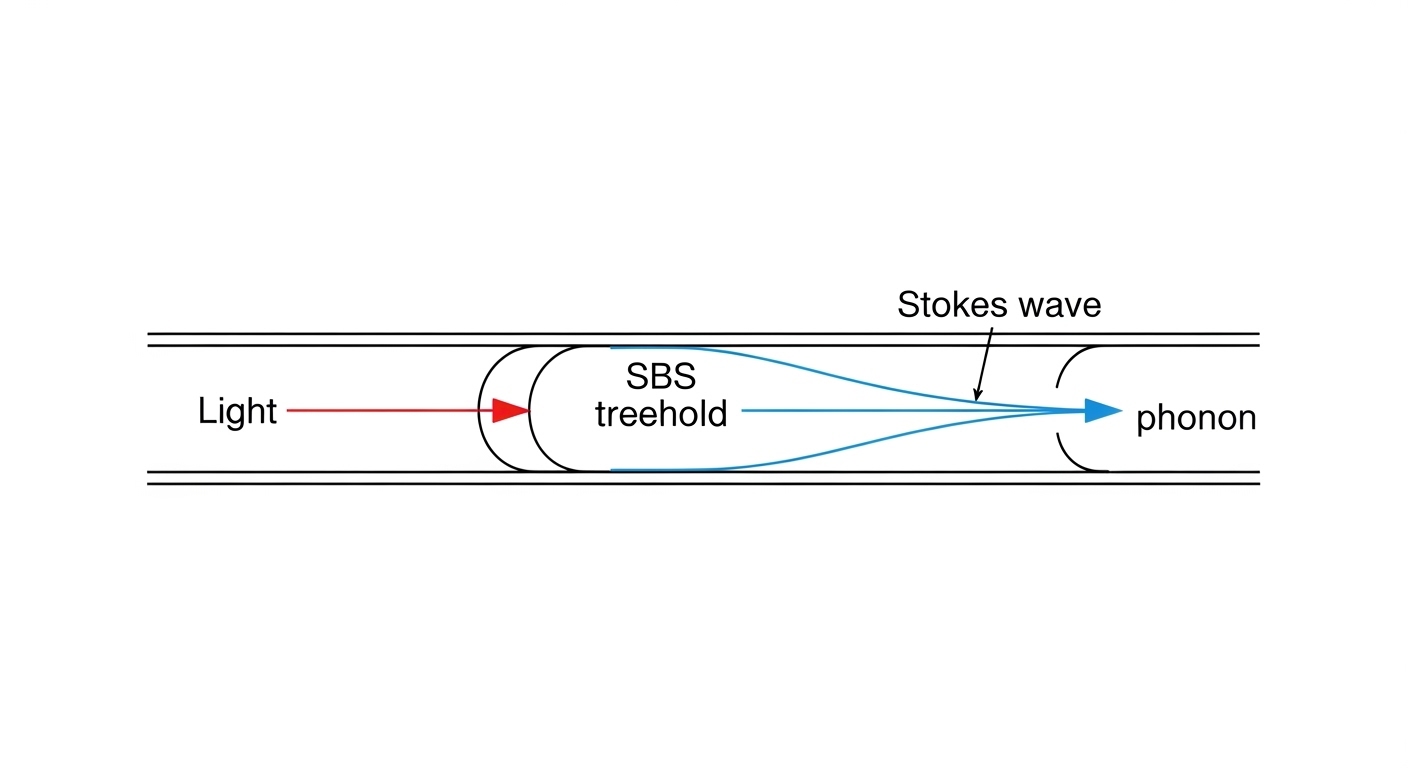
SBS is a nonlinear effect where strong light couples to an acoustic phonon in the glass, generating a backward-propagating Stokes wave. As input power rises, the system reaches an SBS threshold where the Stokes wave grows rapidly, diverting power away from the forward signal and degrading OSNR and link margin. In practice, SBS becomes visible first as increased back-reflected optical power, reduced receiver margin, and sometimes a “stair-step” change in error rates when transmit power crosses a threshold. IEEE 802.3 defines Ethernet physical layers but does not prescribe SBS mitigation; vendor datasheets and fiber design notes are typically where the SBS threshold specifications live. [Source: IEEE 802.3-2022]
What changes when you pick SBS threshold fiber
Different fiber constructions target higher SBS thresholds by modifying effective mode area, acoustic properties, and strain or doping profiles. A common engineering lever is increasing the effective area (Aeff) to reduce optical intensity for a given launched power. Another lever is reducing overlap between the optical mode and acoustic interaction region, which can be influenced by core/cladding design and material composition. SBS threshold fiber is often offered as “high SBS threshold” or “reduced SBS” fiber, with a specified threshold curve versus linewidth, temperature, and length. [Source: Corning SMF-28 and high-performance fiber application notes]
Pro Tip: Many teams validate SBS threshold using a single “maximum power” number, but SBS is sensitive to laser linewidth and modulation. In the field, a source with narrower linewidth can trigger SBS at significantly lower launched power than a broader linewidth source, even when optical carrier power looks similar.
Key specs that determine SBS threshold in real links
To choose SBS threshold fiber, you need to align fiber parameters with your transmitter characteristics. SBS threshold is not just “fiber length times a constant”; it depends on the laser linewidth, effective mode area, acoustic damping, and sometimes polarization and temperature. The most useful specs for engineers are wavelength band, modal parameters, connector type, maximum operating temperature, and any provided SBS threshold test conditions. When vendor documentation includes an SBS threshold vs. linewidth curve, it becomes the primary decision artifact for power-limited links.
| Spec category | What to check | Why it matters for SBS | Typical target ranges (engineering starting points) |
|---|---|---|---|
| Operating wavelength | 1550 nm band support for most SBS mitigation fibers | BS gain varies with wavelength and material response | 1550 nm (C-band) |
| Effective area (Aeff) | Aeff and mode-field diameter (MFD) | Higher Aeff lowers optical intensity and raises threshold | ~80 to 120 um^2 for many high-area designs |
| Core/cladding design | SMF vs LMA fiber class, acoustic interaction design | Material and structural damping reduce SBS gain | Vendor-specific construction |
| SBS threshold spec | Threshold test conditions: linewidth, length, temperature | Directly predicts where Stokes power rises sharply | Look for curves, not a single number |
| Connector and splicing | UPC/APC, low-loss fusion splices, reflectance control | Back-reflections can worsen apparent instability | Use low-reflection practices |
| Operating temperature | Max/min service temperature rating | Temperature shifts phonon behavior and margin | -10 C to +70 C or better, depending on deployment |
| Data rate compatibility | Does fiber support your modulation format and reach | Higher power may interact with OSNR and dispersion penalties | 10G to 100G+ depending on optics and DSP |
In addition to fiber specs, include transmitter specs such as output power, laser linewidth (or effective linewidth for modulated signals), and whether the system uses distributed feedback or external cavity sources. If your link uses coherent optics, the DSP may tolerate some SBS-induced OSNR degradation, but SBS can still reduce usable power and force lower modulation formats. For authoritative SBS fundamentals, consult peer-reviewed fiber optics references and vendor SBS test methodology guidance. [Source: Agrawal, Nonlinear Fiber Optics]
Deployment scenario: preventing SBS in a leaf-spine aggregation upgrade
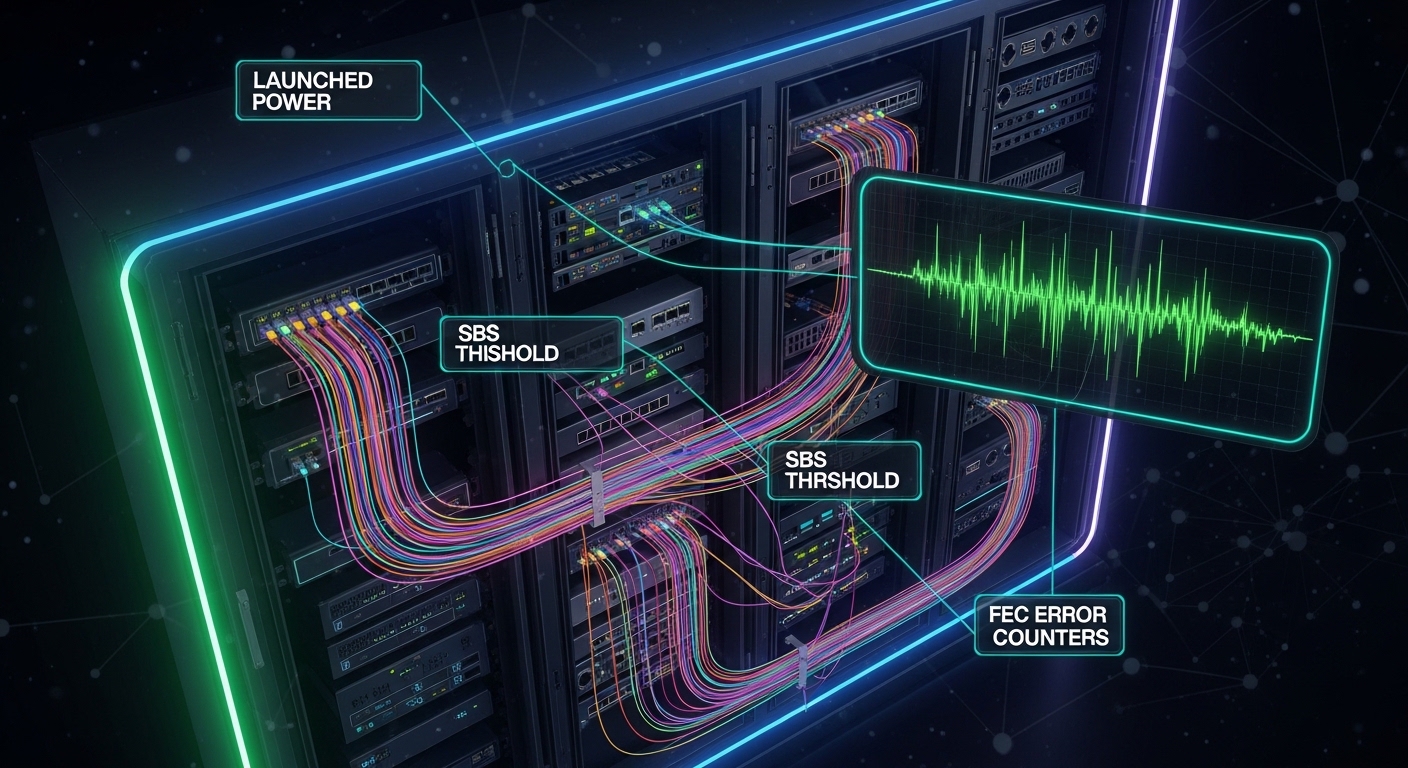
Consider a 3-tier data center with a leaf-spine topology: 48-port 10G ToR switches uplink into aggregation, then into a spine using long-reach optics. During an upgrade, the operator moves several trunk links from 10G to 25G using higher launch power and tighter margins to reduce oversubscription. Each affected run is 1.8 km of single-mode fiber in pathways with ambient temperatures ranging from 18 C to 33 C, with measured splice loss averaging 0.05 dB per splice and connector loss 0.3 dB. After the change, two links show a sudden rise in FEC errors when transmitter power is set above a specific value, and OSA measurements reveal a backward Stokes component consistent with SBS onset.
What the team did
The team compared vendor fiber documentation for the existing SMF and an available SBS threshold fiber reel. They then recalculated the link with a conservative SBS margin by assuming the transmitter effective linewidth could be narrower under certain operating modes. By swapping only the affected 1.8 km spans to SBS threshold fiber, they kept the same optics but reduced the needed transmitter power setpoint by 1 to 2 dB to regain OSNR margin while staying below the SBS knee. Field verification used continuous traffic at line rate and monitored FEC counters for 24 hours across temperature swings.
This type of targeted replacement is often faster than re-architecting optics across the fleet. It also reduces downtime because you can isolate risk to spans where SBS is provoked by higher launched power and longer effective interaction length. The key is to use documented SBS thresholds with your transmitter conditions, not generic “high power fiber” claims.
Selection criteria checklist for SBS threshold fiber purchases
When procurement meets engineering reality, the SBS threshold fiber decision should be traceable and testable. Use the checklist below in order, and require evidence for any specification that will drive link power setpoints.
- Distance and effective interaction length: Use actual span length including patch leads and pigtails, then add a margin for worst-case routing.
- Transmitter power and linewidth: Confirm output power, modulation format, and any stated linewidth or effective linewidth assumptions.
- Fiber band and attenuation: Match wavelength band (typically C-band around 1550 nm) and verify attenuation at that wavelength.
- Vendor SBS threshold test conditions: Prefer threshold curves vs linewidth and length; require temperature and test setup details.
- DOM and diagnostics support: If you use pluggable optics with digital diagnostics, ensure the optical module vendor supports the target transceiver ecosystem. For example, many 10G/25G pluggables implement DOM via I2C and standardized digital IDs, but fiber choice still affects link stability.
- Operating temperature range: Confirm service rating for your environment, including hot aisle and cold start conditions.
- Connectorization and reflectance control: Specify low-reflection practices and verify connector type. Back-reflections can amplify apparent instability even if SBS threshold is adequate.
- Compatibility and lock-in risk: Evaluate splicing compatibility with your existing fiber type and whether future repairs can use the same fiber class.
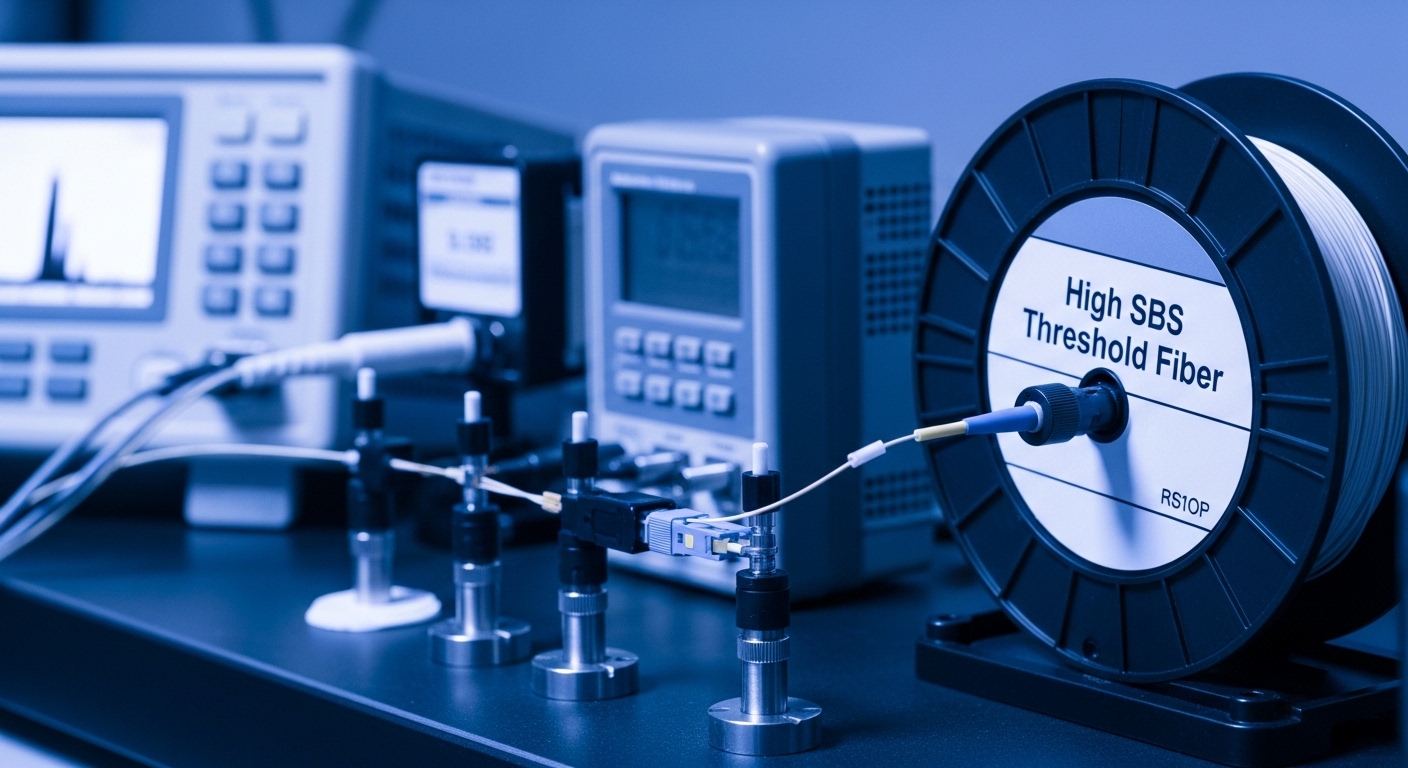
- Acceptance testing plan: Define what “pass” means: optical power response, BER/FEC behavior under elevated power, and any OSA checks for backward Stokes.
If your team uses specific transceiver models, validate that their power and spectral characteristics match the fiber assumptions. Example module families include Cisco optics and third-party equivalents, but always confirm power settings and DOM reporting behavior. For reference on common optical transceiver types and DOM capabilities, consult vendor datasheets and the relevant IEEE physical layer specifications. [Source: Cisco transceiver documentation and IEEE 802.3-2022]
Common mistakes and troubleshooting tips
SBS issues are frequently misdiagnosed because symptoms can resemble general link impairment, aging optics, or dispersion penalties. Below are concrete pitfalls with root causes and fixes.
Mistake: using a single “max power” number from the datasheet
Root cause: SBS threshold depends on linewidth and interaction length; a single number often assumes a specific linewidth and test setup. Your transmitter’s effective linewidth may be narrower in operation, pushing the system into the SBS knee earlier.
Solution: Request the vendor’s SBS threshold curve vs linewidth and apply it to your transmitter mode. If you cannot get curves, do a controlled power sweep in a lab or during maintenance: increase launch power in 0.5 dB steps and watch for FEC/BER step changes.
Mistake: ignoring back-reflections and connector reflectance
Root cause: High reflectance from poor APC/UPC handling or damaged connectors can create feedback paths. While this is not the root mechanism of SBS, it can worsen stability and make the backward Stokes component more noticeable.
Solution: Inspect and clean connectors, re-terminate if needed, and enforce low-reflection practices. Verify reflectance with an OTDR or similar method and keep connector loss within spec.
Mistake: treating temperature as a minor factor
Root cause: Temperature changes can alter SBS behavior and system margin, especially in hot aisles. A link that passes at 20 C may fail at 40 C under the same power setpoint.
Solution: Validate across your operational temperature envelope. If you cannot run long thermal tests, at least run an accelerated validation using the hottest predictable conditions and confirm FEC counters remain stable.
Mistake: swapping fiber but keeping the same transmitter power profile
Root cause: Even with higher SBS threshold fiber, your system might still be overdriving the link because total OSNR margin includes dispersion, connector losses, and aging optics.
Solution: Re-optimize transmitter power setpoints after fiber replacement. Use an OSNR/FEC-based acceptance test rather than assuming the old power configuration is safe.
Cost and ROI considerations for SBS threshold fiber
Pricing varies by supplier, reel volume, and whether the fiber is standard SMF with enhanced SBS performance or a specialized construction. In many deployments, OEM or premium reels can cost roughly 1.5x to 3x standard single-mode fiber on a per-meter basis, but the ROI can still be strong when you avoid repeated maintenance, optics churn, or costly redesign. Total cost of ownership depends on failure rates, splicing/termination labor, and the cost of downtime windows.
For ROI, treat SBS threshold fiber as an insurance policy for specific spans where launched power would otherwise exceed safe operating conditions. If you can reduce transmitter power setpoints by 1 to 2 dB, you may also extend optics lifetime and reduce thermal stress in pluggables. However, note that the benefit is real only if you validate with correct transmitter assumptions and acceptance tests; otherwise, you risk paying a premium without eliminating the underlying impairment.
FAQ
What is SBS threshold fiber, in practical terms?
SBS threshold fiber is single-mode fiber designed to raise the power level where stimulated Brillouin scattering becomes significant. Practically, it lets you launch more optical power over longer spans without triggering backward Stokes growth that degrades link performance. The most important detail is the fiber vendor’s documented SBS threshold test conditions.
How do I estimate whether my link will hit SBS?
Start with your span length, launched optical power, and transmitter effective linewidth. Then compare against the vendor’s SBS threshold curve or threshold specification that matches those conditions. If the vendor provides only a single threshold number, run a controlled power sweep and monitor FEC/BER step behavior.
Does SBS threshold fiber work with standard pluggable optics?
Yes in most cases because fiber choice is largely transparent to the electrical data interface. The constraint is optical power, spectral properties, and connectorization quality. Ensure the transceiver power setpoints and any DOM-based monitoring align with your operational plan.
What are the signs that the problem is SBS rather than a bad splice?
SBS often presents as a sharp performance change when transmitter power crosses a knee, and it may correlate with increased backward-propagating optical power observed in test equipment. A bad splice typically shows increased attenuation or reflectance and affects performance more continuously rather than at a narrow power threshold.
Can I mitigate SBS without changing the fiber?
Often you can reduce launched power, broaden effective linewidth, or adjust modulation format and DSP settings to improve OSNR margin. However, if your system needs higher power for reach or oversubscription, SBS threshold fiber can be the most direct fix. Evaluate both options and compare total cost and operational risk.
What acceptance testing should I require after installing SBS threshold fiber?
Require an elevated-power stability test that includes traffic at target line rate and monitoring of FEC counters for at least several hours across your expected temperature range. If feasible, capture OSA or backward-power indicators to confirm SBS behavior aligns with the vendor expectations. Document fiber reel IDs and splicing records for traceability.
Choosing the right SBS threshold fiber is less about buying “high power fiber” and more about matching documented SBS behavior to your transmitter linewidth, launch power, and real span conditions. Next, review how to calculate link budget for fiber optics to translate those specs into a measurable, acceptance-driven rollout plan.
Author bio: I have deployed and trouble-shot optical transport links in data centers and industrial environments, using power sweeps, OTDR trace correlation, and FEC counter telemetry to isolate non-linear impairments. I also write vendor-accurate acceptance tests for transceiver and fiber compatibility, aligning field measurements with IEEE-aligned physical layer requirements.