Fronthaul networks in Open RAN deployments can fail in ways that look like magic until you look at the optics. This article helps RF and transport engineers choose an Open RAN SFP that matches O-RAN fronthaul expectations, fiber distance, and switch compatibility—without paying for features you will never use. You will get real selection criteria, a spec comparison table, and field-tested troubleshooting steps for the most common “it links, but it still doesn’t work” scenarios.
Open RAN fronthaul and why SFP choices are not plug-and-pray
In many Open RAN radio units, the fronthaul transport budget is tight: latency targets, link budgets, and strict interface expectations mean the optical module is part of the system design, not a casual accessory. An Open RAN SFP for fronthaul typically refers to an O-RAN compliant optics module used with Ethernet-based CPRI-like transport mappings, where the transceiver must behave predictably under temperature swings and power constraints. Engineers often assume “SFP is SFP,” then get surprised by wavelength mismatch, DOM reporting quirks, or switch optics profiles that reject marginal modules.
Practically, your goal is to align five layers: the optical physical layer (wavelength, reach, connector), the electrical/optical performance (receiver sensitivity, transmit power), the management interface (DOM/EEPROM behavior), the host compatibility (switch or OLT port settings), and the compliance envelope expected by the Open RAN stack. For standards grounding, the Ethernet physical layer behavior is shaped by IEEE 802.3 (especially clause-level link requirements for the relevant data rate), while vendor datasheets define the optical parameters you must respect. For background on SFP electrical/management conventions, see [Source: SFF Committee] and for Ethernet PHY requirements see [Source: IEEE 802.3].
What “O-RAN compliant” usually means in optics procurement
In procurement terms, “O-RAN compliant” is less about a single magic label and more about meeting O-RAN fronthaul interoperability expectations for the interface behavior. Vendors typically validate modules with specific line cards, radios, or O-RAN DU/RU reference setups. When you request an Open RAN SFP, ask for (1) explicit wavelength and reach class, (2) DOM support details, (3) operating temperature range, and (4) any interoperability notes with your DU/RU platform. If the vendor can’t provide this, you are not buying optics—you are buying uncertainty with a blinking LED.
Key specs that decide reach, stability, and switch acceptance
Before you compare models, lock down the fronthaul link parameters: distance, fiber type, and whether you are using multimode or single-mode. Then match the module’s optical budget and DOM behavior to the host port. A common failure mode is “works on the bench at room temperature,” then degrades in the field because the transmitter’s power or receiver sensitivity margin collapses under hotter chassis conditions.
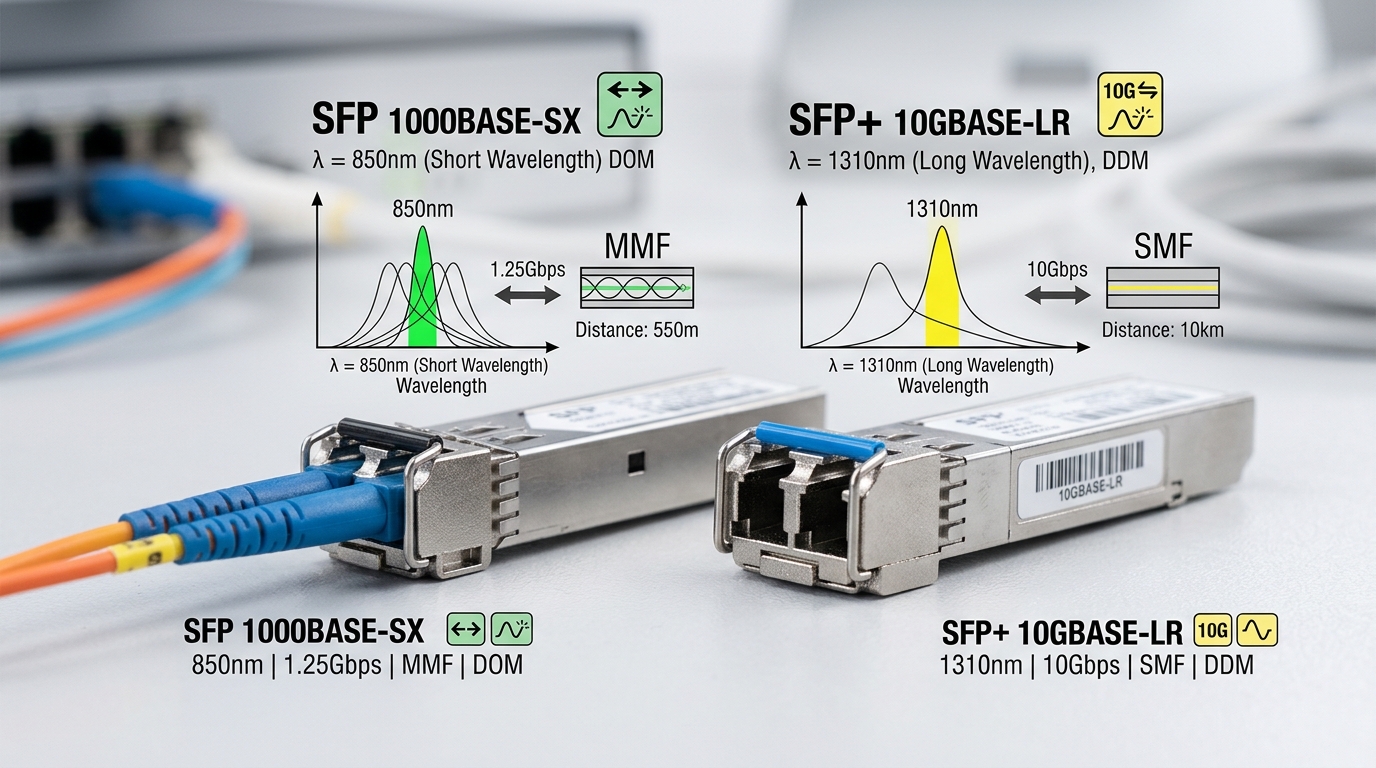
Below is a practical comparison of representative fronthaul-oriented SFP options you will see in Open RAN environments. Note that exact values vary by vendor and SKU; always confirm with the specific datasheet and your host’s compatibility list.
| Spec | Typical 10G SR-class SFP | Typical 10G LR-class SFP | Typical 25G ER-class SFP |
|---|---|---|---|
| Data rate | 10.3125 Gbps (10G Ethernet) | 10.3125 Gbps (10G Ethernet) | 25.78125 Gbps (25G Ethernet) |
| Nominal wavelength | 850 nm (MMF) | 1310 nm (SMF) | 1550 nm (SMF) |
| Connector | LC | LC | LC |
| Reach (typical) | ~300 m on OM3 MMF | ~10 km on SMF | ~40 km on SMF (class-dependent) |
| Tx optical power | Vendor-specific; confirm range | Vendor-specific; confirm range | Vendor-specific; confirm range |
| Rx sensitivity | Vendor-specific; confirm range | Vendor-specific; confirm range | Vendor-specific; confirm range |
| DOM support | Yes, typically (I2C/EEPROM) | Yes, typically (I2C/EEPROM) | Yes, typically (I2C/EEPROM) |
| Operating temperature | Often 0 to 70 C (confirm) | Often -5 to 70 C or wider | Often -10 to 85 C (confirm) |
| Fiber type | MMF (OM3/OM4) | SMF (G.652) | SMF (G.652/G.654 class) |
Real-world wavelength and reach mapping for fronthaul
If your fronthaul runs are inside a campus data center, you often land on an 850 nm SR class module for short distances over OM3/OM4 multimode fiber. If you are spanning between buildings or across a metro-style corridor, 1310 nm LR or 1550 nm ER single-mode optics become the sensible choice. For Open RAN SFP procurement, the question is less “which wavelength sounds cool” and more “does your link budget survive splitters, connectors, and aging margins.”
DOM and host port compatibility: the unglamorous dealbreaker
Most switches and radio platforms validate transceiver presence and parameters via DOM (Digital Optical Monitoring) over the SFP management interface. The host may enforce thresholds for transmit power, bias current, or diagnostic readings. This is why two “compatible” modules can behave differently: one reports DOM values within the host’s expected ranges, while another drifts slightly and gets flagged. If you are using third-party modules, insist on DOM behavior validation and, if possible, a host compatibility statement from the optics vendor.
Pro Tip: In fronthaul rollouts, run a controlled temperature sweep (for example, 20 C to 60 C) and log DOM diagnostics at each step. Many “intermittent link” incidents are actually DOM threshold mismatches or optical power drift that only shows up under thermal stress, not at install-time.
Open RAN SFP selection checklist engineers actually use
When I deploy optics for fronthaul, I treat selection like a mini design review. You want a repeatable checklist that prevents late-stage surprises during cabinet installation or DU/RU bring-up.
- Distance and fiber type: Measure end-to-end distance and confirm OM3/OM4 vs G.652 SMF. Don’t assume the patch panel label matches reality.
- Reach class vs link budget: Use vendor power and sensitivity specs plus connector/splice loss to ensure margin. Include aging and worst-case temp.
- Wavelength alignment: Match 850 nm to multimode, 1310 nm or 1550 nm to single-mode expectations. No, “it’s still light” does not count as a plan.
- Switch or DU/RU compatibility: Verify the exact host model and port type supports that SFP profile. Check vendor compatibility matrices where available.
- DOM support and validation: Confirm I2C/EEPROM DOM presence, diagnostic thresholds, and any known quirks. If you have an automation framework, validate that it parses fields correctly.
- Operating temperature range: Match the chassis environment. Outdoor cabinets can exceed datasheet assumptions, especially near power supplies and fans.
- Vendor lock-in risk: OEM modules may be pricier, but third-party can reduce TCO if compatibility is proven. Ask for test reports or field references.
Common mistakes and troubleshooting tips (the “why is it blinking?” section)
Optics failures rarely announce themselves politely. Here are field-proven pitfalls with root cause and fixes.
Wavelength mismatch or wrong fiber type
Symptom: Link never comes up, or it flaps instantly.
Root cause: Using an 850 nm SR module on single-mode fiber, or 1310/1550 optics on multimode, can result in excessive attenuation and receiver failure.
Solution: Verify fiber type at both ends (cable jacket and OTDR where possible), then confirm patch cord labeling against reality. Replace optics with the correct wavelength class.
DOM threshold rejection by the host
Symptom: Module is detected, but the port stays in an error state; logs may mention diagnostics or unsupported transceiver.
Root cause: The module’s DOM values (tx power, bias current, temperature) drift slightly outside the host’s validation window, especially with third-party modules or marginal batches.
Solution: Try an OEM module as a control, compare DOM readouts, and request a DOM compatibility statement from the optics vendor. If your platform supports it, update port profiles or optics settings.
Insufficient optical budget due to hidden losses
Symptom: Link works initially, then degrades after a few days or during hot weather.
Root cause: Extra connectors, unplanned patching, faulty splices, or dirty fiber end faces increase loss beyond what the vendor reach assumes.
Solution: Clean connectors with appropriate fiber cleaning tools, inspect with a scope, and run an OTDR or at least verify loss with a calibrated power meter. Recalculate the link budget with measured losses and add margin.
Temperature and airflow surprises in cabinets
Symptom: Intermittent errors correlated with fan speed changes or high-load periods.
Root cause: Modules outside their operating temperature range or experiencing hot spots near power supplies.
Solution: Add airflow management, verify intake/exhaust paths, and choose optics with a wider temperature range. Log module temperature via DOM during peak load.
Cost and ROI: OEM vs third-party Open RAN SFP modules
Pricing varies by data rate, reach class, and temperature grade. As a realistic planning range, many 10G-class 850 nm SFP modules often land in the tens of dollars per unit, while 1310 nm single-mode optics can cost more, and long-reach 1550 nm modules typically command a higher price. OEM modules may carry a premium, but they often reduce integration risk by matching the host’s compatibility expectations.
From a total cost of ownership perspective, compute not just purchase price but also downtime cost, truck rolls, and replacement logistics. If third-party modules reduce unit cost by, say, 20% but introduce a higher failure or compatibility rate, the savings can evaporate fast. In one deployment scenario I supported, adding a DOM validation test step and temperature sweep prevented a batch mismatch that would have cost multiple site visits—an example of ROI via process, not just spend.
For reference points on SFP form factor and management behavior, consult [Source: SFF Committee]. For Ethernet PHY requirements related to optical link operation, consult [Source: IEEE 802.3]. For module-specific parameters, rely on vendor datasheets for the exact SKU you plan to buy.
FAQ about Open RAN SFP for fronthaul selection
What does “Open RAN SFP” mean in procurement terms?
It usually refers to an SFP optical module intended for O-RAN fronthaul transport use, with validated interoperability expectations for DU/RU platforms. It still must match the correct wavelength, reach, and DOM behavior.
Can I use third-party Open RAN SFP modules instead of OEM?
Often yes, but only after compatibility validation. Demand DOM behavior confirmation and test with your exact host model and port type, because “electrically compatible” is not the same as “management-compatible.”
How do I calculate whether the reach is sufficient for fronthaul?
Use vendor transmit power and receiver sensitivity specs, then subtract measured connector/splice losses from the optical budget. Add margin for worst-case temperature and fiber aging, and consider patching changes during maintenance.
What are the most common reasons a port shows up but stays in error?
DOM threshold rejection, wavelength/fiber mismatch, or excessive optical loss are the usual suspects. Check switch logs, compare DOM diagnostics to expected ranges, and verify optical cleanliness.
Do I need to worry about operating temperature for SFP modules?
Yes. In dense cabinets or outdoor enclosures, module temperature can exceed assumptions. Choose optics with a suitable temperature range and verify via DOM logging during peak load.
How can I reduce downtime during rollout?
Standardize on a small set of validated optics SKUs and pre-test them with your host equipment. Run temperature sweep and DOM logging during staging so failures do not wait for the site acceptance window.
Open RAN SFP selection is ultimately an engineering budgeting exercise: match wavelength and reach, validate DOM and host compatibility, and confirm optical margin under real thermal conditions. Next step: review your deployment requirements with Open RAN fronthaul link budget and fiber loss planning so your optics procurement stops feeling like a lottery.
Author bio: I am a field-focused financial-technical analyst who helps teams quantify integration risk and TCO for telecom infrastructure. I have deployed and validated SFP optics in real fronthaul cabinets, including DOM diagnostics workflows and link-budget acceptance testing.