Moving from 400G to 800G usually fails for one reason: the optics look “compatible” on paper, but the transceivers, fiber plant, and switch optics budgets do not line up. This buying guide helps network engineers, data center ops leads, and procurement teams choose high-speed transceivers that will actually light up and stay stable during the 800G transition. You will get the practical checklist I use on field installs, plus troubleshooting patterns that show up within the first week after a cutover.
What changes in the 800G transition (and why it breaks “normal” purchases)
At 800G, you are dealing with tighter link budgets, higher aggregate lane counts, and more sensitive host-interface behavior. Most vendors implement 800G over parallel optics (for example, 400G-class electrical front ends feeding higher-speed optical engines), which means your transceiver type, connector geometry, and MPO/MTP cleanliness matter as much as wavelength. In practice, I see teams reuse a bill of materials from 400G and then discover that the 800G optics demand different receive sensitivity, different supported DOM behavior, or simply different fiber polarity conventions.
From an standards perspective, the Ethernet PHY and optical interconnect details are anchored in IEEE 802.3 for 800G Ethernet link definitions, including lane mapping and optical reach expectations. For connector and cabling handling, ANSI/TIA cabling guidance and vendor optics handling notes are still the real-world guardrails. If you plan procurement without reading the switch vendor’s optics compatibility matrix, you risk buying modules that are electrically “close” but firmware-incompatible or unsupported.
800G optics types that show up in buying conversations
Before you compare SKUs, name the optical form factor and the use case: short-reach leaf-spine within a row, mid-reach across suites, or long-reach for campus. The 800G market commonly uses coherent or advanced modulation for longer reach, while data center interconnects often rely on short-reach, multi-fiber parallel optics. Your key decision is typically whether you are standardizing on a specific vendor optics ecosystem or mixing OEM/third-party modules with strict compatibility controls.
When you evaluate high-speed transceivers for 800G, you should expect these recurring requirements: supported wavelengths (for example, nominal 850 nm for short reach), guaranteed reach under specified link budgets, and DOM telemetry fields your network controller can poll. Also confirm temperature and power draw; 800G modules can run warm, and a “works on the bench” module can fail in a dense chassis if airflow is marginal.
| Spec category | Example module class | Typical values you must verify | Why it matters for 800G |
|---|---|---|---|
| Data rate | 800G short-reach optics | 800G aggregate | Lane mapping and host interface requirements differ from 400G |
| Wavelength | Short-reach multi-fiber | 850 nm nominal | Determines fiber type support and dispersion assumptions |
| Reach | Data center interconnect | Commonly up to 100 m on OM4/OM5 (verify per vendor) | Loss budget tightness increases with higher-speed modulation |
| Connector | Parallel fiber | MPO/MTP (number of fibers depends on optics design) | Polarity and cleaning determine insertion loss and reflections |
| DOM / telemetry | Digital optical monitoring | DOM fields for temperature, voltage, bias, RX power | Helps you detect marginal links before they flap |
| Operating temperature | Industrial or data center grade | Typically 0 to 70 C class (confirm) | Thermal headroom limits sustained error-free operation |
| Power draw | 800G optics | Often higher than 400G; verify vendor datasheet | Impacts chassis thermal design and power budget |
Concrete example SKUs to anchor your procurement
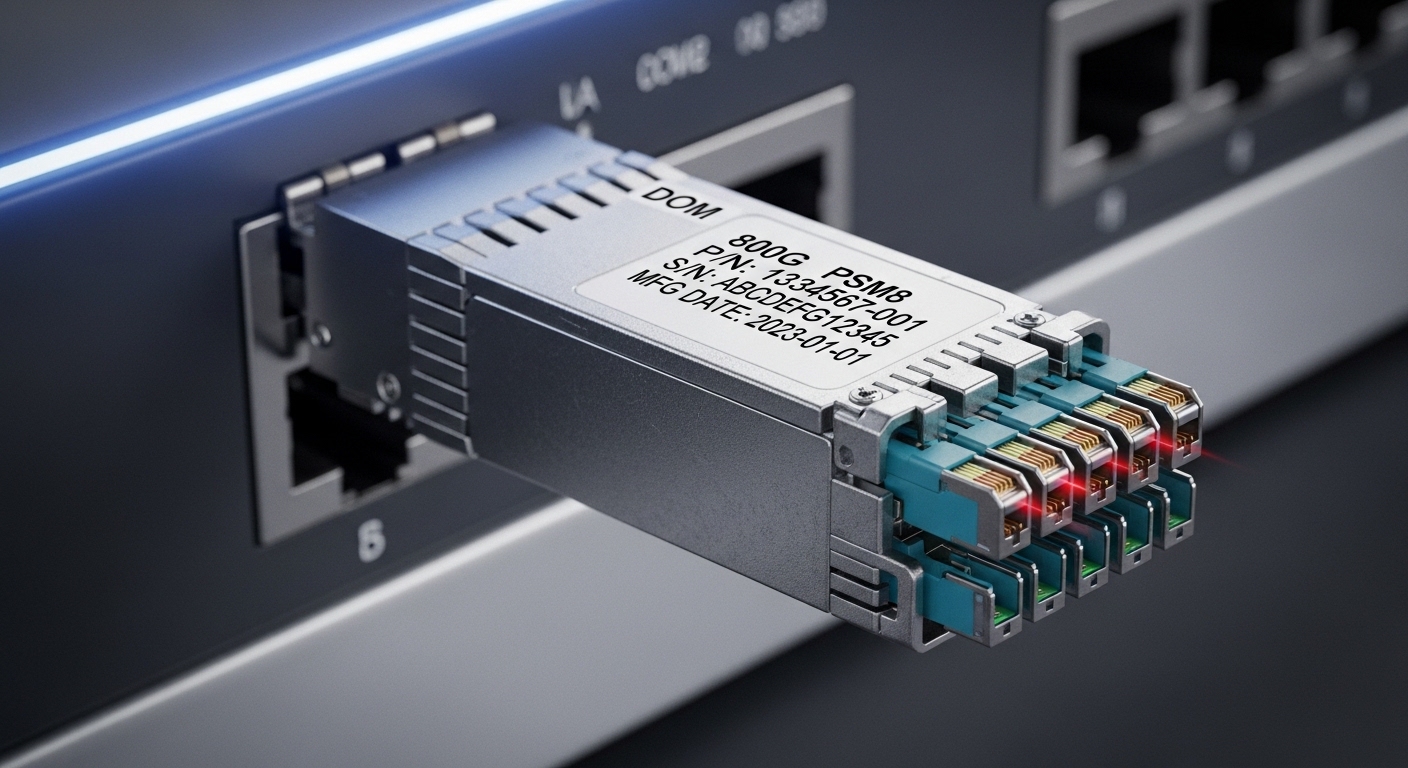
When teams ask “what exact part numbers should we test,” I usually start with a known-good baseline from your switch vendor and one or two alternatives. For short-reach, examples you may see in the ecosystem include FS.com SFP-10GSR-85 for 10G (as a form factor reference, not an 800G fit), and for higher-speed optics you will typically find equivalent 850 nm families using vendor-specific part numbers. For 800G, always validate the exact 800G module model approved for your switch platform, not just the wavelength and reach.
Use the vendor optics compatibility guide and DOM behavior notes. The optics datasheets and module programming guides from module vendors matter because some third-party optics expose fewer DOM fields or implement different alarms, which can trigger controller warnings even when the link is stable.
Real-world deployment scenario: how 800G fails during cutover
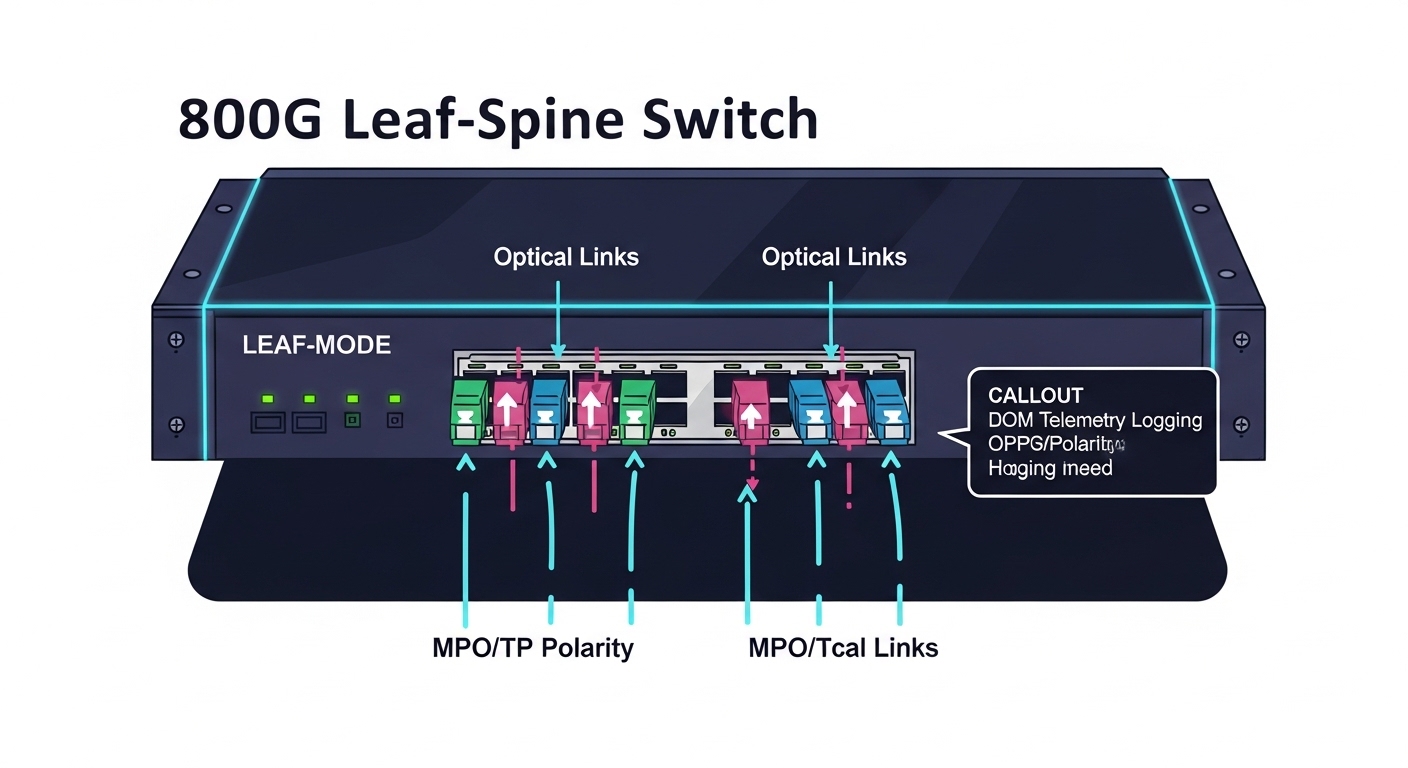
In a 3-tier data center leaf-spine topology with 48-port 800G capable top-of-rack switches, we planned a staged cutover: 16 ports per ToR per weekend to limit blast radius. The fabric used OM4 cabling with pre-terminated MPO trunks, and we targeted 80 m average link distance including patch panels. On day one, the optics negotiated link but flapped under peak traffic, with RX power readings drifting and CRC counters increasing.
The root cause was not “bad optics.” The connector inspection missed a polymer residue on two MPO trunk ends, which increased insertion loss and reflections. Under higher modulation stress, the error margin shrank, and the controller began resetting optics to recover. After we cleaned with proper endface tools, re-terminated one patch, and verified polarity mapping end-to-end, the links stabilized. The lesson: in 800G transitions, optical cleanliness and polarity validation can dominate the outcome over the mere presence of an “800G 850 nm” module.
Selection criteria checklist for high-speed transceivers in an 800G rollout
Use this ordered checklist during evaluation. I recommend printing it and attaching it to each test case ticket so procurement and engineering are aligned.
- Distance vs specified reach: verify the vendor’s guaranteed reach for your exact fiber type (OM4 vs OM5) and include worst-case patch panel loss.
- Switch compatibility matrix: confirm the module is supported on your switch model and firmware level; do not assume “same form factor” equals compatibility.
- Optical budget and margin: compare RX sensitivity requirements and ensure you have headroom for aging and temperature variation.
- DOM support and alarm behavior: confirm the DOM fields your monitoring stack expects; some controllers flag missing alarms.
- Operating temperature and airflow: check chassis thermal maps; dense 800G ports can exceed safe module temperature during sustained load.
- Connector and polarity handling: validate MPO/MTP fiber count, polarity method, and labeling conventions across patch panels.
- DOM and vendor lock-in risk: evaluate whether third-party modules trigger support exclusions or require special firmware settings.
- Provisioning workflow: confirm you can inventory modules, read telemetry, and automate replacement under your change management process.
Pro Tip: When you test two candidate high-speed transceivers, do not stop at “link up.” Run a 30 to 60 minute traffic soak and log DOM temperature plus RX power. A marginal connector or low optical margin often shows up as slow RX power drift and rising error counters long after the initial link negotiation looks healthy.
Common mistakes and troubleshooting patterns (with fixes)
Below are failure modes I have seen repeatedly in 800G deployments. Each one includes the root cause and what to do next.
“It links up” but errors spike within hours
Root cause: optical insertion loss too high due to endface contamination, damaged MPO pins, or micro-scratches that increase reflections. 800G optics have less error margin than older generations.
Solution: inspect endfaces with a microscope, clean using lint-free swabs and an approved cleaning kit, and verify with a visual polarity check. If you see nonconforming endface polish or connector damage, replace the patch cord/trunk segment.
Port flaps after a firmware update
Root cause: DOM telemetry or initialization behavior differs from what the switch firmware expects. Some third-party modules expose different DOM alarm thresholds or interpret control bytes differently.
Solution: keep a controlled firmware baseline during optics qualification. If flaps correlate with firmware versions, contact the module vendor for the supported firmware list and DOM compatibility notes, and retest with the new firmware in a lab chassis.
Works on one side of a patch panel but not the other
Root cause: polarity mismatch. MPO/MTP trunks often follow a polarity scheme (for example, polarity A/B) that must be consistent across both ends. In 800G, lane mapping sensitivity makes polarity errors more visible.
Solution: trace each fiber group from transmitter to receiver using polarity documentation and labeling. Validate with an optical continuity test or a polarity verification jig before you blame the transceiver.
Thermal throttling symptoms under sustained load
Root cause: insufficient airflow or obstructed intake/exhaust near high-density 800G ports. The module runs hotter under full-rate operation, and some optics derate or error more frequently as temperature rises.
Solution: verify fan speed setpoints, clear baffles, and measure module temperature during load. If needed, rebalance traffic and relocate cables to improve airflow paths.
Cost and ROI note: what to budget beyond the sticker price
In most enterprise bids, high-speed transceivers represent a meaningful portion of the 800G capex, but the bigger cost is operational downtime during cutover. OEM modules often cost more per unit but reduce compatibility risk and speed up support resolution. Third-party optics can lower initial purchase price, but you must include testing labor, spares strategy, and potential support exclusion risk.
As a rough planning range, short-reach 800G optics can land in the high hundreds to low thousands of currency units per module depending on OEM, reach tier, and DOM feature set; your actual quote depends heavily on switch vendor approval. For ROI, model not only module cost but also: expected failure rate during first-year operations, expected mean time to replace, and the cost of a failed cutover weekend. If your team has strong test automation and optical cleaning discipline, third-party modules may pencil out; if not, the “expensive but safe” OEM path can be cheaper overall.
For standards and interoperability context, review IEEE 802.3 Ethernet PHY guidance and your switch vendor’s optics qualification notes. For cabling handling, use ANSI/TIA cabling practices and follow vendor cleaning and inspection recommendations. [Source: IEEE 802.3 Ethernet standard] [Source: ANSI/TIA cabling standards overview] [Source: Cisco optics compatibility and transceiver documentation] [Source: Juniper optics and DOM documentation] [Source: Broadcom Ethernet transceiver application notes]
FAQ about buying high-speed transceivers for the 800G transition
Which high-speed transceivers are best for 800G short reach?
For most enterprise data centers, short reach 800G optics are the practical first step when you are staying within the vendor-guaranteed distance on OM4 or OM5. Choose modules that are explicitly supported by your switch model and firmware, and validate MPO/MTP polarity and connector type against your cabling plant.
Can we mix OEM and third-party high-speed transceivers in the same switch?
Often you can, but not always safely. The switch may accept the link but still generate DOM or alarm behavior that breaks monitoring expectations or triggers support exclusions. Run a lab test on your exact switch firmware and monitoring stack before mixing module brands.
What should we measure during a transceiver acceptance test?
Measure DOM telemetry (temperature, voltage, bias, RX power) and run a sustained traffic soak while logging error counters. A successful initial link does not guarantee stable performance under load, especially if optical margin is thin or connectors are contaminated.
Do we need MPO/MTP cleaning tools for 800G?
Yes. At 800G, small endface defects can become link killers because the optical budget is tighter. Use an inspection microscope and an approved cleaning workflow, and document the cleanliness checks as part of your change record.
How do we avoid polarity mistakes across patch panels?
Use consistent labeling and polarity documentation, then verify continuity and polarity mapping before installing modules. In the field, I also recommend assigning one technician to trace and sign off the polarity end-to-end for each trunk group.
When should we plan for spares?
Plan spares based on your cutover schedule and your troubleshooting capacity. If you cannot quickly isolate whether a failure is optics, fiber, or switch behavior, having one or two known-good spare modules reduces downtime during the first weeks of the 800G transition.
Choosing high-speed transceivers for the 800G transition is mostly about compatibility proof, optical budget margin, and disciplined fiber handling, not just matching wavelength and reach. Next step: build a test matrix using the selection checklist above, then validate with DOM telemetry and a traffic soak before you scale the rollout using related topic.
Author bio: I design and troubleshoot high-throughput fiber links in live data centers, with focus on optics qualification, DOM telemetry validation, and cutover playbooks. I update my field notes based on vendor datasheets, IEEE 802.3 behavior, and real acceptance-test outcomes.