
In modern data centers and metro networks, you can burn time and budget chasing optics that look compatible on paper but fail under real traffic and temperature swings. This article helps network engineers and early-stage operators decide when a 100G single lambda transceiver is the smartest fit for reach, power, and vendor risk. You will also get a practical selection checklist, deployment example, and troubleshooting steps pulled from field-style operations.
Why single lambda matters for 100G links
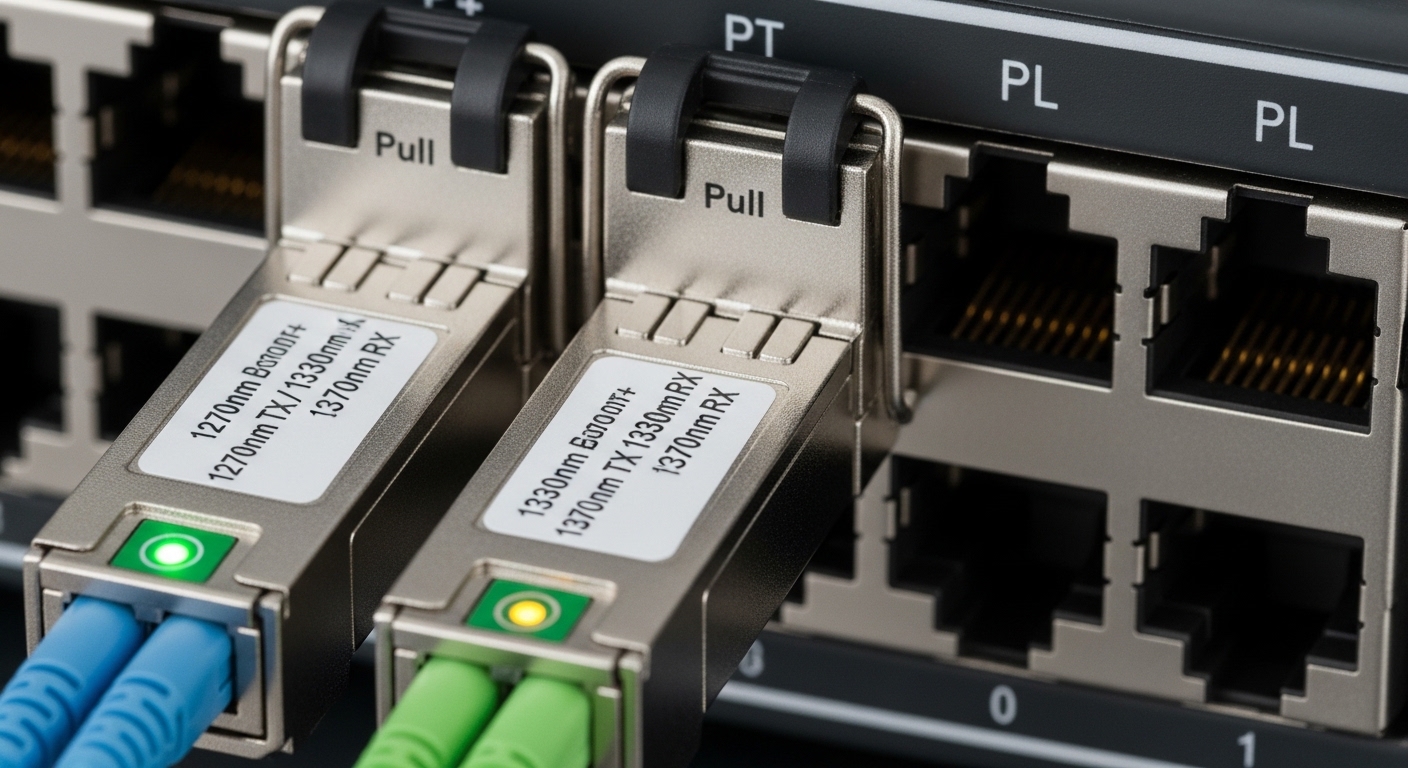
A 100G single lambda transceiver uses one optical wavelength to carry the full 100G payload, instead of splitting the signal across multiple wavelengths. In practice, that means the optics and the fiber path must be aligned to a specific center wavelength and meet chromatic dispersion tolerance for the chosen modulation and reach. If your network already has wavelength-stable components or you want to reduce the number of moving parts, single lambda can simplify both planning and troubleshooting.
Under IEEE 802.3 standards, 100G Ethernet over fiber typically maps to different PHY implementations with defined link budgets and reach classes. The optics vendor datasheet will specify wavelength, receiver sensitivity, and optical power ranges; those values are what you should validate against your installed fiber loss and connector/splice plan. For reference, IEEE 802.3-2018 defines 100GBASE-LR4, ER4, and related PHY behavior for multi-lambda approaches, while single-lambda 100G uses different PHY families and vendor-specific implementations. See [Source: IEEE 802.3].
Pro Tip: In the field, the fastest way to avoid “mystery flaps” is to compare the transceiver’s receiver sensitivity and minimum optical power against your worst-case link budget at the exact wavelength, then add a 1 to 2 dB operational margin for patch cord aging. Many teams only check transmit power, but receiver margin is what decides whether the link survives temperature and aging.
Key specs you must verify before ordering
Even when two modules both say “100G,” the details decide whether they will work reliably with your switch, optics cage, and fiber plant. Before you buy a 100G single lambda transceiver, confirm the exact form factor, wavelength, reach target, DOM behavior, and environmental limits. If you skip DOM and temperature validation, you can end up with silent telemetry gaps or unexpected link degradation in warm racks.
Common module targets and representative part families
Many operators use 100G single lambda optics variants for short-to-medium reach where a single wavelength is easier to manage than multi-lambda solutions. You will see vendor part numbers across QSFP28 and similar high-density form factors, with specific wavelengths and reach classes. Examples you may encounter include QSFP28-style optics and single-lambda coherent or direct-detect families; always verify the datasheet against your switch vendor’s compatibility list.
| Spec | What to check | Why it matters for 100G single lambda |
|---|---|---|
| Wavelength (nm) | Center wavelength and tolerance | Must match filters, WDM plan, and meet dispersion assumptions |
| Reach class | Guaranteed reach in km | Determines link budget and acceptable fiber loss |
| Fiber type | Single-mode fiber (SMF) grade | Wrong fiber can push dispersion and attenuation out of spec |
| Optical power | Min/Max transmit power and receiver sensitivity (dBm) | Decides whether the link stays up during aging and temperature drift |
| Connector | LC duplex is most common | Connector cleanliness and insertion loss can dominate budget |
| DOM support | I2C presence, alarms, and vendor specifics | Needed for monitoring, alerts, and supportability |
| Operating temp | Case temperature range | Warm environments can trigger power reductions and flaps |
| Data rate | 100G nominal, lane mapping details | Switch PHY must match the module’s electrical interface |
For concrete reference, check vendor datasheets for specific models such as Finisar/NeoPhotonics and other manufacturers’ 100G optics families. If you need examples of commonly referenced optics, you might see parts like Finisar FTLX8571D3BCL or similar 100G transceivers depending on reach and wavelength. Always validate that the module is the correct single-lambda variant for your target network and switch. For third-party optics, confirm DOM and EEPROM compatibility with your platform.
Authority sources for foundational expectations include IEEE 802.3 for PHY behavior and vendor datasheets for module electrical/optical parameters. See [Source: IEEE 802.3] and [Source: Vendor transceiver datasheets].
When single lambda is the best engineering choice
A 100G single lambda transceiver is often a win when your network design benefits from wavelength consolidation or when operational simplicity matters more than squeezing every last dB of reach from a multi-lambda design. It can also reduce the number of optical components needed if you are avoiding WDM complexity for 100G segments that do not require multi-wavelength splitting.
Decision criteria: use it when these conditions hold
- Distance matches the module reach class: confirm km support with your worst-case link budget, not average loss.
- Wavelength alignment is straightforward: your patching, filters, or any WDM gear expects that center wavelength.
- Switch compatibility is documented: verify your exact switch model supports the module type and electrical interface.
- DOM works for your monitoring stack: ensure alarms and thresholds are exposed via I2C and recognized by your network OS.
- Operating temperature fits your rack: validate case temp range and your measured air temperature at the cage.
- Budget and TCO are aligned: compare OEM vs third-party pricing, but include failure rate and warranty terms.
- Vendor lock-in risk is manageable: if you need multi-vendor optics later, prioritize modules with consistent DOM behavior and published interoperability guidance.
In many deployments, single lambda also helps during incident response: fewer wavelength lanes mean fewer “which lane is bad” scenarios, and technicians can focus on polarity, cleanliness, and link budget at the single wavelength.
Real-world deployment scenario: leaf-spine with controlled reach
In a 3-tier data center leaf-spine topology with 48-port 10G ToR switches upgraded to 100G uplinks, an operator planned 100G connections from ToR aggregation switches to a spine layer using short SMF patch runs. Each uplink used an LC duplex path of 120 m average, but with a conservative design that assumed 2.5 dB per link for patch cords and connectors plus an additional 1 dB margin for aging and cleaning variability. They selected 100G single lambda transceivers with a reach class comfortably above the physical distance and verified receiver sensitivity against the worst-case loss at the module wavelength.
Operationally, the team set up monitoring for DOM temperature, received optical power, and link error counters on day one. After rollout, they observed stable link uptime during a summer temperature spike when measured cage-area air temp rose by 6 C; DOM logs showed transmitter bias remained within the module’s alarm thresholds. The key was validating optical budget and temperature headroom up front, not just confirming that the module “lights up.”
Common pitfalls and troubleshooting that saves outages
Even when a 100G single lambda transceiver is the right type, field failures often come from repeatable mistakes. Below are common failure modes I have seen during cutovers and incident reviews, along with practical root causes and fixes.
Link comes up then flaps under load
Root cause: receiver sensitivity margin is too tight because real insertion loss is higher than the plan, or the patch cords are not within spec. Dirty connectors can also add loss and intermittently impact the signal.
Solution: clean connectors with proper inspection and cleaning tools, then measure optical power at the receiver side if your platform supports it. Recalculate link budget using worst-case values from the module datasheet and your measured fiber loss and connector insertion loss.
“No DOM” or missing alarms in monitoring
Root cause: the module’s DOM implementation is not recognized by your network OS, or the platform expects a specific threshold mapping. Sometimes a third-party module reports presence but doesn’t expose the full alarm set.
Solution: confirm DOM support in the transceiver datasheet and test in a staging port. Validate alarm propagation in your telemetry system by checking I2C reads and verifying alert triggers for temperature and received power.
Works in one switch but fails in another
Root cause: electrical compatibility differences between switch PHY implementations, including lane mapping expectations and FEC behavior. Some platforms also enforce stricter compliance checks on EEPROM fields.
Solution: consult the switch vendor compatibility list or run a controlled pilot with the exact switch models. If you must use third-party optics, choose vendors with documented interoperability and warranty coverage.
Temperature-related degradation in warm racks
Root cause: case temperature exceeds the module operating range, causing transmitter power reduction or increased error rates. This is more common in high-density racks with inadequate airflow.
Solution: measure cage-area air temperature, check fan profiles, and confirm the module’s operating temperature range from the datasheet. Add airflow management or reduce port density if thresholds are exceeded.
Cost, ROI, and TCO reality check
Pricing for 100G single lambda transceivers varies widely by form factor, wavelength, reach, and whether you buy OEM or third-party. In many markets, OEM modules often cost more upfront, while third-party optics can reduce purchase cost but may introduce higher variability in DOM behavior, warranty support, or interoperability. A realistic approach is to evaluate not just unit price but also installed failure rates, RMA turnaround time, and the cost of operational downtime.
For TCO, include:
- Spare inventory strategy: how many spares you need to cover lead time and failure probability.
- Power and cooling impact: optics power draw is usually modest, but thermal headroom matters in dense racks.
- Supportability: OEM may shorten troubleshooting cycles because vendor support aligns with their optics validation.
- Migration flexibility: if you expect hardware refresh, prioritize optics that maintain consistent DOM telemetry across upgrades.
In early-stage PMF terms: optimize for “time to stable links,” not just “lowest BOM.” A small premium for predictable interoperability often outperforms aggressive cost-cutting when reliability is your growth bottleneck.
FAQ: buying and deploying 100G single lambda transceivers
Is a 100G single lambda transceiver compatible with any 100G switch port?
No. Compatibility depends on form factor, electrical interface, and switch PHY expectations. Always verify against your switch model and confirm DOM behavior matches your monitoring stack. If you cannot find a compatibility list, run a short pilot before scaling.
What fiber type and connector should I plan for?
Most 100G single lambda deployments use single-mode fiber with LC duplex connectors. You must validate insertion loss, connector cleanliness, and splice quality because link budgets can be tight even at short distances when margins are small.
How do I estimate link budget for a real installation?
Use the module datasheet values for transmit power and receiver sensitivity, then subtract measured fiber attenuation plus connector and splice losses. Incorporate a margin for aging and cleaning variability, especially if you expect frequent patching.
Do I need DOM support for operations?
For mature operations, yes. DOM enables monitoring of temperature, optical power, and alarm thresholds, which speeds incident response and supports proactive maintenance. If DOM is missing or unrecognized, you lose early warning signals.
Can third-party optics reduce cost without increasing risk?
Sometimes, but only if the vendor provides clear interoperability evidence and warranty terms. Test in staging, confirm DOM and alarms, and validate stability under expected temperature conditions before broad rollout.
What is the most common cause of “lights up but no traffic”?
Usually optics mismatch, incorrect wavelength expectation, or polarity/connector issues. Clean and inspect connectors first, then validate that the module type and switch PHY are truly aligned for the 100G link.
If you want the fastest path to PMF-level network reliability, treat optics selection as a validation exercise: confirm specs, validate link budget, and pilot with telemetry turned on. Next, compare transceiver types and reach classes using 100G optics reach classes and compatibility.
Author bio: I build and deploy fiber and transceiver validation pipelines for early-stage teams, focusing on measurable link stability and rapid interoperability checks. I write with a field-engineer mindset: optics specs, DOM telemetry, and failure modes first.
